

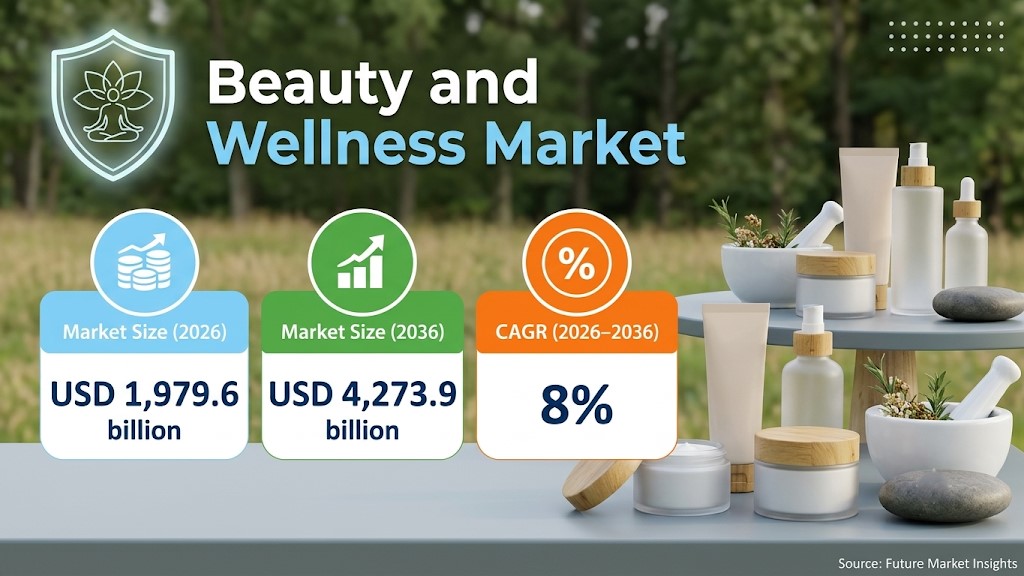
The global beauty and wellness market is estimated to reach USD 1,979.6 billion in 2026, up from USD 1,833.0 billion in 2025, according to the latest market intelligence report published by Future Market Insights (FMI). The market is projected to reach USD 4,273.9 billion by 2036, expanding at a compound annual growth rate (CAGR) of 8.0% between 2026 and 2036. Growing demand for dermatologist-backed skincare, salon-grade beauty products, ingestible wellness solutions, and digital beauty retail is supporting market expansion.
Market Size & Growth Forecasts
- 2025 Baseline Market Value: USD 1,833.0 billion
- 2026 Estimated Market Size: USD 1,979.6 billion
- 2036 Projected Market Value: USD 4,273.9 billion
- Growth Rate: 8.0% CAGR (2026–2036)
- Incremental Growth Opportunity: USD 2,294.3 billion
- Market Expansion Multiple: 2.2x
FMI estimates that the beauty and wellness market will more than double over the forecast period. Increasing consumer interest in products that combine appearance-related benefits with personal wellbeing is creating opportunities across skincare, hair care, nutrition, and wellness categories.
Get detailed market forecasts, competitive benchmarking, and pricing trends: https://www.futuremarketinsights.com/reports/sample/rep-gb-18761
Key Market Segments
By Type: Skincare Products Lead Market Demand
Skincare products are expected to account for 34.6% of the beauty and wellness market in 2026, making them the leading product category. Daily-use products such as cleansers, serums, moisturisers, and sunscreens support recurring purchases.
Food and nutrition products represent 27.6% of the market, followed by hair care products at 11.8%, makeup products at 9.4%, wellness products at 7.3%, medicinal products at 6.1%, and other products at 3.2%.
Clinical skincare is gaining attention as consumers increasingly seek dermatologist recommendations and products with specific skin benefits. L’Oréal reported 10.6% adjusted like-for-like growth in its Dermatological Beauty division during the first half of 2026, while its Professional Products division recorded 11.6% growth.
By Distribution Channel: Online Sales Take the Lead
Online channels are projected to capture 41.2% of distribution in 2026, ahead of supermarkets and hypermarkets at 35.2%. Specialty stores account for 17.9%, while other channels represent 5.7%.
Marketplaces, brand websites, social commerce, and subscription services are improving access to premium beauty products. The expansion of online retail is also allowing consumers to compare prices, review product information, and purchase established skincare products more conveniently.
Regional Market Highlights
India is projected to record the fastest growth among the profiled country markets, with a 10.8% CAGR through 2036. Rising online purchases and demand from younger middle-class consumers are supporting expansion.
Other regional growth forecasts include:
- ASEAN: 9.7% CAGR, supported by social commerce and first-time skincare buyers.
- Australia and New Zealand: 9.3%, with demand for sun care and independently tested products.
- GCC Countries: 8.6%, driven by premium fragrance purchases and gifting.
- China: 8.2%, supported by premium skincare and domestic retail channels.
- Germany: 7.5%, reflecting demand for pharmacy-led skincare.
- United Kingdom: 6.3%, supported by established beauty retail and online purchasing.
- United States: 5.7%, with growth influenced by volume sales and changing consumer spending patterns.
Major Market Trends & Growth Drivers
Clinical Skincare and Professional Beauty: Consumers are increasingly choosing dermatologist-backed skincare and salon-recommended products. L’Oréal’s Dermatological Beauty and Professional Products divisions recorded respective growth of 10.6% and 11.6% during the first half of 2026.
Expansion of Ingestible Wellness: Supplements targeting hair, skin, and sleep are becoming part of broader beauty routines. Unilever reported double-digit growth for Olly during the first half of 2026, creating opportunities for beauty companies to extend their product portfolios into wellness.
Digital Retail and Marketplace Expansion: Online channels are strengthening their position in beauty distribution. Estée Lauder expanded its marketplace presence through Amazon and TikTok Shop during fiscal 2026, while consumers increasingly use digital platforms to compare products and prices.
Tariff Costs and Regulatory Scrutiny: Import duties are putting pressure on brand margins. Estée Lauder reported USD 102 million in incremental tariff costs during fiscal 2026. Meanwhile, Australia’s Therapeutic Goods Administration pulled or recalled 11 sunscreen products between June and October 2025 following concerns about SPF claims.
Competitive Landscape
The beauty and wellness market includes established international companies competing across skincare, personal care, cosmetics, fragrance, and wellness categories. Product innovation, digital distribution, clinical positioning, and portfolio expansion remain important competitive considerations.
Key Companies Profiled Include:
- European Groups: L’Oréal, Unilever, LVMH, Beiersdorf, and Rituals.
- American Groups: Estée Lauder, Procter & Gamble, and Coty.
- Japanese Groups: Shiseido and Kao.
L’Oréal, Unilever, and Estée Lauder have documented positions across major beauty categories, while Beiersdorf and Shiseido maintain established skincare portfolios.
Analyst Perspective / Insight
“I see dermatological skincare and ingestible wellness as the two lines that will add the most new shoppers through 2036. A brand pairing a clinic-grade serum with a daily supplement will keep the same customer across both categories, and I would put marketing money behind pharmacy and marketplace launches first.”
— Rahul Pandita, Principal Consultant, Future Market Insights.
Explore More Related Reports Links:
Foot Care Product Market: https://www.futuremarketinsights.com/reports/foot-care-product-market
Skin Lightening Product Market: https://www.futuremarketinsights.com/reports/skin-lightening-products-market
Remineralizing Gum Market: https://www.futuremarketinsights.com/reports/remineralizing-gum-market
About Future Market Insights (FMI)
Future Market Insights (FMI) is an ESOMAR-certified market research and consulting organisation providing actionable intelligence, strategic insights, and industry analysis to businesses worldwide. The company covers industries including food and beverages, healthcare, chemicals, technology, packaging, consumer goods, and industrial markets, with a global presence across the United States, United Kingdom, UAE, and India.
Media Contact:
Corporate Communications Team
Future Market Insights (FMI)
Email: sales@futuremarketinsights.com
Phone: +1-347-918-3531
Official Report Page: Beauty and Wellness Market Report, 2026–2036