

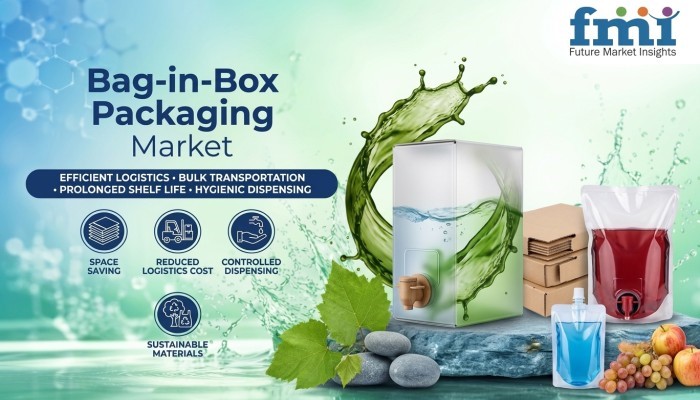
The global bag-in-box packaging market is projected to grow from USD 5.2 billion in 2026 to USD 12.3 billion by 2036, according to Future Market Insights (FMI). The market, valued at USD 4.8 billion in 2025, is forecast to expand at a compound annual growth rate (CAGR) of 8.9% between 2026 and 2036, generating an additional USD 7.1 billion in revenue over the period.
Demand is being supported by food and beverage processors, commercial beverage bottlers and foodservice operators seeking alternatives to rigid liquid containers. Lightweight packaging, lower product residue and reduced oxidation during repeated dispensing are strengthening the commercial case for bag-in-box formats. Aseptic systems are projected to account for 54.0% of technology demand in 2026, while food and beverage applications are expected to represent 61.0% of the market.
Get detailed market forecasts, competitive benchmarking, and pricing trends:
https://www.futuremarketinsights.com/reports/sample/rep-gb-13064
KEY MARKET TAKEAWAYS
- Market Valuation: The market is projected to rise from USD 5.2 billion in 2026 to USD 12.3 billion by 2036, following a 2025 valuation of USD 4.8 billion.
- Growth Rate: Sales are forecast to expand at an 8.9% CAGR from 2026 to 2036.
- Leading Technology: Aseptic bag-in-box systems are projected to hold 54.0% of technology demand in 2026.
- Leading Application: Food and beverages are expected to account for 61.0% of application demand in 2026.
- Fastest-Growing Country: China leads the evaluated markets with a projected 11.3% CAGR through 2036.
- Core Growth Driver: Demand for lightweight liquid packaging that supports product preservation, efficient distribution and repeated dispensing.
INDUSTRY SHIFTS & MARKET DYNAMICS
Bag-in-box packaging is gaining commercial relevance as liquid processors reconsider the cost of transporting and dispensing products in rigid containers. The format combines a flexible inner bag with an outer corrugated case, allowing the package to collapse as its contents are dispensed. This can limit exposure to outside air and reduce product left behind after use. The advantages are particularly relevant to wine, syrups, juices, concentrates and other liquids supplied to foodservice and institutional buyers.
Capacity selection is also influencing purchasing decisions. Medium-sized packs, typically ranging from 5 to 10 liters, offer a practical balance between storage requirements and refill frequency. They can reduce replenishment interruptions in commercial kitchens without creating the handling challenges associated with larger containers. For suppliers, the opportunity extends beyond the outer carton: film performance, fitment compatibility and filling-line qualification all influence whether a format can meet a buyer’s operating requirements.
Aseptic technology is an important part of this shift. Its projected 54.0% share in 2026 reflects demand for sterile filling and ambient distribution, which can reduce dependence on refrigeration during transit. However, aseptic systems require suitable equipment and process validation. These requirements can limit adoption among smaller processors that cannot justify the associated investment.
Material recovery remains another challenge. Multi-layer barrier films help protect oxygen-sensitive liquids, but their structures can be difficult to process through some local recycling systems. Regulation and changing packaging requirements are increasing pressure on suppliers to demonstrate recovery compatibility without compromising shelf life or seal integrity. Mono-material structures offer a potential route forward, although their barrier performance must be validated for each application.
REGIONAL MARKET SUMMARY
China and India are expected to record the strongest growth among the countries evaluated by FMI. Their expansion reflects opportunities in liquid food processing, foodservice, dairy modernization and organized retail. Australia and European markets are also expected to benefit from wine packaging requirements, export logistics and material innovation.
- China: Projected to expand at an 11.3% CAGR from 2026 to 2036, supported by liquid food processing and foodservice dispensing.
- India: Expected to register a 10.8% CAGR, driven by dairy modernization and organized retail.
- Australia: Forecast to grow at a 7.9% CAGR, with wine export packaging and recycle-ready formats supporting demand.
- Spain: Projected to record a 7.6% CAGR, supported by wine production and export logistics.
- France: Expected to expand at a 7.3% CAGR, with packaging innovation and product preservation shaping demand.
Germany is forecast to grow at 6.8%, supported by industrial liquid applications and packaging engineering. The United States is projected to record a 5.3% CAGR through 2036, with foodservice dispensing and craft beverage distribution contributing to demand.
ANALYST INSIGHTS
“Bag-in-box purchasing is moving from container replacement toward coordinated film, fitment, and filling-line qualification. Suppliers that prove barrier integrity and recovery compatibility will secure longer beverage and industrial programs,” stated Nandini Roy Choudhury, Principal Consultant at Future Market Insights.
COMPETITIVE LANDSCAPE
Competition in the bag-in-box packaging market is shaped by the ability to supply compatible packaging components and technical support. Buyers assess the inner bag, barrier film, fitment, outer carton and filling system as parts of one operating solution. Suppliers that can support product trials and line qualification are positioned to address more complex procurement requirements.
Notable companies covered in the market include Smurfit Westrock, SIG Group, Amcor, DS Smith, Liquibox, Aran Group, CDF Corporation and TPS Rental Systems. Smurfit Westrock and SIG Group have integrated offerings spanning packaging components and filling-system capabilities. Amcor and Liquibox participate through flexible packaging and bag formats, while specialist suppliers address bulk liquid and industrial applications.
Product development is increasingly focused on material reduction and recovery compatibility. In August 2025, SIG introduced a recycle-ready mono-material bag structure for Australian wine packaging. In September 2025, Smurfit Westrock launched Bag-in-Box Powergrip for cleaning materials, oils and agrochemical products, reporting up to 75% less plastic than rigid HDPE alternatives. These developments illustrate how suppliers are addressing both packaging performance and material-use requirements.
ABOUT THE REPORT
The Future Market Insights report examines the global bag-in-box packaging market from 2026 to 2036. It analyses the market by capacity, material type, technology, application, end-use industry and distribution channel. Regional coverage includes North America, Latin America, Western Europe, Eastern Europe, East Asia, South Asia and Pacific, and the Middle East and Africa. The assessment draws on primary and secondary research, market sizing and data triangulation.
For more information on the full report: https://www.futuremarketinsights.com/reports/paper-recycling-market
Explore More Related Reports Links:
https://www.openpr.com/news/4681261/stainless-steel-water-bottles-market-to-reach-usd-6-4-billion
https://www.openpr.com/news/4681268/folding-boxboard-market-is-expected-to-exceed-usd-140-400-0
FMI Custom Research: Strategic Intelligence for Confident Decision-Making
In today’s rapidly evolving business environment, leadership teams need more than market data—they need clear, actionable intelligence tailored to their strategic objectives. FMI’s Custom Research solutions are designed around the specific business questions organizations need answered, enabling executives to evaluate growth opportunities, validate investments, assess competitive dynamics, and reduce uncertainty before making critical decisions. By combining deep industry expertise, primary research, and proprietary market intelligence, FMI delivers insights that help organizations move from assumptions to evidence-based strategies with greater speed and confidence.
Business Impact
FMI helps organizations transform market complexity into strategic clarity, enabling leadership teams to identify growth opportunities faster, optimize resource allocation, strengthen competitive positioning, and make high-stakes business decisions with confidence.
To explore how FMI Custom Research can support your strategic priorities, please connect with our team at – sales@futuremarketinsights.com
About Future Market Insights (FMI)
Future Market Insights, Inc. (FMI) is an ESOMAR-certified, ISO 9001:2015 market research and consulting organization, trusted by Fortune 500 clients and global enterprises. With operations in the U.S., UK, India, and Dubai, FMI provides data-backed insights and strategic intelligence across 30+ industries and 1200 markets worldwide.
Contact Us:
Future Market Insights Inc.
Christiana Corporate, 200 Continental Drive,
Suite 401, Newark, Delaware – 19713, USA
T: +1-347-918-3531
For Sales Enquiries: sales@futuremarketinsights.com
Website: https://www.futuremarketinsights.com
LinkedIn| Twitter| Blogs | YouTube