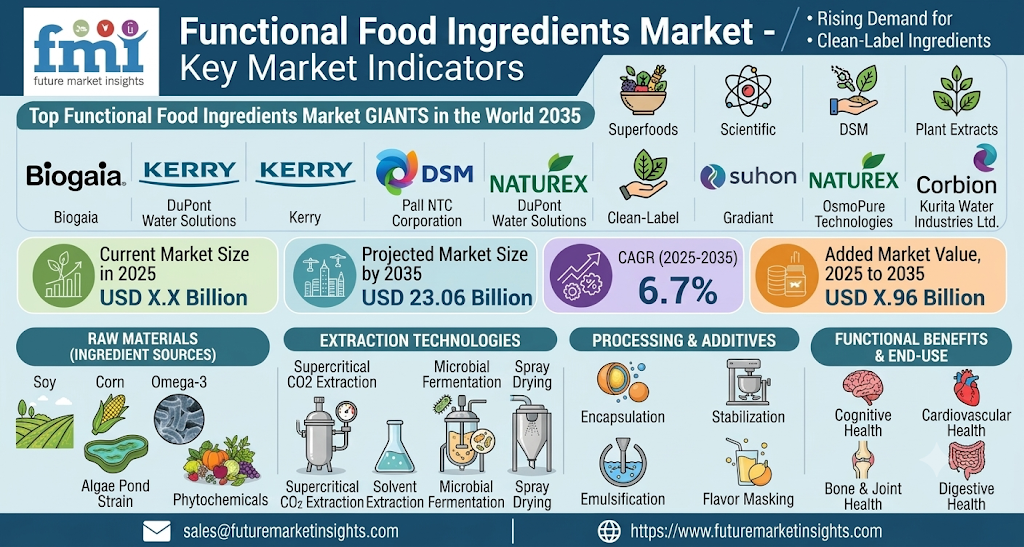
NEWARK, Del., November 11, 2026 — The global Functional Food Ingredients Market is estimated to reach USD 12.06 billion in 2025. According to the latest market intelligence report published by Future Market Insights (FMI), the market is projected to grow to USD 23.06 billion by 2035, registering a compound annual growth rate (CAGR) of 6.7% between 2025 and 2035.
The market outlook reflects increasing consumer demand for health-oriented food products, rising awareness of digestive wellness and growing adoption of nutritional ingredients across mainstream food and beverage manufacturing. Functional food ingredients are becoming essential components of product reformulation strategies as manufacturers seek to improve nutritional profiles while maintaining taste, texture, shelf stability and product performance.
Food manufacturers are increasingly incorporating probiotics, prebiotics, functional proteins, amino acids, omega-3 fatty acids, dietary fibers, carotenoids and plant-based extracts into packaged food and beverage formulations. These ingredients support product development focused on digestive health, immunity, cardiovascular wellness, nutritional enrichment and overall consumer well-being.
The growing preference for clean-label products is also influencing ingredient sourcing and formulation decisions. Manufacturers are exploring natural botanical extracts, fermented ingredients and plant-derived nutritional compounds as alternatives to conventional synthetic inputs. At the same time, advancements in microencapsulation, fermentation and ingredient stabilization are improving the compatibility of sensitive functional ingredients with industrial food processing.
As consumer preferences increasingly shift toward everyday foods offering additional nutritional benefits, functional food ingredients are gaining commercial importance across dairy products, bakery and confectionery, beverages, snacks, sports nutrition and specialized food formulations.
Get the latest market insights and forecasts: Request a Sample Report: https://www.futuremarketinsights.com/reports/sample/rep-gb-15915
Functional Food Ingredients Market Metric | Value
- Estimated Market Size in 2025: USD 12.06 billion
- Projected Market Size by 2035: USD 23.06 billion
- CAGR, 2025 to 2035: 6.7%
- Absolute Market Opportunity: USD 11.00 billion
- Market Forecast Period: 2025–2035
- Quantitative Units: USD Billion
The Short Version
- Digestive wellness is accelerating ingredient adoption: Growing consumer interest in gut health is supporting demand for probiotics, prebiotics and functional dietary fibers across packaged food and beverage categories.
- Probiotics are leading ingredient demand: Probiotics are projected to account for 36.7% of the ingredient type segment in 2025, supported by growing interest in digestive health and functional nutrition.
- Bakery and confectionery are expanding functional applications: These applications are expected to account for 25.8% of market share in 2025 as manufacturers introduce fiber-enriched and nutritionally enhanced products.
- Clean-label preferences are influencing sourcing: Natural ingredients are projected to represent 60% of the market in 2025 as manufacturers increasingly incorporate botanical extracts and fermented ingredients.
- Advanced ingredient technologies are creating opportunities: Microencapsulation, fermentation and stabilization technologies are improving ingredient performance during food processing and storage.
- Emerging markets are supporting expansion: India is projected to register the fastest country-level growth at a 7.1% CAGR through 2035.
Growth Driver
The functional food ingredients market is supported by increasing consumer awareness of the relationship between nutrition, digestive wellness and long-term health. Consumers are increasingly looking beyond basic food products and seeking formulations that provide additional nutritional value. This shift is encouraging manufacturers to incorporate scientifically supported functional ingredients into everyday food and beverage products.
One of the most important demand drivers is the growing adoption of probiotics and prebiotics. Rising interest in digestive health is encouraging food manufacturers to introduce probiotic cultures, prebiotic fibers and synbiotic formulations across dairy products, functional beverages, nutritional snacks and other packaged food categories. Improvements in ingredient stabilization and encapsulation technologies are helping manufacturers maintain functional performance during processing, transportation and storage.
Another significant growth driver is the expansion of clean-label food development. Consumers increasingly examine ingredient lists and prefer recognizable, naturally sourced components. This trend is encouraging manufacturers to explore botanical extracts, fermented concentrates, plant-based proteins and natural antioxidant ingredients. Ingredients derived from turmeric, acerola, moringa and other botanical sources are gaining attention as companies seek to strengthen nutritional positioning while responding to clean-label requirements.
The bakery and confectionery sector is also creating opportunities for functional ingredient suppliers. Manufacturers are increasingly reformulating traditional products with soluble fibers, functional proteins, omega-3 fatty acids and specialized carbohydrate ingredients. These developments allow companies to introduce nutritional improvements into familiar products without significantly changing established consumption habits.
Technological innovation is further supporting commercial adoption. Microencapsulation can help protect sensitive functional compounds from heat, moisture, oxidation and other processing conditions. Fermentation technologies are also enabling the development of specialized probiotic cultures, bioactive compounds and functional ingredient systems with improved application flexibility.
The expansion of personalized nutrition and specialized wellness products is creating additional opportunities. Food ingredient suppliers are increasingly working with manufacturers to develop formulations designed around digestive health, immunity, sports nutrition and other targeted nutritional requirements.
Key factors supporting market expansion include:
- Digestive health awareness: Growing demand for probiotics, prebiotics and gut-health-oriented food formulations is supporting ingredient consumption.
- Clean-label product development: Increasing preference for natural extracts and recognizable ingredients is influencing procurement and formulation decisions.
- Nutritional enrichment: Food manufacturers are incorporating functional proteins, fibers, vitamins and omega-3 fatty acids into everyday products.
- Bakery reformulation: Functional fibers, probiotics and specialized carbohydrates are creating new opportunities in bakery and confectionery.
- Ingredient technology advancement: Microencapsulation and fermentation are improving functional ingredient stability and processing compatibility.
- Personalized nutrition: Targeted wellness products are encouraging specialized ingredient development and customized formulations.
- Consumer health awareness: Rising interest in digestive wellness, immunity and nutritional balance is supporting functional food innovation.
Where Growth Is Strongest
The global functional food ingredients market is projected to expand from USD 12.06 billion in 2025 to USD 23.06 billion by 2035, registering a CAGR of 6.7% during the forecast period.
Probiotics are expected to remain the leading ingredient category, accounting for 36.7% of the market in 2025. Growing demand for digestive wellness products, improved probiotic stability and increasing use of functional cultures in packaged food formulations are supporting this segment.
Bakery and confectionery are projected to represent 25.8% of the application segment in 2025. Manufacturers are incorporating dietary fibers, functional proteins, probiotics and specialized carbohydrates into baked goods and confectionery products to address growing demand for nutritionally enhanced everyday foods.
Natural ingredients are expected to account for 60.0% of the market in 2025. The growing preference for clean-label formulations is encouraging manufacturers to explore plant extracts, botanical compounds and fermented ingredients across different food categories.
Regional growth opportunities are also expanding. India is projected to lead the evaluated country markets with a 7.1% CAGR between 2025 and 2035, supported by growing demand for fortified packaged foods, botanical ingredients and plant-based nutritional products.
The United Kingdom is projected to register a 6.9% CAGR, while Germany is expected to expand at 5.4%. The United States is forecast to grow at 4.2%, reflecting continued opportunities in digestive wellness, fiber enrichment and functional food reformulation.
Who Is Moving: Market Developments and Competitive Landscape
Competition in the functional food ingredients market is influenced by ingredient innovation, scientific research capabilities, fermentation technologies, product stability, regulatory compliance and global distribution networks.
Leading ingredient manufacturers are focusing on expanding their functional ingredient portfolios to address growing demand across food, beverage and specialized nutrition applications. Companies are investing in research and development to improve the functionality of probiotics, prebiotics, plant extracts, proteins and specialty carbohydrates.
The increasing importance of digestive health is encouraging suppliers to develop strain-specific probiotic ingredients and complementary prebiotic solutions. Manufacturers are also working on encapsulation and stabilization technologies that enable functional ingredients to maintain performance in challenging food processing environments.
Clean-label reformulation is another important competitive priority. Ingredient suppliers are developing natural alternatives, fermented concentrates and plant-derived compounds that can support nutritional positioning while maintaining formulation compatibility.
Market participants can strengthen their positioning through:
- Expanding probiotic, prebiotic and specialty dietary fiber portfolios.
- Developing advanced fermentation and microencapsulation technologies.
- Introducing natural botanical extracts and plant-derived functional compounds.
- Improving ingredient stability across dairy, beverage and bakery applications.
- Establishing strategic partnerships with food manufacturers and contract formulators.
- Investing in scientific validation, application research and quality assurance.
- Expanding international distribution and technical customer support capabilities.
Key Competitive Factors
The competitive landscape is shaped by ingredient quality, scientific validation, product functionality, sourcing reliability, processing stability, regulatory compliance and manufacturing capabilities.
Companies with diversified ingredient portfolios can address a broader range of applications across food and beverage manufacturing. The ability to supply probiotics, prebiotics, functional proteins, omega-3 fatty acids and botanical extracts allows suppliers to work with manufacturers developing multiple health-focused product categories.
Research and development capabilities are becoming increasingly important. Ingredient manufacturers must demonstrate that their products can maintain functional performance under different processing, storage and formulation conditions. This is particularly relevant for probiotic cultures and sensitive bioactive compounds used in bakery, dairy and beverage applications.
Natural ingredient sourcing also represents an important competitive consideration. Manufacturers increasingly require traceable raw materials, standardized active compounds and consistent ingredient specifications to support product quality and regulatory requirements.
Strategic partnerships with food processors, nutritional brands and ingredient distributors can further strengthen market positioning by improving application development, customer access and international commercialization.
Strategic Opportunities for Market Participants
- Expand probiotic and prebiotic portfolios: Develop advanced cultures and prebiotic ingredient systems for digestive wellness, dairy products and functional beverages.
- Invest in microencapsulation: Improve the stability and processing compatibility of sensitive bioactive compounds across different food applications.
- Develop clean-label solutions: Expand natural botanical extracts, fermented ingredients and plant-derived functional compounds.
- Target bakery and confectionery manufacturers: Introduce functional fibers, specialty carbohydrates, proteins and heat-tolerant ingredients for nutritional reformulation.
- Strengthen personalized nutrition capabilities: Develop customized functional ingredient blends for digestive health, sports nutrition and specialized wellness products.
- Improve scientific validation: Invest in research supporting ingredient efficacy, stability, safety and application performance.
- Expand emerging-market distribution: Build partnerships with regional food manufacturers and nutritional brands, particularly in high-growth markets such as India.
Explore the market outlook, forecast analysis and competitive landscape in the Full Report: https://www.futuremarketinsights.com/reports/functional-food-ingredients-market
Where to Be Careful
- Raw material price volatility: Changes in botanical extracts, specialty proteins, fermentation substrates and other raw materials can influence manufacturing costs.
- Ingredient stability: Probiotics and sensitive bioactive compounds require appropriate processing, packaging and storage conditions to maintain functionality.
- Regulatory compliance: Health claims, ingredient approvals, labeling standards and food safety requirements vary across international markets.
- Scientific substantiation: Manufacturers must ensure that functional claims are supported by appropriate scientific evidence and comply with applicable regulations.
- Manufacturing complexity: Fermentation, encapsulation and specialized extraction processes can increase capital and operational requirements.
- Supply-chain reliability: Natural ingredient sourcing can be affected by agricultural conditions, seasonal availability and geopolitical disruptions.
- Consumer trust: Inconsistent product performance or unsupported nutritional claims can weaken consumer confidence in functional food products.
- Competitive pressure: Competition from established ingredient suppliers and specialized biotechnology companies can influence pricing and innovation strategies.
Analyst Perspective
The functional food ingredients market’s projected 6.7% CAGR reflects a significant commercial opportunity within the global food and beverage ingredients industry. As consumers increasingly prioritize digestive wellness, nutritional enrichment and clean-label products, functional ingredients are becoming important components of mainstream food manufacturing strategies.
The market is moving beyond traditional nutritional fortification toward more targeted ingredient solutions designed to deliver specific functional benefits while maintaining product quality and consumer acceptance. Probiotics and prebiotics are gaining importance as manufacturers respond to growing interest in gut health, while plant-derived extracts and specialty fibers are supporting the development of natural and nutritionally enhanced products.
Bakery and confectionery applications represent an important commercialization opportunity because they allow manufacturers to introduce functional ingredients into familiar food categories. Fiber enrichment, probiotic incorporation and specialized carbohydrate systems are creating new formulation possibilities for products that combine convenience, taste and nutritional value.
Technological advancement will remain a key factor shaping the industry’s development. Microencapsulation, precision fermentation, advanced extraction and ingredient stabilization are helping suppliers overcome formulation challenges and improve the commercial application of sensitive functional compounds.
Regional markets will also offer different growth opportunities. India’s projected 7.1% CAGR highlights the potential of emerging markets where botanical ingredients, pulse proteins and fortified packaged foods are gaining commercial visibility. Meanwhile, established markets in Europe and North America continue to provide opportunities through product reformulation, clean-label development and specialized nutritional applications.
Companies that combine scientifically supported ingredient portfolios, advanced processing technologies, reliable sourcing and strong application-development capabilities can strengthen their competitive positioning over the forecast period.
The commercial message is clear: the future of functional food ingredients is increasingly connected to preventive nutrition, digestive wellness and clean-label innovation. Businesses investing in probiotic technologies, botanical ingredients, functional fibers and application-specific formulation solutions can capitalize on the market’s projected expansion.
Market Definition and Scope
The functional food ingredients market includes commercial market value generated from specialized nutritional ingredients incorporated into food and beverage products to provide additional functional, nutritional or physiological benefits beyond basic nutritional value.
These ingredients are used to improve the nutritional composition of finished products and support applications associated with digestive wellness, immunity, cardiovascular health, nutritional balance and other consumer health priorities.
The market covers different functional ingredient categories, including:
- Probiotics: Beneficial microorganisms incorporated into food and beverage formulations to support digestive and gut health.
- Prebiotics: Specialized fibers and compounds that support the growth and activity of beneficial microorganisms in the digestive system.
- Proteins and Amino Acids: Nutritional ingredients used to improve protein content, amino acid composition and functional food performance.
- Phytochemicals and Plant Extracts: Botanical ingredients containing bioactive compounds used in health-oriented food formulations.
- Omega-3 Fatty Acids: Functional lipid ingredients used in nutritional products and fortified foods.
- Carotenoids: Naturally occurring pigments and bioactive compounds used in nutritional and functional food applications.
- Fibers and Specialty Carbohydrates: Ingredients used to improve dietary fiber content, digestive functionality, texture and nutritional composition.
Market Breakdown: Ingredient Type, Source, Application and Region.
Market Segmentation Highlights
By Ingredient Type
- Probiotics: 36.7% share in 2025
- Prebiotics
- Proteins and Amino Acids
- Phytochemicals and Plant Extracts
- Omega-3 Fatty Acids
- Carotenoids
- Fibers and Specialty Carbohydrates
By Source
- Natural: 60.0% share in 2025
- Synthetic
By Application
- Food and Beverage
- Dairy Products
- Bakery and Confectionery: 25.8% share in 2025
- Animal Feed
By Region
- North America
- Latin America
- Western Europe
- Eastern Europe
- East Asia
- South Asia and Pacific
- Middle East and Africa
Regional Growth Outlook
Country-level growth opportunities are supported by increasing demand for fortified foods, digestive wellness products, natural nutritional ingredients and functional food reformulation.
- India: 7.1% CAGR
- United Kingdom: 6.9% CAGR
- Germany: 5.4% CAGR
- United States: 4.2% CAGR
- China: 2.8% CAGR
India is expected to lead the evaluated country markets, supported by increasing incorporation of botanical extracts, pulse proteins and traditional plant-based ingredients into packaged foods and beverages.
The United Kingdom is benefiting from greater emphasis on fiber enrichment and nutritional reformulation across bakery and beverage categories. Germany offers opportunities in fermented functional ingredients, probiotics and specialized nutritional products.
In the United States, demand is supported by digestive wellness, functional proteins and clean-label product development. China presents opportunities in fortified staples, functional beverages and traditional botanical ingredient applications.
Key Companies in the Functional Food Ingredients Market
The competitive landscape includes established food ingredient manufacturers, biotechnology companies, specialty nutritional suppliers and botanical ingredient producers.
Key companies profiled include:
- Kerry Group
- Cargill, Incorporated
- Archer Daniels Midland (ADM)
- DuPont Nutrition & Biosciences
- Ingredion Incorporated
- Tate & Lyle PLC
- BASF SE
- Royal DSM
- Arla Foods Ingredients
- Chr. Hansen Holding A/S
- Glanbia plc
- FrieslandCampina
- Roquette Frères
- Naturex (acquired by Givaudan)
- Kemin Industries, Inc.
- Bioriginal Food & Science Corp.
- Sabinsa Corporation
- Nutraceutical International Corporation
- AIDP, Inc.
- Brenntag Group
These companies compete through functional ingredient innovation, fermentation technologies, natural ingredient sourcing, nutritional research and application-specific product development across global food and beverage markets.
Related Food & Beverage Industry Reports Explore additional market intelligence and industry research from Future Market Insights:
Non-Dairy Ice Cream Market https://www.futuremarketinsights.com/reports/non-dairy-ice-cream-market
Meal Kit Market https://www.futuremarketinsights.com/reports/meal-kit-market
Sauces and Condiments Market https://www.futuremarketinsights.com/reports/sauces-and-condiments-market
Xylose Market https://www.futuremarketinsights.com/reports/xylose-market
Hybrid Meat Products Market https://www.futuremarketinsights.com/reports/hybrid-meat-products-market
About Future Market Insights (FMI)
Future Market Insights (FMI) is a market intelligence and consulting company providing research, market sizing, forecasts, industry trends and competitive assessments to support business planning and investment decisions across global industries.
Media Contact
For Press & Corporate Inquiries
Rahul Singh
AVP – Marketing and Growth Strategy
Phone: +91 8600020075
For Sales: sales@futuremarketinsights.com
For Media: Rahul.singh@futuremarketinsights.com
Website: https://www.futuremarketinsights.com