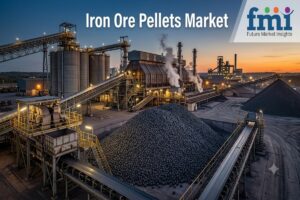


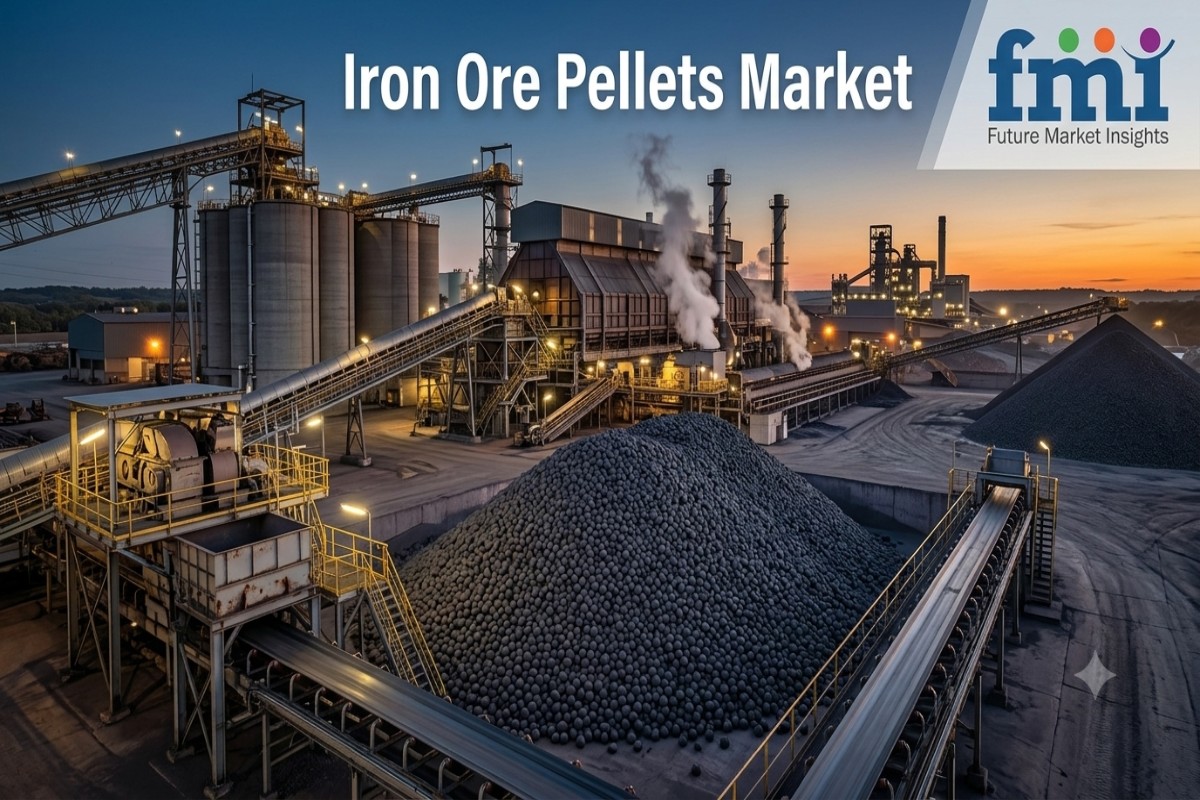
The global iron ore pellets market is estimated at USD 58.5 billion in 2026 and is projected to reach USD 90.8 billion by 2036, expanding at a CAGR of 4.5% during the forecast period. The market was valued at USD 56.0 billion in 2025.
Demand is linked to steel industry investments in electric arc furnaces (EAFs), direct reduced iron (DRI) production and lower-carbon steelmaking. Steelmakers are shifting away from coal-based sintering and increasing their use of high-grade iron ore pellets. Rising beneficiation and induration costs remain challenges, while low-silica DR-grade pellets and cold-bonded briquettes are opening new opportunities.
The short version
- The iron ore pellets market is expected to add USD 32.3 billion in revenue between 2026 and 2036.
- Direct Reduction DR-Grade Pellets (67% Fe and low silica) will lead pellet grade sales with a 64.0% share in 2026, while magnetite ore concentrate pellets will account for 58.0% of source ore mineralogy demand.
- India will record the fastest country-level growth at a 6.2% CAGR, followed by China at 5.6% and the United States at 5.2%.
- EAF-DRI steelmaking and demand for low-impurity pellets will support long-term procurement across major steel-producing regions.
Where growth is strongest
India is expected to lead country-level growth at a CAGR of 6.2% from 2026 to 2036, supported by captive pellet plant investments, slurry pipeline development and expanding DRI-EAF steelmaking capacity. Tata Steel’s acquisition of a 50.01% stake in Thriveni Pellets and its 8 MTPA Kalinganagar expansion highlight the country’s capacity development.
China is projected to grow at 5.6%, driven by tighter emissions requirements, higher pellet ratios in blast furnaces and investments in direct-reduction technologies. The United States is forecast to expand at 5.2%, supported by domestic taconite pellet production and growing DRI-EAF steelmaking demand.
Australia is expected to register a CAGR of 4.9%, reflecting magnetite beneficiation investments and green-iron projects, while Mexico is projected to grow at 4.8%, supported by gas-based DRI facilities and automotive steel demand.
European markets will record comparatively moderate growth. The United Kingdom is forecast to expand at 4.4%, supported by its national Steel Strategy and Port Talbot EAF conversion. Germany is projected to register a CAGR of 4.3%, driven by hydrogen-ready DRI plant investments in Duisburg and Salzgitter. Italy is expected to grow at 4.0%, supported by EAF operations and virgin metallics requirements.
Who is moving
The industry is responding to steel decarbonization targets, increasing demand for high-grade DR pellets and investments in beneficiation technologies. Producers are prioritizing low-silica concentrate production and upgrading existing pelletizing facilities to meet changing steelmaker requirements.
Key dated developments
- September 2026: Ferrexpo announced a USD 100 million equity raise to strengthen operational liquidity after reporting 1.4 million metric tons of premium pellet production in the first half of 2026.
- May 28, 2026: Champion Iron disclosed that its USD 500 million Bloom Lake Direct Reduction Pellet Feed facility had passed initial production runs completed in March 2026.
- February 12, 2026: Metinvest signed an engineering agreement for a flotation concentration complex and refurbishment of the LURGI 552-A pelletizer at Northern Iron Ore.
- January 2026: Rio Tinto reported that Iron Ore Company of Canada produced 9.3 million metric tons of iron ore pellets and concentrate during 2025.
- December 2025: Tata Steel’s Board approved the acquisition of a 50.01% equity stake in Thriveni Pellets Private Limited for up to INR 636 crore.
- December 2025: BHP and Zenith Steel completed commercial-scale pellet trials at Nantong, China, using Pilbara iron ore.
Key players profiled
Vale S.A., LKAB, Cleveland-Cliffs Inc., Ferrexpo plc, Metinvest Holding LLC, Bahrain Steel BSCC, Jindal Steel and Power Limited, Rio Tinto plc, Champion Iron Limited and Tata Steel Limited.
Where to act
- Expand Indian market coverage: India’s 6.2% CAGR and investments in captive pellet plants, slurry pipelines and integrated steel facilities create opportunities for pellet producers and equipment suppliers.
- Prioritize high-grade DR pellets: Direct Reduction DR-Grade Pellets are expected to account for 64.0% of pellet grade value in 2026, creating opportunities for suppliers with 67%+ Fe and low-silica products.
- Invest in beneficiation technology: Reverse-flotation silica rejection and magnetite upgrading can help producers improve iron content and meet demanding DRI specifications.
- Develop alternative agglomeration formats: Cold-bonded briquettes and lower-carbon pelletizing technologies offer opportunities to reduce induration-related emissions.
- Strengthen seaborne supply agreements: Merchant pellet contracts account for 61.0% of trade and captive channel demand in 2026, supporting long-term relationships between miners and coastal steelmakers.
Where to be careful
- High electricity and natural gas costs can increase grinding, beneficiation and induration expenses.
- Low steelmaking margins and excess global steel capacity may restrict pellet procurement.
- Low-silica magnetite reserves and high-grade concentrate availability can constrain DR-pellet production.
- War-related energy and logistics disruptions in Eastern Europe can affect production and export volumes.
- High dry-bulk freight costs and port infrastructure limitations can reduce the competitiveness of seaborne pellet suppliers.
Analyst perspective
“Global steelmakers are discovering that building electric arc furnaces and hydrogen shaft reactors is the easy part; securing 67% to 69% Fe iron ore pellets with combined silica and alumina below 2% is the true structural bottleneck. Ore producers that invest in reverse-flotation silica rejection and grate-kiln induration will capture outsized DR-pellet premiums over the next decade as blast furnace sinter plants close.”
— Nikhil Kaitwade, Principal Consultant, Future Market Insights.
Related Report:
https://www.openpr.com/news/4678792/top-players-in-potassium-chloride-market-to-drive-usd-19-5
https://www.openpr.com/news/4678795/top-players-in-polyurea-coatings-market-as-global-revenue
https://www.openpr.com/news/4678797/top-companies-in-the-nanocellulose-market-as-global-revenue
https://www.openpr.com/news/4678805/top-players-in-mining-explosives-consumables-market-as-revenue
About Future Market Insights
Future Market Insights (FMI) is an ESOMAR-certified market research and consulting firm providing syndicated, customized, investment, and social media research across industries, including food and beverage, healthcare, chemicals, technology, and consumer markets. FMI delivers market intelligence, competitive analysis, and strategic insights to help organizations evaluate emerging opportunities and make informed business decisions. The company has offices in the United States, the United Kingdom, the UAE, and India.
For Press & Corporate Inquiries
Rahul Singh
AVP – Marketing and Growth Strategy
Future Market Insights, Inc.
For Sales: sales@futuremarketinsights.com
For Media: Rahul.singh@futuremarketinsights.com
Website: https://www.futuremarketinsights.com/