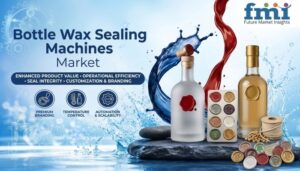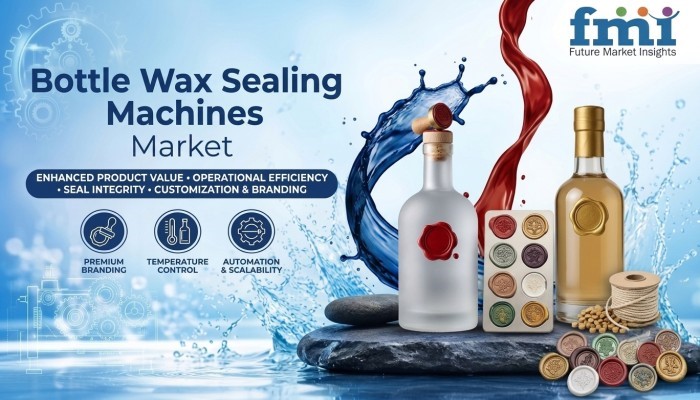
The global bottle wax sealing machines market is estimated to reach USD 51.2 million in 2026, up from USD 48.6 million in 2025, and is projected to grow to USD 86.6 million by 2036. According to the latest market analysis published by Future Market Insights (FMI), the industry is anticipated to expand at a compound annual growth rate (CAGR) of 5.4% between 2026 and 2036, creating an absolute dollar opportunity of USD 35.4 million.
Market expansion is closely linked to premium bottle presentation, particularly among spirits producers and manufacturers handling limited product releases. Wax sealing is generally applied over an existing bottle closure as a decorative finishing feature rather than as an essential protective mechanism. This positions specialized wax sealing equipment within the broader demand for distinctive packaging and flexible finishing operations.
Get detailed market forecasts, competitive benchmarking, and pricing trends:
https://www.futuremarketinsights.com/reports/sample/rep-gb-35749
KEY MARKET TAKEAWAYS
- Market Valuation: The bottle wax sealing machines market is estimated at USD 51.2 million in 2026 and is projected to reach USD 86.6 million by 2036.
- Growth Rate: The market is forecast to expand at a 5.4% CAGR from 2026 to 2036.
- Leading Automation Segment: Semi-automatic machines are expected to account for 49.0% of automation demand in 2026.
- Leading Configuration: Standalone floor-mounted systems are projected to hold 54.0% of configuration demand.
- Dominant Application Method: Bottle-neck dipping is estimated to account for 72.0% of application method demand.
- Core End Use: Spirits producers are expected to represent 44.0% of end-use demand in 2026.
- Core Growth Driver: Demand for distinctive bottle presentation across premium spirits and selected limited releases supports investment in dedicated wax-finishing equipment.
INDUSTRY SHIFTS & MARKET DYNAMICS
Bottle wax sealing is increasingly positioned as a specialized bottle-finishing process for products where packaging contributes to brand identity. In premium spirits, wine and selected specialty beverages, a wax-covered bottle neck can create a recognizable visual distinction. Since the wax is generally applied after the primary filling and closure stages, producers can introduce this finishing step without replacing their existing filling or capping equipment. This supports demand for standalone and semi-automatic machinery, particularly among manufacturers handling selected product lines and shorter production runs.
Equipment selection is being shaped by production flexibility rather than running speed alone. Semi-automatic machines offer an intermediate option between manual dipping and fully automated production by mechanizing activities such as bottle rotation and wax immersion while retaining manual loading or unloading. Standalone floor-mounted systems also suit operations that prefer to add wax sealing as an independent finishing station. Meanwhile, bottle-neck dipping remains the leading application method because it can produce a continuous wax covering around the closure and upper bottle neck through a single immersion process.
However, the market faces limitations from the specialized nature of wax sealing. Standard bottle closures already provide the required closure function, meaning wax is not essential for most spirits packaging. Its commercial value depends largely on product presentation and differentiation. Softer wine-sector conditions may also limit capacity-led machinery investment. The International Organisation of Vine and Wine reported that global wine consumption declined 2.7% to 208.0 million hectolitres in 2025. Consequently, equipment opportunities are more closely associated with premium products, selective production runs and the replacement of manual finishing processes than with broad-based increases in beverage volumes.
REGIONAL MARKET SUMMARY
Country-level forecasts indicate varying growth prospects across established wine and spirits markets. Japan records the highest projected CAGR among the profiled countries.
- Japan: Expected to expand at a 6.4% CAGR from 2026 to 2036, supported by export-oriented premium beverage categories and demand for distinctive bottle presentation.
- Italy: Projected to register a 5.9% CAGR, with opportunities concentrated among estate wines and limited releases.
- United Kingdom: Forecast to grow at a 5.7% CAGR, supported by the importance of premium whisky and spirits packaging.
- France: Expected to record a 5.4% CAGR, with demand focused on premium wine and spirits applications.
- Australia: Projected to expand at a 5.2% CAGR, as export-oriented producers selectively use packaging differentiation.
Other profiled markets include Portugal at 5.0%, the United States at 4.8%, and Germany at 4.6%.
ANALYST INSIGHTS
“Bottle wax sealing is evolving from a closure-related process into a specialized bottle-finishing step. For small production runs, machine economics depend heavily on changeover time. In an illustrative batch calculation, cutting changeover from 60 minutes to 10 minutes increases effective output by 187.5% for a 500-bottle batch at 30 bottles per minute, assuming batch time consists of changeover plus running time, while doubling running speed from 30 to 60 bottles per minute increases output by only 12.2%. This favors flexible semi-automatic systems and line-integrated modules for premium spirits, limited releases and other short-run applications.”
— Nandini Roy Choudhury, Principal Consultant at Future Market Insights
COMPETITIVE LANDSCAPE
The bottle wax sealing machines market features a fragmented supplier base comprising specialist equipment manufacturers and packaging machinery suppliers offering wax-dipping solutions. Key players include ZONESUN, DAAP International, Q&L Packaging Machinery, Yantai Sailing Automation Technology and CRU Systems.
Competition is shaped by equipment flexibility, bottle-format compatibility, automation options and the ability to accommodate different production batch sizes. ZONESUN and DAAP International offer multi-station semi-automatic configurations, while Q&L Packaging Machinery supplies semi-automatic dipping equipment alongside filling and capping machinery. Yantai Sailing Automation Technology offers semi-automatic and rotary automatic systems. CRU Systems serves smaller and medium-sized bottling operations with single-bottle, three-bottle and six-bottle dipping configurations.
As producers seek to mechanize manual finishing or introduce wax application to selected products, suppliers with adaptable bottle fixtures, manageable changeover requirements and multiple automation options are positioned to address varied production needs.
ABOUT THE REPORT
The Bottle Wax Sealing Machines Market Report by Future Market Insights examines global market performance and the outlook for 2026 to 2036.
It analyzes demand by automation, configuration, application method, batch handling, wax handling, end use, bottle compatibility and equipment demand.
The study also provides country-level forecasts, competitive analysis and insights into equipment selection and production requirements.
For more information on the full report, visit: https://www.futuremarketinsights.com/reports/bottle-wax-sealing-machines-markethttps://www.futuremarketinsights.com/reports/bottle-wax-sealing-machines-market
Explore More Related Reports Links:
https://www.openpr.com/news/4678721/biodegradable-disposable-tableware-market-is-expected-to-reach
https://www.openpr.com/news/4678724/corrugated-box-market-is-anticipated-to-reach-usd-273-9-billion
FMI Custom Research: Strategic Intelligence for Confident Decision-Making
In today’s rapidly evolving business environment, leadership teams need more than market data—they need clear, actionable intelligence tailored to their strategic objectives. FMI’s Custom Research solutions are designed around the specific business questions organizations need answered, enabling executives to evaluate growth opportunities, validate investments, assess competitive dynamics, and reduce uncertainty before making critical decisions. By combining deep industry expertise, primary research, and proprietary market intelligence, FMI delivers insights that help organizations move from assumptions to evidence-based strategies with greater speed and confidence.
Business Impact
FMI helps organizations transform market complexity into strategic clarity, enabling leadership teams to identify growth opportunities faster, optimize resource allocation, strengthen competitive positioning, and make high-stakes business decisions with confidence.
To explore how FMI Custom Research can support your strategic priorities, please connect with our team at – sales@futuremarketinsights.com
Future Market Insights, Inc. (FMI) is an ESOMAR-certified, ISO 9001:2015 market research and consulting organization, trusted by Fortune 500 clients and global enterprises. With operations in the U.S., UK, India, and Dubai, FMI provides data-backed insights and strategic intelligence across 30+ industries and 1200 markets worldwide.
Contact Us:
Future Market Insights Inc.
Christiana Corporate, 200 Continental Drive,
Suite 401, Newark, Delaware – 19713, USA
T: +1-347-918-3531
For Sales Enquiries: sales@futuremarketinsights.com
Website: https://www.futuremarketinsights.com
LinkedIn| Twitter| Blogs | YouTube