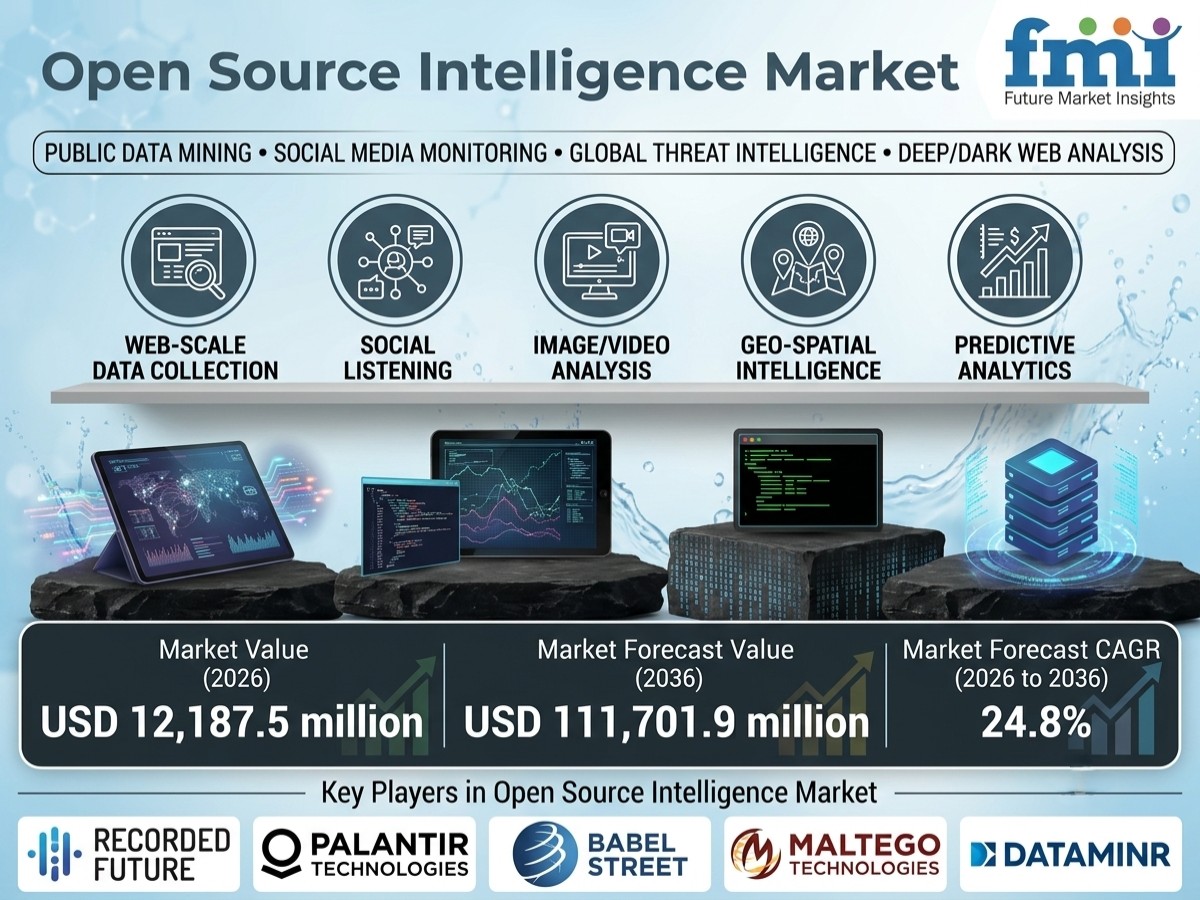
NEWARK, Del. — The global Open Source Intelligence Market is projected to increase from USD 12,187.5 million in 2026 to USD 111,701.9 million by 2036, registering a compound annual growth rate (CAGR) of 24.8% over the forecast period, based on the updated 2026–2036 figures supplied for this release. Open source intelligence (OSINT) involves collecting and analyzing information from publicly accessible sources to support security, investigative, and business decisions.
Organizations are using OSINT to interpret information from news publications, social media, public records, websites, and other open data sources. As the volume of digital information grows, demand is shifting toward platforms that can identify relevant signals, connect information across sources, and help analysts assess emerging risks.
Access the Sample Report — Explore Key Insights Today!
https://www.futuremarketinsights.com/reports/sample/rep-gb-16925
Open Source Intelligence Market: Key Findings
- Market size in 2026: USD 12,187.5 million
- Projected market size by 2036: USD 111,701.9 million
- Forecast CAGR, 2026–2036: 24.8%
- Key analytical area: Data analytics
- Important technology areas: Social media analysis, big data software, text analytics, and video analytics
- Companies profiled: Recorded Future, Palantir Technologies, Babel Street, Maltego Technologies, and Dataminr
Rising Cybersecurity Risks Strengthen OSINT Demand
The growing frequency and complexity of cyber threats are encouraging enterprises and government agencies to improve their intelligence capabilities. OSINT platforms help security teams monitor publicly available information, identify potential threats, and build a broader picture of emerging incidents.
In cybersecurity, these tools can support the monitoring of suspicious online activity, exposed information, and indicators associated with potential attacks. Financial institutions and businesses can also use public information to support fraud investigations, reputation monitoring, and risk assessment.
Government agencies and law enforcement organizations represent another important demand base. Publicly available information can help investigators examine events, identify connections, and support situational awareness. Defense and national security organizations may also use OSINT to complement other intelligence sources.
The value of these platforms depends on the quality of the information collected and the ability to distinguish relevant evidence from misleading or manipulated content. As a result, data verification, source evaluation, and analyst oversight remain important parts of OSINT operations.
Data Analytics and AI Improve Intelligence Processing
Data analytics is a central area of the OSINT market because analysts must process large volumes of information from different sources. Analytical tools can help organize datasets, identify patterns, and connect information that may otherwise remain difficult to interpret.
Artificial intelligence and machine learning are expanding these capabilities. Automated classification, language processing, and pattern recognition can help analysts review information more efficiently. These technologies can also support the analysis of multilingual content and large streams of social media activity.
Technology segments identified in FMI’s report include social media analysis, big data software, text analytics, social media analytics, and video analytics. Each supports a different part of the intelligence process, from collecting and organizing information to identifying relationships and interpreting visual or written content.
However, automation does not eliminate the need for human review. False positives, incomplete source information, manipulated media, and misinformation can affect analytical conclusions. Organizations therefore need processes that combine automated analysis with verification and professional judgment.
Regional Outlook: North America, Europe, and Asia Pacific
FMI identifies North America as a prominent OSINT market, supported by cybersecurity investment, defense infrastructure, and the presence of government intelligence agencies and technology providers. Enterprises also use OSINT for fraud prevention, corporate risk analysis, and social media monitoring.
Europe presents opportunities linked to cybersecurity investment, counterterrorism requirements, and regulatory compliance. Germany, the United Kingdom, France, and Italy are among the markets where public agencies and private organizations use intelligence tools. Data protection requirements, including the General Data Protection Regulation, make responsible information collection and processing an important consideration for providers.
Asia Pacific is an emerging growth region. Geopolitical tensions, cyber threats, and expanding digital activity are supporting interest in OSINT solutions across China, India, Japan, and South Korea. Demand is also connected to the need for localized platforms that can interpret regional languages and cultural context.
Across these regions, purchasing decisions are shaped by the ability to combine multiple public sources, support timely analysis, and maintain appropriate data governance. FMI’s accessible country outlook provides individual growth forecasts for the United States, United Kingdom, European Union, Japan, and South Korea for 2025–2035. Those country rates are not presented here as 2026–2036 forecasts because the forecast periods differ.
Competitive Landscape: Top Companies in the OSINT Market
FMI’s competitive analysis identifies Recorded Future, Palantir Technologies, Babel Street, Maltego Technologies, and Dataminr as representative participants in the Open Source Intelligence Market.
Recorded Future provides intelligence platforms and related services, while Palantir Technologies supports intelligence workflows through its software portfolio. Babel Street focuses on language and text-related intelligence tools. Maltego Technologies provides link analysis and investigative capabilities, while Dataminr specializes in event detection and risk information.
These providers address different buyer requirements. Organizations may assess solutions based on source coverage, language capabilities, data integration, analytical workflows, and the speed at which relevant information can be surfaced. The competitive assessment does not establish a market-share ranking among these companies.
FMI’s broader report materials also identify privacy, ethical data collection, information overload, and data accuracy as important market challenges. Providers that support transparent sourcing, appropriate access controls, and effective verification processes can address key concerns among enterprise and government buyers.
Outlook for the Open Source Intelligence Market
The Open Source Intelligence Market is positioned for expansion as organizations seek better ways to interpret publicly available information and respond to evolving security risks. Demand is expected across cybersecurity, national security, law enforcement, financial services, and corporate risk management.
AI-assisted analytics, multilingual processing, social media monitoring, and real-time event detection are shaping product development. At the same time, data privacy, misinformation, and source reliability will remain important considerations for buyers.
For detailed market forecasts, segmentation, regional analysis, and competitive coverage, visit the Future Market Insights Open Source Intelligence Market report: https://www.futuremarketinsights.com/reports/open-source-intelligence-market
Explore More Related Reports –
QR Code Labels Market – https://www.futuremarketinsights.com/reports/qr-code-labels-market
B2B Telecommunication Market – https://www.futuremarketinsights.com/reports/b2b-telecommunication-market
Edutainment Market – https://www.futuremarketinsights.com/reports/edutainment-market