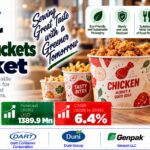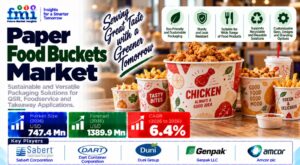


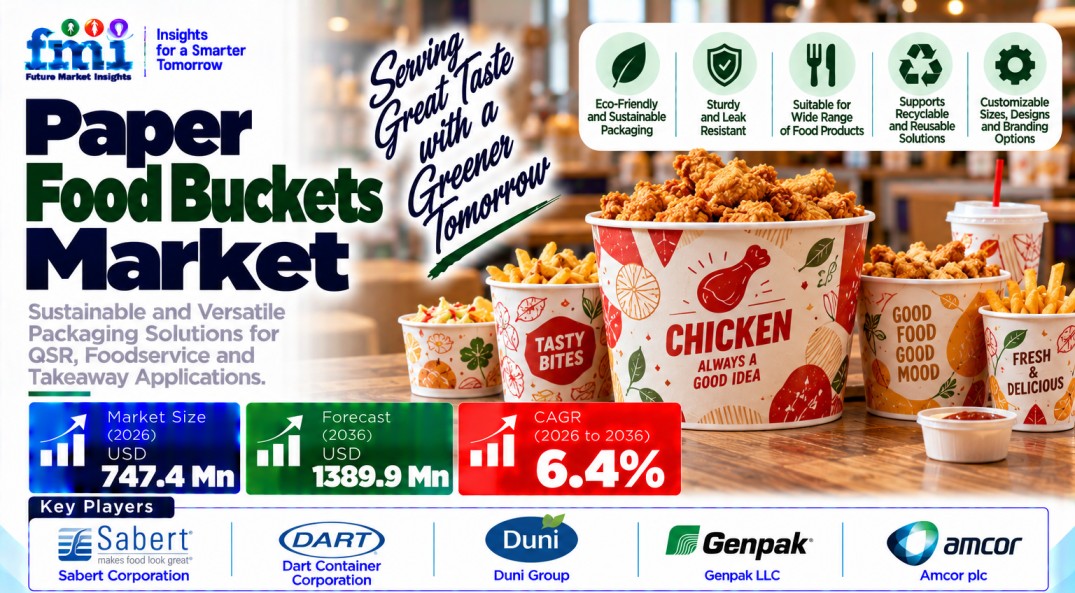
The global Paper Food Buckets Market is projected to grow from US$747.4 million in 2026 to US$1.39 billion by 2036, registering a compound annual growth rate (CAGR) of 6.4% over the forecast period, according to Future Market Insights (FMI). The market was valued at US$702.4 million in 2025. The forecast represents an additional US$642.5 million in market value between 2026 and 2036.
Demand is being driven by quick-service restaurant (QSR) chains, fried-chicken outlets, supermarket hot-food counters, and delivery operators seeking containers that protect food quality during transport. Paper food buckets are increasingly important for family-sized poultry meals, where resistance to grease, heat, steam, and stacking pressure can influence customer experience and packaging procurement decisions.
Paper Food Buckets Market: Key Forecast Highlights
- Market size in 2026: US$747.4 million
- Forecast market size by 2036: US$1.39 billion
- CAGR (2026–2036): 6.4%
- Market size in 2025: US$702.4 million
- Leading product type: Paper buckets with vented paperboard lids, projected at 44.6% in 2026
- Leading material: PE-coated virgin kraft paperboard, projected at 38.4% in 2026
- Leading end-use segment: Quick-service restaurants, projected at 53.8% in 2026
- Fastest-growing profiled country: South Korea, with a projected 7.8% CAGR through 2036
>> Get Detailed Market Forecasts, Competitive Benchmarking, and Pricing Trends: https://www.futuremarketinsights.com/reports/sample/rep-gb-35997
What Is Driving the Paper Food Buckets Market?
The expansion of off-premises dining is a major demand driver. Fried chicken, family meal bundles, and hot deli products require packaging that maintains structural integrity and limits grease penetration during delivery. Paper buckets with vented lids can help release steam while supporting food presentation and reducing the risk of condensation affecting crispness.
QSR operators also value standardized packaging that supports rapid order assembly, efficient storage, and consistent presentation across multiple locations. For converters, reliable rim locking, bottom-seam integrity, and compatible lids can strengthen their position when bidding for national restaurant contracts.
Regulatory and sustainability requirements are also influencing material selection. Foodservice buyers are assessing alternatives to certain fluorochemical grease barriers and plastic-heavy packaging constructions. Aqueous dispersion coatings and molded-fiber formats offer potential routes toward lower-plastic packaging, although suppliers must validate grease resistance, food-contact compliance, recyclability, and cost before changing established specifications.
Vented-Lid Buckets and Kraft Paperboard Lead Key Segments
Paper buckets with vented paperboard lids are expected to account for 44.6% of product-type demand in 2026. Their projected leadership reflects the need to manage steam and protect food during stacking and delivery. Vented lids can support food quality, while well-designed closures help reduce accidental opening during handling.
PE-coated virgin kraft paperboard is projected to represent 38.4% of the material segment in 2026. Its continued use reflects the importance of stiffness, grease resistance, and compatibility with established high-speed bucket-forming processes. However, pressure to reduce plastic content is creating opportunities for aqueous and PFAS-free dispersion-coated paperboard, bio-polymer laminates, and molded-fiber alternatives.
Standard family meal buckets measuring 64 to 130 ounces are forecast to account for 47.2% of format-size demand in 2026. Quick-service restaurants are expected to represent 53.8% of end-use demand, while broadline foodservice distributors are projected to account for 45.6% of sales-channel demand.
Regional Opportunities: South Korea Leads Growth Forecasts
FMI’s country-level outlook identifies Asia and the Middle East as important growth markets, with established Western markets also progressing as packaging requirements evolve.
- South Korea: 7.8% CAGR, supported by urban fried-chicken delivery networks and demand for vented fiber packaging.
- United Arab Emirates: 7.4%, with cloud-kitchen expansion and restrictions on single-use plastic food containers supporting the transition.
- United States: 6.9%, driven by QSR demand, domestic packaging capacity, and changes in grease-barrier requirements.
- Saudi Arabia: 6.6%, supported by QSR poultry-chain expansion and food-contact compliance requirements.
- United Kingdom: 6.1%, with extended producer responsibility and recyclability assessments influencing packaging choices.
- Germany: 5.8%, reflecting packaging-recyclability requirements and interest in mono-material fiber designs.
- France: 5.4%.
- Japan: 4.9%.
For manufacturers, these forecasts can guide distributor development, capacity planning, and regional customer acquisition. Companies should also assess local regulations, logistics costs, raw-material availability, and the technical qualification requirements of major restaurant chains.
Top Players in the Paper Food Buckets Market
FMI identifies the following notable companies in the Paper Food Buckets Market:
- Graphic Packaging International
- Detmold Group (Detpak)
- Huhtamaki Oyj
- Novolex (incorporating Pactiv Evergreen)
- Sabert Corporation
- Dart Container Corporation
- Duni Group
- Genpak LLC
- Amcor plc (incorporating Berry Global)
These companies operate across paperboard converting, foodservice packaging, molded-fiber containers, and takeaway packaging systems. Their capabilities differ, and the list should not be interpreted as a ranking by market share.
Competition is increasingly influenced by the ability to deliver high-speed forming performance, reliable grease barriers, matched bucket-and-lid systems, and consistent supply to large foodservice accounts. Suppliers that combine technical performance with lower-impact material options may be better positioned as restaurant operators review packaging specifications.
>> Access Detailed Market Insights: https://www.futuremarketinsights.com/reports/paper-food-buckets-market
Strategic Priorities for Foodservice Packaging Suppliers
Three priorities stand out for decision-makers.
First, validate performance under real delivery conditions. Test hot-oil resistance, stack-crush strength, seam integrity, lid retention, and steam management to ensure containers perform during typical delivery windows.
Second, develop alternatives to conventional barriers. PFAS-free aqueous coatings and fiber-based designs may help address changing customer and regulatory requirements. Their performance and recyclability should be validated against the infrastructure and standards in each target market.
Third, improve production and distribution efficiency. Accurate bucket dimensions, reliable denesting, matched lids, and reduced forming waste can improve converter economics and help restaurant operators replenish stock efficiently.
Nandini Roy Choudhury, Principal Consultant at Future Market Insights, said: “Quick-service poultry chains no longer judge a paper food bucket by board basis weight alone; procurement approval hinges on whether the bucket-and-lid assembly passes 45-minute hot-oil holdout and stack-crush tests using PFAS-free barrier chemistry. Converters that combine captive cupstock mill integration with audible-lock vented paperboard lids will capture multi-year national chain contracts.”