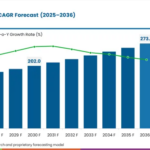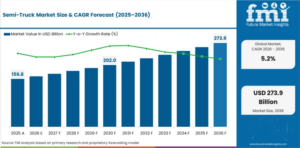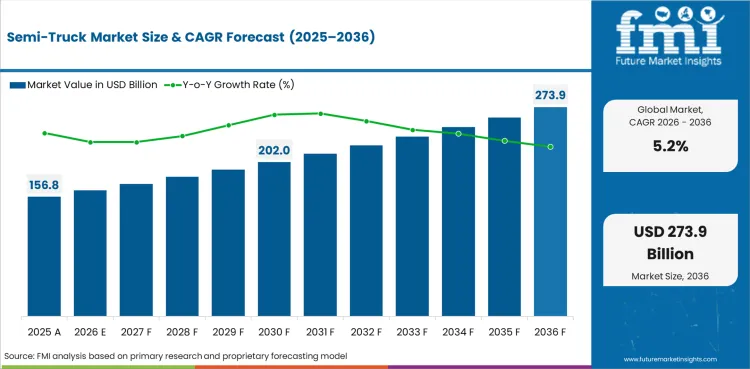
The global semi-truck market was valued at USD 156.80 billion in 2025 and is projected to expand from USD 165.0 billion in 2026 to USD 273.85 billion by 2036. Global demand for heavy-duty commercial transport will register a compound annual growth rate (CAGR) of 5.2% over the ten-year assessment period. This expansion trajectory reflects an absolute incremental revenue opportunity of USD 108.90 billion between 2026 and 2036. The sector is undergoing a structural evolution as commercial fleet operators, logistics providers, and industrial enterprises modernize heavy transport assets to align with evolving regulatory mandates, expanding freight corridors, and strict operational efficiency requirements.
Get detailed market forecasts, competitive benchmarking, and pricing trends:
https://www.futuremarketinsights.com/reports/sample/rep-gb-25121
Key Market Highlights at a Glance
• 2025 Market Valuation: USD 156.80 billion
• 2026 Market Valuation: USD 165.0 billion
• 2036 Market Forecast: USD 273.85 billion
• Forecast Period CAGR (2026-2036): 5.2%
• Absolute Incremental Opportunity: USD 108.90 billion
• Leading Truck Class Segment: Class 8 (47.6% market share in 2026)
• Leading Propulsion Segment: Diesel (69.4% market share in 2026)
• Leading Body Segment: Tractor-Trailer (58.2% market share in 2026)
• Fastest-Growing Country Markets: China (7.0% CAGR) and India (6.5% CAGR)
• Largest Regional Market: Europe
• Leading Market Participant: Volvo Group (16.0% market share)
• Report Scope and Volume: 250-page deep-dive commercial transport study
Why Is the Semi-Truck Market Growing?
Demand across the global semi-truck industry is accelerating as logistics networks face heightened freight volumes, expanding cross-border supply chains, and increasingly stringent vehicle safety and emission standards. Industrial operators and commercial transport providers are actively replacing aging equipment with high-performance vehicles designed to maximize uptime and reduce operating costs.
• End-Use Vertical Expansion: Broadening adoption across logistics, manufacturing, retail distribution, and construction verticals is sustaining steady procurement volume during the forecast period.
• Regulatory Compliance Frameworks: Evolving emissions rules and structured safety requirements compel commercial fleets to upgrade legacy vehicles with compliant, high-efficiency models.
• Emerging Market Infrastructure Spending: Substantial government and private investment in transportation corridors across high-growth regions is accelerating fleet acquisition.
The semi-truck sector is transitioning from a traditional procurement category into a more established industrial supply segment as adoption accelerates across primary end-use environments. Adoption is shaped by the convergence of regulatory requirements, infrastructure investment, and the operational need for improved performance and efficiency. Companies that deliver validated performance, competitive pricing, and reliable supply are positioned to capture growing procurement volume.
Segment Breakdown: What Drives Class, Propulsion, and Body Leadership?
Truck Class Segmentation: Class 8 Vehicles Retain Dominance
The Class 8 heavy-duty truck segment is projected to account for 47.6% of total truck class revenue in 2026. Class 8 vehicles serve as the foundational workhorse for long-haul freight and high-capacity cargo movement across major industrial supply routes.
• Class 8: Expected to hold 47.6% share of the truck class segment in 2026 due to essential long-haul logistics requirements.
• Class 7: Widely deployed in regional haulage and heavy municipal transport applications.
• Class 6: Preferred for medium-duty vocational tasks and urban freight consolidation.
Industry evaluations confirm that Class 8 platform dominance stems from its irreplaceable role in high-payload logistics, where haulage scale directly controls transport margins.
Propulsion Segmentation: Diesel Power Maintains Primary Share
Diesel engines represent the leading propulsion technology, forecast to capture 69.4% of the global market in 2026. Mature fueling infrastructure, continuous thermal efficiency improvements, and high torque output sustain diesel dominance across long-haul operational profiles.
• Diesel: Projected at 69.4% propulsion market share in 2026, supported by mature distribution networks and high reliability.
• Natural Gas: Preferred in dedicated regional routes prioritizing localized emissions reduction.
• Electric and Hybrid: Gaining early adoption in urban and short-haul distribution corridors.
The propulsion ecosystem remains anchored by diesel technology while alternative powertrains expand in specialized local routes.
Body Type Segmentation: Tractor-Trailer Configurations Lead
The tractor-trailer body configuration is anticipated to represent 58.2% of overall body segment value in 2026.
• Tractor-Trailer: Expected to secure 58.2% body segment share in 2026.
• Straight Truck & Van Truck: Serving last-mile logistics and regional freight distribution.
• Dump Truck: Supporting heavy construction and civil infrastructure projects.
Tractor-trailer units capture the largest market share due to their unmatched versatility in intermodal shipping operations.
Speak to Analyst: Customize insights for your business strategy:
https://www.futuremarketinsights.com/customization-available/rep-gb-25121
Market Dynamics: Drivers, Restraints, and Key Trends
Primary Market Drivers
Structured fleet modernization programs driven by regulatory compliance and industrial output expansion represent the primary demand drivers.
Primary Market Restraints
Margin compression resulting from institutional buyer consolidation and fleet price sensitivity presents an ongoing operational challenge for vehicle manufacturers.
Emerging Market Trends
Commercial vehicle procurement is increasingly prioritizing total cost of ownership (TCO) optimization, integrating predictive telematics and fuel-efficient drivetrain architectures.
Regional Outlook: Asia-Pacific Accelerates While Europe Leads Overall Demand
• China: Forecast to expand at a market-leading 7.0% CAGR through 2036.
• India: Projected to register a strong 6.5% CAGR over the 10-year assessment period.
• Europe: Maintains its status as the largest total regional market driven by institutional enterprise procurement.
• North America: Characterized by robust Class 8 replacement cycles across major logistics corridors.
China leads worldwide expansion with a 7.0% CAGR through 2036, propelled by massive national infrastructure projects and expanding manufacturing logistics. India follows closely with a 6.5% CAGR through 2036 as rapid urbanization and highway network expansion boost freight vehicle acquisitions. In Europe, enterprise buyers and strict fleet emissions targets sustain consistent replacement cycles, cementing the region as the largest market overall.
Latest Automotive Industry Analysis Reports:
https://www.futuremarketinsights.com/industry-analysis/automotive
Competitive Landscape: Strategic Positioning Among Industry Leaders
• Volvo Group: Leads global market share at an estimated 16.0%, supported by global production scale and established fleet supply agreements.
• Daimler AG: Maintaining strong global presence through advanced heavy-duty truck platforms and telematics integration.
• Paccar Inc.: Focusing on premium long-haul tractor designs and customer-tailored commercial fleets.
• Tata Motors Limited: Dominating regional freight channels in high-growth South Asian transport markets.
• Iveco S.p.A.: Specialized in European regional haulage and alternative fuel commercial vehicle options.
• Hyundai Motor Company: Advancing specialized heavy commercial vehicle platforms across emerging transport markets.
Competitive dynamics are shifting toward total lifecycle support, with leading original equipment manufacturers emphasizing service reliability, fuel efficiency, and software-driven fleet management tools.