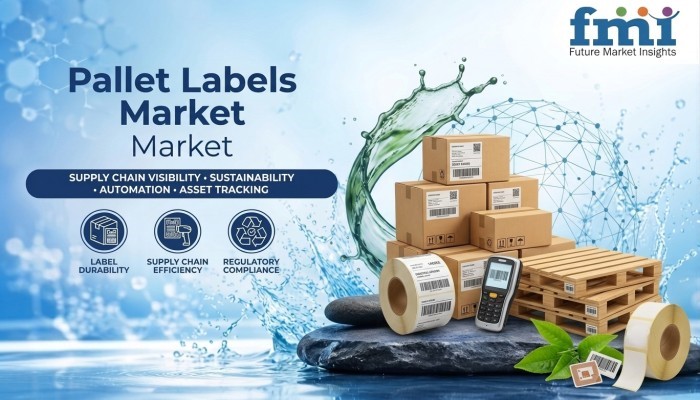
The global pallet labels market is projected to grow from USD 782.7 million in 2026 to USD 1,262.8 million by 2036, registering a compound annual growth rate (CAGR) of 4.9% during the forecast period. The market was valued at USD 746.1 million in 2025, according to Future Market Insights (FMI). Growth is being supported by warehouse automation, standardized shipment identification, and the need to connect physical pallet movements with electronic warehouse and shipment records.
A key industry development is the standardization of pallet identification and logistics data. In November 2025, GS1 Germany initiated a pallet-load-height harmonization project involving 11 industrial and retail companies to align national practices with the European EUL1 standard. Such initiatives highlight the importance of consistent pallet identification and handling procedures across supply chains. Label suppliers must ensure barcode readability, reliable adhesion, and compatibility with warehouse printers, scanners, and receiving systems.
Get detailed market forecasts, competitive benchmarking, and pricing trends:
https://www.futuremarketinsights.com/reports/sample/rep-gb-35481
Global Segment Leaders
- Label Type: Barcode Pallet Labels — 34.0% share in 2026. Barcode labels lead because they work with widely used scanners and Serial Shipping Container Code (SSCC) workflows without requiring RFID readers at every warehouse handoff.
- Material: Paper — 43.0% share in 2026. Paper labels benefit from clear barcode printing and lower costs on dry logistics routes.
- End Use: Warehousing — 29.0% share in 2026. Warehousing leads because pallets require repeated identification during storage, dispatch, receiving, and internal movement.
- Printing: The report identifies on-demand labels, pre-printed labels, RFID-encoded labels, and color-coded labels. A leading printing segment share is not disclosed in the accessible report summary.
- Sales Channel: The report covers label converters, industrial distributors, printer OEM consumables, and e-commerce/catalog channels. A leading sales-channel share is not disclosed in the accessible report summary.
FMI’s segmentation also includes RFID pallet labels, thermal transfer labels, direct thermal labels, weather-resistant labels, polypropylene, polyester, synthetic paper, specialty adhesive stock, food and beverage logistics, retail distribution, pharmaceutical logistics, and manufacturing plants.
Country-Level Performance
FMI’s published country analysis identifies seven markets with specific forecast CAGRs through 2036. Finland leads at 6.2%, while Japan records the lowest projected growth rate among these profiled countries at 4.1%.
- Finland — 6.2% CAGR: Automated retail logistics and standardized pallet marking support adoption. GS1 Finland stated in September 2025 that SSCC identifies pallets and other logistics units and can be carried in GS1-128 barcodes or RFID.
- Mexico — 5.8% CAGR: Domestic retail requirements and cross-border distribution support demand for standardized pallet identification. GS1 Mexico stated in May 2026 that its identification standards help automate inventory control, reduce distribution errors, and meet retail-chain requirements.
- Canada — 5.5% CAGR: Traceability requirements and demanding cold-weather logistics conditions influence label selection and performance requirements.
- France — 5.2% CAGR: Shipment-unit identification and mixed-load traceability support demand. GS1 France updated its identification guidance in May 2026, emphasizing the SSCC’s role in identifying shipping units independently of their contents.
- United States — 4.8% CAGR: Large-scale logistics networks rely on SSCC-based pallet tracking. GS1 US published updated SSCC guidance in May 2026, explaining how the code identifies a logistics unit and is typically encoded in a GS1-128 barcode on the logistics label.
- Germany — 4.5% CAGR: Established warehouse systems and the transition toward standardized logistics data influence adoption. In July 2026, GS1 Germany revised guidance for transport, warehousing, and co-packing involving standard electronic data interchange (EDI) messages.
- Japan — 4.1% CAGR: Shared logistics data standards and collaborative transportation initiatives shape the market outlook as operators seek greater coordination across distribution networks.
Regional Context
Faster-growing markets include Finland, Mexico, Canada, and France, where automated logistics, retail identification requirements, shipment traceability, and cross-border distribution contribute to demand. Finland’s 6.2% CAGR reflects the importance of standardized pallet marking in automated operations, while Mexico’s 5.8% outlook is linked to domestic retail requirements and export logistics.
Moderate-growth and more mature markets include the United States, Germany, and Japan. The United States benefits from established SSCC-based tracking systems, while Germany’s existing warehouse infrastructure requires suppliers to maintain compatibility with printers, scanners, enterprise resource planning systems, and established data practices. Japan’s 4.1% forecast reflects the continued development of shared logistics standards and joint transportation networks.
FMI’s full report covers North America, Latin America, Western Europe, Eastern Europe, East Asia, South Asia and Pacific, and the Middle East and Africa, with more than 20 countries and additional regional groupings included in the broader assessment.
Get the Complete Story—Read More About Our Latest Report!
https://www.futuremarketinsights.com/reports/pallet-labels-market
Competitive Landscape
The key companies profiled in FMI’s pallet labels market report are Avery Dennison, UPM Adhesive Materials, CCL Industries, Zebra Technologies, SATO, Brady Corporation, TSC Auto ID, Toshiba Tec, HERMA, and cab Produkttechnik GmbH & Co KG. These companies participate in label materials, converting, industrial printing, RFID encoding, and identification workflow solutions.
Recent developments illustrate the industry’s focus on standardized logistics identification and label performance. In November 2025, GS1 Germany launched its pallet-load-height harmonization project with 11 industrial and retail companies. In May 2026, Avery Dennison announced that it had achieved industry-first OCC-E certification and How2Recycle pre-qualification for thermal labels, according to the company’s announcement cited in FMI’s report bibliography. In July 2026, GS1 Germany also revised its guidance for transport, warehousing, and co-packing using standard EDI messages.
These developments reflect the operational requirements shaping purchasing decisions. Buyers assess labels alongside printers, warehouse data, adhesion performance, barcode quality, and receiving procedures. Poor adhesion, unreadable barcodes, incorrect printer settings, and shipment-data errors can disrupt warehouse handoffs. Suppliers that help customers validate complete labeling workflows can address these practical barriers to adoption.
Related Reports:
https://www.openpr.com/news/4660722/recyclable-thermal-box-liners-market-to-reach-usd-2-077-8
https://www.openpr.com/news/4660746/paper-based-jewelry-shipping-mailers-market-to-reach-usd-964-5
https://www.openpr.com/news/4660911/paper-based-book-shipping-mailers-market-to-reach-usd-1-483-1
FMI Custom Research: Strategic Intelligence for Confident Decision-Making
In today’s rapidly evolving business environment, leadership teams need more than market data—they need clear, actionable intelligence tailored to their strategic objectives. FMI’s Custom Research solutions are designed around the specific business questions organizations need answered, enabling executives to evaluate growth opportunities, validate investments, assess competitive dynamics, and reduce uncertainty before making critical decisions. By combining deep industry expertise, primary research, and proprietary market intelligence, FMI delivers insights that help organizations move from assumptions to evidence-based strategies with greater speed and confidence.
Business Impact
FMI helps organizations transform market complexity into strategic clarity, enabling leadership teams to identify growth opportunities faster, optimize resource allocation, strengthen competitive positioning, and make high-stakes business decisions with confidence.
To explore how FMI Custom Research can support your strategic priorities, please connect with our team at – sales@futuremarketinsights.com
About Future Market Insights (FMI)
Future Market Insights, Inc. (FMI) is an ESOMAR-certified, ISO 9001:2015 market research and consulting organization, trusted by Fortune 500 clients and global enterprises. With operations in the U.S., UK, India, and Dubai, FMI provides data-backed insights and strategic intelligence across 30+ industries and 1200 markets worldwide.
Contact Us:
Future Market Insights Inc.
Christiana Corporate, 200 Continental Drive,
Suite 401, Newark, Delaware – 19713, USA
T: +1-347-918-3531
For Sales Enquiries: sales@futuremarketinsights.com
Website: https://www.futuremarketinsights.com
LinkedIn| Twitter| Blogs | YouTube