

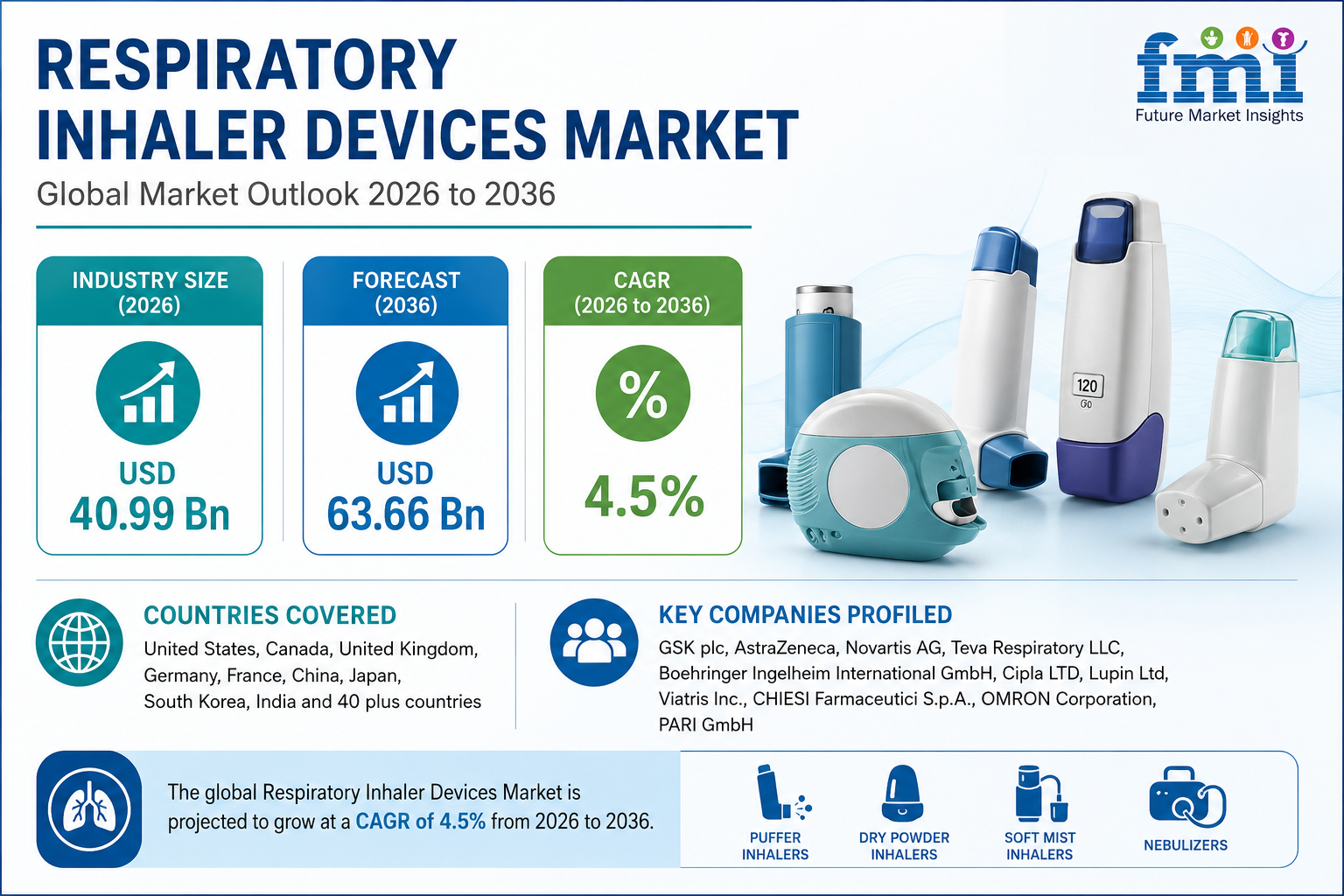
NEWARK, Del. — According to Future Market Insights (FMI), the global respiratory inhaler devices market is projected to grow from USD 40.99 billion in 2026 to USD 63.66 billion by 2036, registering a 4.5% CAGR during the forecast period. Chronic asthma and chronic obstructive pulmonary disease treatment continue to sustain recurring demand for inhalation devices, while improving treatment access in high-population markets such as India and China is expanding prescription volumes.
The market encompasses dry powder inhalers, metered dose inhalers, nebulizers, and soft mist inhalers used across chronic and acute pulmonary care. Established device formats continue to dominate because prescribers and patients are familiar with their use, while digital inhalers and lower-emission formats are creating new avenues for product differentiation.
Get Detailed Market Forecasts, Competitive Benchmarking, and Pricing Trends
Key Market Highlights
- Market Size (2026): USD 40.99 billion
- Forecast Value (2036): USD 63.66 billion
- CAGR (2026–2036):5%
- Leading Product: Metered Dose Inhalers, with 71.6% share in 2026
- Leading Drug Class: Short-Acting Beta2 Agonist Inhalers, with 24.4% share
- Leading Technology: Manual Inhalers, with 91.0% share
- Leading Disease Indication: Asthma, with 36.7% share
- Leading Sales Channel: Hospitals, with 34.9% share
- Fastest-Growing Country: India, at 7.2% CAGR
- Second-Fastest-Growing Country: China, at 7.0% CAGR
Global Segment Leaders
Metered Dose Inhalers — 71.6% Share: Metered dose inhalers account for the largest product share in 2026. Their established prescription base, familiarity among prescribers, and continued use for rescue therapy keep the format central to routine airway care.
Short-Acting Beta2 Agonist Inhalers — 24.4% Share: Short-acting Beta2 agonist inhalers lead the drug-class segment as reliever therapy continues to generate substantial demand across large asthma patient populations. Salbutamol-led rescue prescribing keeps the category in frequent hospital and retail circulation.
Manual Inhalers — 91.0% Share: Manual inhalers dominate technology demand because standard non-connected devices continue to account for most global prescription volumes. Digital inhalers are gaining attention in selected programs where adherence tracking and remote monitoring are priorities.
Asthma — 36.7% Share: Asthma represents the largest disease-indication segment. Long-duration treatment and recurring maintenance and rescue therapy keep inhaler refill activity high across adult and pediatric care.
Hospitals — 34.9% Share: Hospitals represent the leading sales channel because acute respiratory episodes and specialist reviews frequently influence initial device selection and subsequent therapy changes.
Country-Level Performance
- India – 7.2% CAGR (2026–2036): Rising inhaler access across hospital and retail channels and growing asthma and COPD treatment.
- China – 7.0% CAGR (2026–2036): Improving diagnosis rates, retail penetration, and respiratory therapy access.
- South Korea – 6.6% CAGR (2026–2036): Organized respiratory care and increasing inhaled-therapy use.
- France – 4.5% CAGR (2026–2036): Specialist prescribing and established retail access.
- Italy – 3.7% CAGR (2026–2036): Stable outpatient asthma and COPD treatment.
- Japan – 3.2% CAGR (2026–2036): Mature clinical pathways and continued prescription use.
- United States – 1.7% CAGR (2026–2036): Replacement-led demand and strong generic competition.
India is projected to record the fastest growth among the countries profiled, advancing at a 7.2% CAGR through 2036. FMI attributes the expansion to rising asthma and COPD treatment demand, hospital expansion, and widening access to inhaler-based therapy through hospital and retail channels.
China follows at 7.0% CAGR, supported by improving diagnosis, stronger retail-channel penetration, and a wider treated population. South Korea is expected to expand at 6.6%, with organized treatment channels supporting increased use of inhaled therapies.
France is projected to grow at 4.5%, while Italy and Japan record 3.7% and 3.2%, respectively. The United States trails the countries profiled at 1.7% CAGR, reflecting market maturity, replacement-led demand, and strong generic competition.
Market Drivers, Restraints and Opportunities
Long-term asthma and COPD treatment provides the respiratory inhaler devices market with a recurring demand base. Patients frequently require inhaled maintenance and rescue therapies over extended periods, supporting repeat prescriptions and device replacement across hospitals and pharmacy networks.
Metered dose inhalers benefit from a large installed base and long-standing prescribing familiarity. This familiarity supports stable use across established respiratory treatment pathways even as newer technologies enter the market.
Generic competition and reimbursement controls remain restraints, particularly in mature prescription markets. Pricing pressure limits premium retention across standard inhaler lines, while incorrect inhaler technique can reduce treatment effectiveness and weaken outcomes.
Product innovation provides an opportunity for higher-value growth. Digital inhalers can support adherence tracking and remote monitoring, while patient-friendly formats and lower-emission inhalers are creating additional differentiation. Soft mist inhalers are also gaining attention because lower propellant pressure and easier inhalation can support maintenance therapy.
The report identifies mesh nebulizers as another area of opportunity, with their portable size and quiet operation supporting home-based therapy and pediatric applications.
Competitive Landscape
The respiratory inhaler devices market is moderately concentrated around companies with established respiratory franchises, extensive prescribing relationships, and broad therapy portfolios.
GSK plc and AstraZeneca hold strong positions through deep respiratory portfolios and long-standing prescriber familiarity. Boehringer Ingelheim International GmbH maintains strength in COPD treatment, while Teva Respiratory LLC and Viatris Inc. compete through familiar inhaler formats and value-oriented access. Cipla Ltd. and Lupin Ltd. support expansion in cost-sensitive markets through broad respiratory portfolios.
Device specialists including OMRON Corporation and PARI GmbH compete in nebulizer systems and home-care applications. CHIESI Farmaceutici S.p.A. adds inhaler expertise through pressurized inhaler development and work associated with propellant transition. Other companies profiled by FMI include Novartis AG and Koninklijke Philips N.V.
Entry barriers remain significant because new inhaler formats require regulatory approval, reliable dose delivery, physician confidence, and patient training. Climate-related pressure on propellants is adding another development requirement for pressurized inhaler manufacturers.
Key Industry Developments
- October 2025: AeroRx Therapeutics announced a USD 21 million Series A financing to support late-stage development of a nebulized LABA/LAMA therapy for COPD.
- December 2025: CHIESI UK and Ireland submitted beclometasone using a next-generation propellant to the MHRA as part of its lower-emission pressurized inhaler program.
- January 2026: Kinaset Therapeutics announced the closing of a USD 103 million Series B financing to advance an inhaled therapeutic candidate for respiratory disease.
Analyst Perspective
Anurag Sharma, Principal Consultant for Healthcare at Future Market Insights, states:
“In respiratory care, device selection depends on intuitive handling and consistent dose delivery. Familiar inhalers therefore remain widely used in asthma and COPD management. Future innovation must improve patient-familiar formats to support adherence and steadier market expansion.”
Report Scope
The Respiratory Inhaler Devices Market is segmented by:
- Product: Dry Powder Inhaler, Metered Dose Inhaler, Nebulizer, Soft Mist Inhaler
- Nebulizer Type: Compressed Air, Ultrasonic, Mesh
- Drug Class: Short-Acting Beta2 Agonist Inhalers, Short-Acting Muscarinic Antagonist, Long-Acting Beta2 Agonist Inhalers, Long-Acting Muscarinic Antagonist, Corticosteroid Inhalers, Combination LABA/LAMA Inhalers, Combination ICS/LABA Inhalers
- Technology: Manual Inhalers, Digital Inhalers
- Disease Indication: Asthma, Chronic Obstructive Pulmonary Disease, Pulmonary Arterial Hypertension, Acute Respiratory Distress, Pulmonary Fibrosis
- Sales Channel: Hospitals, Specialty Clinics, Retail Pharmacy Chains, Online Pharmacies and Mail Order Pharmacies
- Regions: North America, Latin America, East Asia, South Asia and Pacific, Western Europe, Eastern Europe, Middle East and Africa
- Forecast Period: 2026–2036
The study covers the United States, Canada, United Kingdom, Germany, France, China, Japan, South Korea, India, and 40+ countries.
Access Full Report: https://www.futuremarketinsights.com/reports/respiratory-inhaler-devices-market
Related Reports:
- https://sites.google.com/view/healthcarewellnessinsights/giant-cell-arteritis-market
- https://sites.google.com/view/healthcarewellnessinsights/intraoperative-neurophysiological-monitoring-electrode-market
- https://sites.google.com/view/healthcarewellnessinsights/healthcare-cybersecurity-market
About Future Market Insights
Future Market Insights, Inc. (FMI) is an ESOMAR-certified market research and consulting firm headquartered in Delaware, USA, with offices in the United Kingdom, the United Arab Emirates and India. FMI delivers syndicated and custom research across food and beverage, healthcare, chemicals, technology, packaging, consumer goods and industrial sectors.
Media Contact
Future Market Insights, Inc.
Email: sales@futuremarketinsights.com
Phone: +1-347-918-3531