

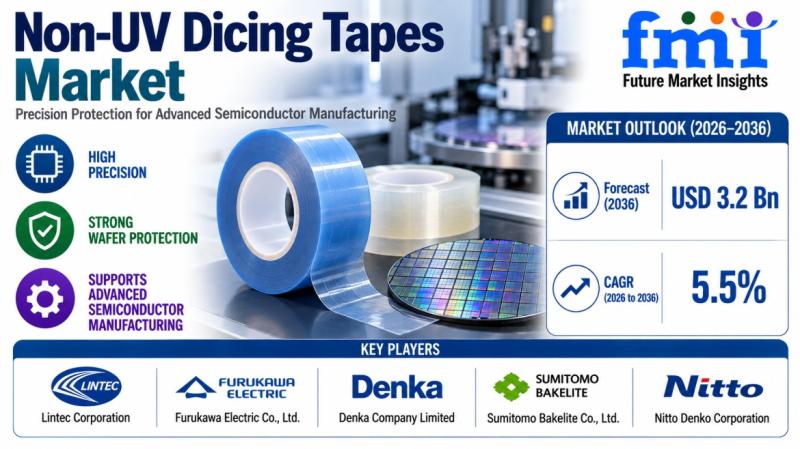
The global non-UV dicing tapes market is projected to grow from USD 1.9 billion in 2026 to approximately USD 3.2 billion by 2036, expanding at a 5.5% CAGR, as semiconductor packaging, wafer dicing, and MEMS manufacturing continue to require controlled wafer handling and consistent adhesive performance.
The market was valued at approximately USD 1.8 billion in 2025 and is expected to create an incremental opportunity of USD 1.33 billion between 2026 and 2036. PVC is projected to account for 50.0% of material-type demand in 2026, while the 85–125 micron thickness category is expected to hold a 45.0% share.
👉 Get Detailed Market Forecasts, Competitive Benchmarking, and Pricing Trends: https://www.futuremarketinsights.com/reports/sample/rep-gb-10866
Why are specification requirements becoming more important for dicing tapes?
Non-UV dicing tapes sit at a critical point in wafer processing: the tape must provide sufficient adhesion during cutting while allowing clean release without compromising the diced components.
That requirement makes material selection and thickness important purchasing variables. PVC remains the leading material because of its established adhesive compatibility and clean-peel performance. The 85–125 micron category also leads thickness demand, reflecting established process specifications across high-volume applications.
Semiconductor packaging is expected to represent 54.0% of application demand in 2026, giving the market a strong connection to advanced electronics manufacturing rather than general-purpose adhesive consumption.
The commercial opportunity therefore depends increasingly on consistency. A lower-cost tape that produces residue, poor die retention, or inconsistent release can create downstream processing costs that outweigh its initial price advantage.
How are manufacturers balancing performance, cost, and compliance?
The market is moving toward a more specification-driven purchasing environment. Manufacturers must balance adhesive performance with raw-material costs, production scale, regulatory requirements, and customer qualification cycles.
This favors established suppliers with validated production processes and long-standing relationships with semiconductor and electronics manufacturers. Lintec Corporation, Furukawa Electric, Denka, Sumitomo Bakelite, and Nitto Denko compete through combinations of material technology, manufacturing scale, application expertise, and geographic reach.
There is also room for specialist suppliers where application requirements become more demanding. Customized thicknesses, adhesive characteristics, and clean-release performance can create opportunities beyond the largest standardized product categories.
Semiconductor manufacturing is creating a quality-versus-cost decision
A key competitive shift is that buyers are increasingly evaluating total process cost rather than tape price alone. Tape performance affects wafer handling, cutting consistency, residue control, die pickup, and production yield.
That creates an advantage for suppliers capable of demonstrating repeatable performance across high-volume manufacturing environments. The ability to maintain specifications while controlling material costs becomes particularly important as semiconductor manufacturers expand production capacity across Asia and other regions.
Analyst perspective
Ismail Sutaria, Principal Consultant at Future Market Insights, says:
“Companies that can improve cost competitiveness while delivering consistent performance in PVC applications are likely to strengthen their position over the forecast period. The ability to scale production while meeting evolving regulatory and specification requirements will separate market leaders from laggards across both established and emerging geographies.”
Non-UV Dicing Tapes Market Snapshot
- Market Size, 2025: USD 1.8 billion
- Market Size, 2026: USD 1.9 billion
- Forecast, 2036: USD 3.2 billion
- CAGR, 2026–2036: 5.5%
- Incremental Opportunity: USD 1.33 billion
- Leading Material: PVC, 50.0%
- Leading Thickness: 85–125 micron, 45.0%
- Leading Application: Semiconductor packaging, 54.0%
- Fastest-Growing Country: South Korea, 5.8% CAGR
Access detailed market insights: https://www.futuremarketinsights.com/reports/brochure/rep-gb-10866
Which countries are positioned for growth?
South Korea is projected to lead country growth at 5.8% CAGR through 2036, followed by the United States at 5.7% and Japan at 5.6%.
South Korea’s position reflects its deep electronics and semiconductor manufacturing base. The United States benefits from established advanced-manufacturing infrastructure and procurement channels, while Japan’s precision manufacturing environment supports demand for specification-controlled materials.
The European Union is projected to grow at 5.5%, matching the global market CAGR, while the United Kingdom is forecast at 5.2%.
The geographic pattern suggests that demand will remain closely tied to semiconductor production ecosystems. Suppliers with regional manufacturing, technical support, and distribution capabilities can reduce qualification and supply risks for customers operating high-value production lines.
What is driving the non-UV dicing tapes market?
Semiconductor packaging demand: Packaging remains the largest application, creating recurring requirements for wafer-processing materials.
Specification upgrades: Semiconductor manufacturers require consistent adhesion, clean peeling, and controlled thickness as process requirements become more demanding.
MEMS manufacturing: Specialized micro-device production creates additional demand for precision handling materials.
Regional capacity expansion: Growth in electronics and semiconductor production supports demand across East Asia and other manufacturing hubs.
Cost optimization: Raw-material volatility is increasing pressure on suppliers to improve production efficiency without sacrificing tape performance.
What are the main constraints?
Input-cost volatility remains a challenge, particularly where PVC and adhesive materials represent a significant portion of manufacturing costs. Price competition can also limit adoption in applications where performance differences are difficult for buyers to quantify.
Qualification requirements create another barrier. Semiconductor manufacturers cannot easily switch critical process materials without validating performance and process compatibility. This protects incumbent suppliers but also lengthens the sales cycle for new entrants.
For emerging suppliers, the opportunity therefore lies in demonstrating measurable process improvements, application-specific performance, or cost savings that justify qualification effort.
About the Non-UV Dicing Tapes Market Report
The Future Market Insights study evaluates the non-UV dicing tapes market by material type, thickness, coating type, application, and region. Applications covered include semiconductor packaging, wafer dicing, and MEMS manufacturing.
The forecast period extends from 2026 to 2036, with more than 30 countries covered across North America, Latin America, Europe, East Asia, South Asia and Pacific, and the Middle East and Africa.