

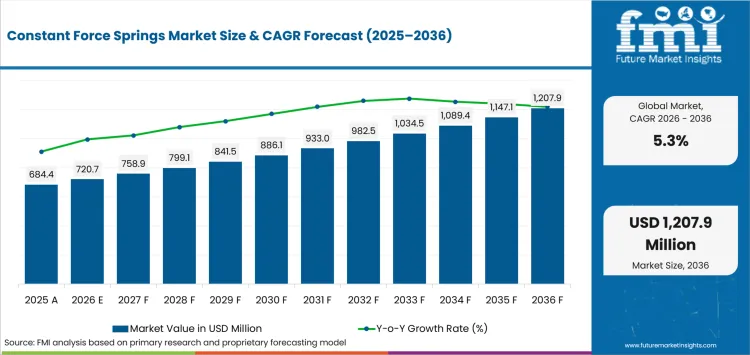
The global Constant Force Springs Market is projected to grow from USD 720.7 million in 2026 to USD 1,207.9 million by 2036, expanding at a 5.3% CAGR during the 2026–2036 forecast period, according to Future Market Insights.
Demand for constant force springs is supported by compact equipment requiring steady pull over long travel without the larger envelope associated with conventional helical springs. Design decisions also depend on material selection, load requirements, fatigue validation, and qualification before springs can be incorporated into production equipment.
Get detailed market forecasts, competitive benchmarking, and pricing trends: https://www.futuremarketinsights.com/reports/sample/rep-gb-35012
Global Segment Leaders
- Standard constant force springs are estimated to account for 34.0% of spring type demand in 2026.
- Stainless steel is projected to represent 46.0% of material demand in 2026, making it the leading material segment.
- Light-load springs are estimated to capture 29.0% of load-range demand in 2026.
Market Growth Drivers
The Constant Force Springs Market is expanding as equipment designers seek compact mechanisms capable of providing steady pull through extended travel. Unlike applications requiring a large helical spring envelope, constant force spring strips can be incorporated into compact equipment where packaging space is constrained.
The expansion of robotic equipment is also increasing the number of mechanisms that engineers need to package within automated systems. The International Federation of Robotics counted 542,000 industrial robot installations in 2024 in its September 2025 release.
Not every industrial robot requires a constant force spring, but the expansion of robotic equipment increases the number of counterbalance and retraction positions that engineers may need to accommodate within compact designs.
Standard Constant Force Springs Support Long-Travel Mechanisms
Standard constant force springs are estimated to account for 34.0% of spring type demand in 2026. Their use is associated with mechanisms that require consistent pulling force through extended travel.
For equipment designers, the ability to package the spring within a compact mechanism can be important where available installation space is limited. Spring selection therefore needs to account for travel requirements, load range, available space, and the operating characteristics of the equipment.
Stainless Steel Leads Material Demand
Stainless steel is projected to represent 46.0% of material demand in 2026. Material selection is an important part of spring design because the spring must maintain its required operating characteristics throughout repeated movement.
Manufacturers and equipment designers can evaluate material alongside fatigue requirements, expected operating cycles, load conditions, and environmental considerations when selecting constant force springs.
Light-Load Applications Drive Load-Range Demand
Light-load constant force springs are estimated to account for 29.0% of load-range demand in 2026. These springs can support compact mechanisms where relatively low pulling force is required over a defined travel distance.
Load-range selection remains closely tied to the mechanism being designed. Engineers must balance the required force with available spring dimensions and the space available within the equipment.
Robotic Equipment Expands Counterbalance and Retraction Requirements
The continued deployment of robotic equipment is expanding the number of automated mechanisms requiring compact movement and positioning solutions. Industrial robots often operate alongside additional equipment and mechanisms that require controlled movement within limited installation space.
The 542,000 industrial robot installations recorded in 2024 demonstrate the scale of the automation equipment base. While this does not mean every robot incorporates constant force springs, expanding robotic deployment increases the number of counterbalance and retraction positions that engineers must package.
Fatigue Validation Shapes Design Decisions
Constant force springs can experience repeated loading and unloading during equipment operation, making fatigue validation an important part of design qualification.
Manufacturers therefore need to evaluate expected travel, load range, operating cycles, and material characteristics before approving a spring for production use. Qualification requirements can also limit design changes once a spring has been validated for a specific application.
Competitive Landscape
Competition in the Constant Force Springs Market centers on spring design, material selection, load range, travel capability, fatigue performance, and dimensional requirements.
Suppliers also compete on their ability to provide springs that fit compact equipment configurations while meeting application-specific qualification requirements. Once a spring has been validated within an established design, fatigue performance and qualification requirements can make switching to an alternative configuration more difficult.
Key Players:
- Hunter Spring
- Vulcan Spring & Manufacturing Company
- John Evans’ Sons
- Ming Tai Industrial Co., Ltd.
- Lee Spring
- MW Components
- Lesjöfors
- KERN-LIEBERS
Get the Complete Story—Read More About Our Latest Report: https://www.futuremarketinsights.com/reports/constant-force-springs-market
Analyst Perspective
“Constant force springs provide equipment designers with a compact way to achieve steady pull over long travel. As robotic and compact equipment deployments expand, material selection, load range, fatigue validation, and qualification remain critical to integrating these springs into reliable mechanisms.”
— Nikhil Kaitwade, Future Market Insights
About Future Market Insights (FMI)
Future Market Insights, Inc. (FMI) is an ESOMAR-certified, ISO 9001:2015 market research and consulting organization, trusted by Fortune 500 clients and global enterprises. With operations in the U.S., UK, India, and Dubai, FMI provides data-backed insights and strategic intelligence across 30+ industries and 1200 markets worldwide.
For Press & Corporate Inquiries
Rahul Singh
AVP – Marketing and Growth Strategy
Future Market Insights, Inc.
+91 8600020075
For Sales: sales@futuremarketinsights.com
For Media: Rahul.singh@futuremarketinsights.com
For Web: Future Market Insights