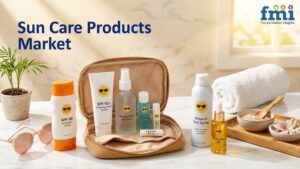


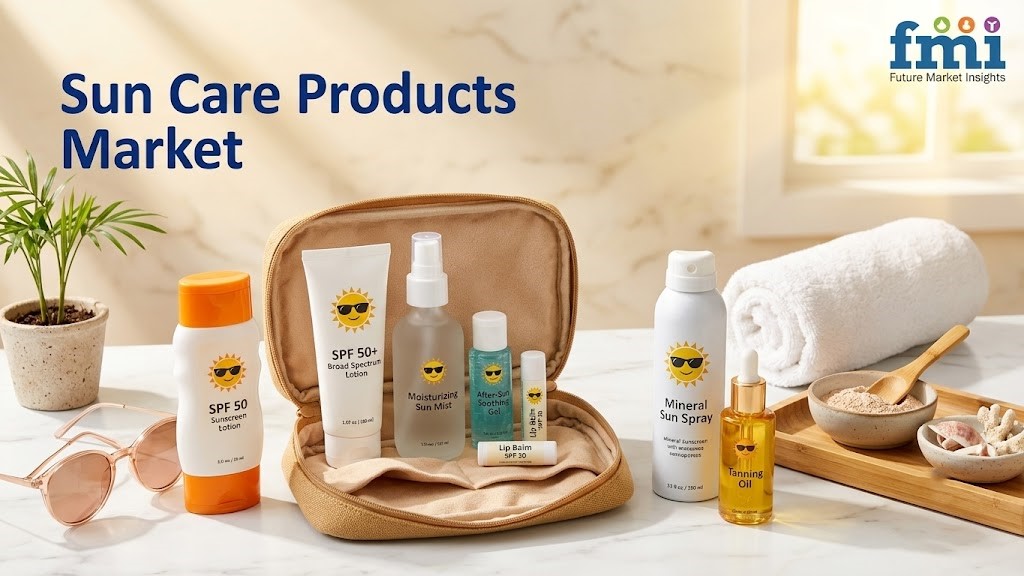
The global sun care products market is projected to expand from USD 14.6 billion in 2026 to USD 22.0 billion by 2036, registering a 4.2% CAGR during the forecast period. Growth is supported by seasonal outdoor buying, rising use of SPF products in everyday skincare routines, and stronger emphasis on product testing and claims governance across major consumer markets.
Demand is also being shaped by changing consumer preferences and retail strategies, with sun protection products remaining the primary volume driver. Medium-priced portfolios are supporting repeat purchases by balancing affordability and brand trust, while offline channels continue to capture significant seasonal demand through supermarkets, pharmacies, specialty beauty stores, and travel-led retail.
Global Segment Leaders
- Product Type – Sun Protection Products: 63.0% share in 2026. The segment leads because sunscreen products remain the primary volume driver in seasonal purchasing, supported by repeat buying and consistent retail planograms.
- Form – Lotion: 48.0% share in 2026. Lotion leads because of mainstream consumer familiarity, broad retailer stocking and efficient shelf execution.
- Price Range – Medium: 52.0% share in 2026. Medium-priced products balance affordability and brand trust while supporting repeat purchases across seasonal promotion cycles.
- Consumer Group – Women: 57.0% share in 2026. Women account for the largest share of purchases, reflecting stronger category participation and multi-SKU basket behavior in personal care and beauty channels.
- Distribution Channel – Offline: 61.0% share in 2026. Offline stores retain leadership because supermarkets, pharmacies, specialty beauty retailers and travel-led stores capture concentrated seasonal demand.
Get detailed market forecasts, competitive benchmarking, and pricing trends: https://www.futuremarketinsights.com/reports/sample/rep-gb-12532
Country-Level Performance
- China – 5.8% CAGR: Growth is supported by offline-to-online category scaling, skincare premiumisation, and wider penetration of protection-led products.
- India – 5.4% CAGR: Expansion is driven by organized retail access, improving product availability, and stronger penetration of branded protection categories.
- Germany – 4.9% CAGR: Growth is supported by strong compliance expectations, replacement-led purchasing, and disciplined retail assortment planning.
- France – 4.5% CAGR: Steady seasonal buying and strong premium portfolio participation support market expansion.
- UK – 4.1% CAGR: Stable category penetration and retailer-led seasonal programs focused on high-velocity sun protection SKUs support growth.
- USA – 3.7% CAGR: Predictable seasonal replacement demand and continued offline-channel strength support expansion, with FDA oversight remaining relevant for OTC sunscreen products.
- Brazil – 3.3% CAGR: Stable seasonal demand and retail-led category presence support growth, alongside technical regulations administered by Anvisa.
Regional Context
China and India form the higher-growth country tier, with CAGRs of 5.8% and 5.4%, respectively. China benefits from expanding offline-to-online category scaling, premiumisation in skincare routines and greater penetration of protection-led lines, while India is supported by organized retail expansion, improving availability and stronger branded sunscreen penetration.
Germany and France occupy the next growth tier, supported by compliance expectations, replacement-led demand, seasonal purchasing and premium portfolio participation. The UK, USA and Brazil show comparatively slower expansion, reflecting mature category penetration, replacement-led cycles and stable seasonal demand. In the United States, FDA oversight remains relevant to OTC sunscreen products, while Brazil’s sunscreen framework includes technical regulations administered by Anvisa.
The full report covers seven regions: North America, Latin America, Western Europe, Eastern Europe, East Asia, South Asia & Pacific, and the Middle East and Africa.
Competitive Landscape
Competition includes global beauty leaders, dermocosmetic-aligned companies and diversified personal care manufacturers. The key companies profiled are L’Oréal Group, Beiersdorf AG (NIVEA), Johnson & Johnson, Edgewell Personal Care, and Shiseido Company. The report states that competitive positioning is increasingly linked to SKU discipline, claims governance, core sun-protection franchises, lotion-focused portfolios, premium extensions and offline-channel execution.
The supplied report page does not list specific dated company developments in a “Key Developments” section. Accordingly, no company event or month/year development has been added.
Explore More Related Studies Published by FMI Research:
https://www.openpr.com/news/4645438/men-s-skincare-products-market-to-reach-usd-52-1-billion-by-2036
https://www.openpr.com/news/4645454/fabric-stain-remover-market-to-reach-usd-19-3-billion-by-2036
Business Impact
FMI helps organizations transform market complexity into strategic clarity, enabling leadership teams to identify growth opportunities faster, optimize resource allocation, strengthen competitive positioning, and make high-stakes business decisions with confidence.
To explore how FMI Custom Research can support your strategic priorities, please connect with our team at – sales@futuremarketinsights.com
About Future Market Insights (FMI)
Future Market Insights, Inc. (FMI) is an ESOMAR-certified, ISO 9001:2015 market research and consulting organization, trusted by Fortune 500 clients and global enterprises. With operations in the U.S., UK, India, and Dubai, FMI provides data-backed insights and strategic intelligence across 30+ industries and 1200 markets worldwide.