

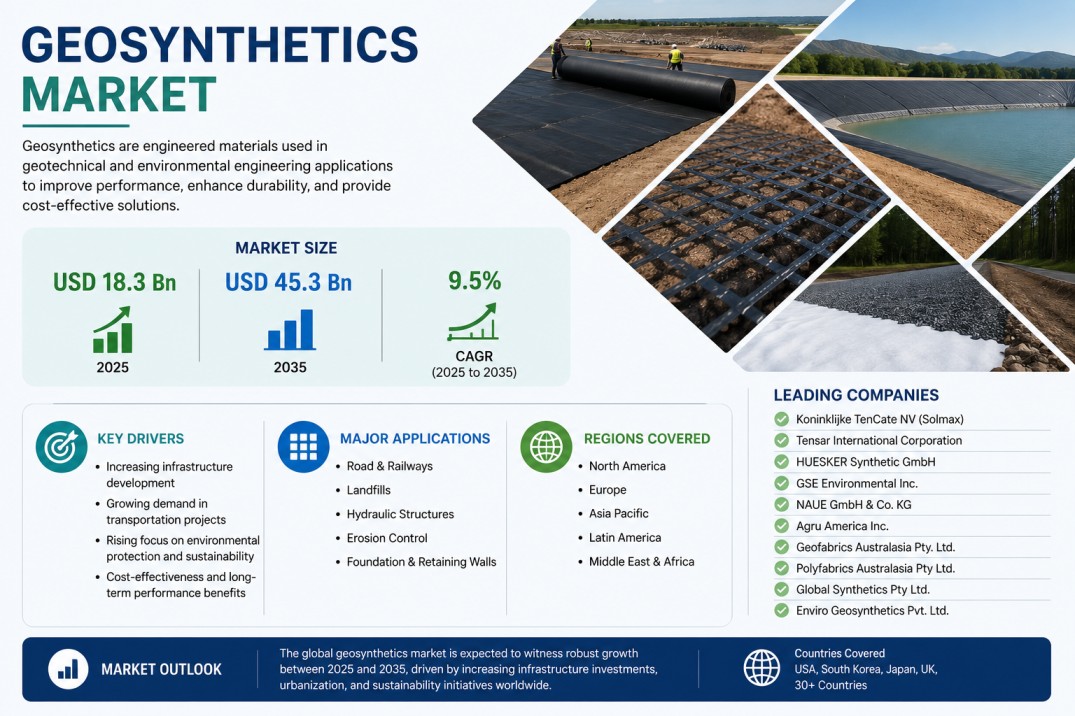
NEWARK, Del., July 16, 2026 — The global Geosynthetics Market is witnessing strong momentum as governments and private infrastructure developers increasingly adopt high-performance engineered materials to improve the durability, sustainability, and cost efficiency of civil engineering projects. According to Future Market Insights (FMI), the market is projected to grow from USD 18.3 billion in 2025 to USD 45.3 billion by 2035, registering a robust 9.5% CAGR during the forecast period. Rising investments in transportation infrastructure, landfill engineering, water management projects, erosion control systems, and environmentally sustainable construction practices are expected to accelerate global market expansion.
The market is expected to generate an absolute dollar opportunity of USD 27.0 billion between 2025 and 2035. Growing demand for durable infrastructure materials, increasing adoption of geosynthetics in road construction, expanding waste containment projects, and stricter environmental regulations continue to strengthen global demand.
Key Geosynthetics Market Highlights at a Glance
- Market Size (2025): USD 18.3 Billion
- Forecast Market Size (2035): USD 45.3 Billion
- Forecast Period: 2025–2035
- CAGR (2025–2035):5%
- Absolute Dollar Opportunity: USD 27.0 Billion
- Leading Product: Geomembranes (31.0% Market Share)
- Leading Material: Polypropylene (47.0% Market Share)
- Fastest-growing Country: USA (10.1% CAGR)
- High-Growth Markets: European Union (9.6% CAGR), South Korea (9.5% CAGR)
- Key Segments Covered: Product Type, Material Type, Primary Application, End Use, Region
- Report Pages: 281
- Last Updated: August 23, 2025
- Reviewed by: Nikhil Kaitwade
Why Is the Geosynthetics Market Growing?
The market is expanding rapidly as infrastructure developers increasingly replace conventional construction materials with engineered geosynthetics that improve structural performance, reduce maintenance costs, and enhance environmental sustainability.
Key Growth Drivers
- Rising investments in transportation infrastructure worldwide.
- Increasing adoption of geosynthetics in road and railway construction.
- Growing landfill lining and waste containment projects.
- Expansion of water management and drainage infrastructure.
- Rising demand for erosion control and slope stabilization solutions.
- Increasing focus on sustainable construction materials.
- Government investments in resilient infrastructure development.
- Growing awareness of long-term lifecycle cost savings.
As infrastructure projects become more complex and sustainability targets become more stringent, geosynthetics continue to gain acceptance across civil engineering applications.
According to Nikhil Kaitwade, Principal Consultant for Chemicals and Materials at Future Market Insights, “Geosynthetics demand is moving closer to long-life infrastructure and environmental protection needs. Suppliers with strong testing standards, local inventory, and application guidance should gain a firmer position across civil engineering projects.”
Which Product Segment Leads the Geosynthetics Market?
Geomembranes remain the leading product segment, accounting for 31.0% of the global market in 2025.
The growing use of geomembranes in landfill liners, mining operations, wastewater treatment facilities, and water conservation projects continues to drive demand due to their superior containment performance and chemical resistance.
Product Segment Highlights
- Geomembranes dominate overall product demand.
- Landfill and mining projects support market growth.
- Excellent barrier performance improves environmental protection.
- Long service life reduces infrastructure maintenance costs.
Why Does Polypropylene Dominate Material Demand?
Polypropylene accounts for 47.0% of material usage owing to its excellent tensile strength, durability, lightweight properties, and cost-effectiveness across diverse infrastructure applications.
The material continues to be widely adopted for geotextiles, geogrids, and drainage systems because of its resistance to chemicals, moisture, and environmental degradation.
Material Segment Highlights
- Polypropylene remains the preferred material.
- High strength supports demanding civil engineering applications.
- Excellent durability extends infrastructure lifespan.
- Cost efficiency encourages widespread adoption.
How Are Infrastructure Projects Driving Market Expansion?
Road construction, railway modernization, landfill development, retaining wall reinforcement, and water management projects continue generating significant demand for geosynthetics worldwide.
End-Use Highlights
- Road construction remains a major demand generator.
- Rail infrastructure modernization supports market expansion.
- Waterworks and wastewater treatment projects increase adoption.
- Landfill and erosion control applications continue growing.
Market Dynamics
Market Drivers
Increasing infrastructure spending, rising environmental protection initiatives, growing landfill construction, expanding erosion control projects, and technological advancements in geosynthetic materials continue driving market growth.
Market Restraints
Volatility in polymer raw material prices, limited awareness in developing economies, project-specific installation challenges, and competition from conventional construction materials continue posing challenges.
Market Trends
Innovation continues reshaping the geosynthetics industry.
Major trends include:
- Development of high-performance engineered geosynthetics.
- Increasing use of natural fiber geotextiles.
- Expansion of sustainable infrastructure projects.
- Smart geosynthetic monitoring technologies.
- Growth of recycled polymer-based products.
- Increasing investment in resilient transportation infrastructure.
Regional and Country Outlook
North America continues to witness strong market expansion, with the USA projected to register the fastest growth at 10.1% CAGR, driven by large-scale infrastructure modernization, transportation investments, and flood protection projects.
The European Union is expected to grow at 9.6% CAGR, supported by stringent environmental regulations, green infrastructure initiatives, and landfill management programs.
South Korea is projected to expand at 9.5% CAGR, benefiting from investments in transportation networks, urban infrastructure, and coastal protection projects.
Asia-Pacific remains a high-growth region as governments continue investing in highways, railways, water infrastructure, and sustainable urban development.
Competitive Landscape
Competition remains moderately consolidated, with leading manufacturers focusing on advanced material innovation, sustainable product development, enhanced durability, technical support services, and strategic expansion of manufacturing capacities.
Key Companies
- TenCate Geosynthetics
- NAUE GmbH & Co. KG
- Solmax
- Officine Maccaferri S.p.A.
- HUESKER Synthetic GmbH
- Tensar International Corporation
- Berry Global Inc.
- AGRU America Inc.
- Propex Operating Company LLC
- Thrace Group
Frequently Asked Questions
- What is the projected size of the Geosynthetics Market by 2035?
The global Geosynthetics Market is projected to reach USD 45.3 billion by 2035, growing from USD 18.3 billion in 2025.
- What is the expected CAGR of the Geosynthetics Market?
The market is forecast to expand at a 9.5% CAGR between 2025 and 2035.
- Which product segment dominates the market?
Geomembranes lead the market, accounting for 31.0% of total demand in 2025.
- Which material type holds the largest market share?
Polypropylene remains the dominant material, accounting for 47.0% of total material usage.
- What factors are driving market growth?
Growing infrastructure investments, increasing road and railway construction, rising landfill and water management projects, expanding erosion control applications, and growing adoption of sustainable construction materials continue driving global market growth.
Related Reports
- The compound semiconductor materials market is estimated at USD 29.9 billion in 2025, expanding to USD 91 billion by 2035 at a CAGR of 11.7% during this period.
- The reinforcement geosynthetics market is anticipated to expand to USD 9.4 billion By 2036 and is expected to register a 10.7% CAGR.
- The Metal Alloys Market is expected to be worth USD 582.93 billion By 2036 and is projected to expand at a CAGR of 4.5%
About Future Market Insights (FMI)
Future Market Insights, Inc. (ESOMAR certified, recipient of the Stevie® Award, and a member of the Greater New York Chamber of Commerce) provides deep insights into governing factors elevating demand in global markets.
FMI delivers market intelligence, consulting services, and syndicated research reports across chemicals, materials, food ingredients, pharmaceuticals, industrial manufacturing, sustainability, advanced materials, and infrastructure sectors.
With global expertise and industry-focused research capabilities, FMI provides actionable insights that help organizations understand market dynamics and identify emerging opportunities.
Contact
Future Market Insights Inc.
Christiana Corporate, 200 Continental Drive, Suite 401, Newark, Delaware 19713, USA
Rahul Singh
AVP – Marketing and Growth Strategy
Future Market Insights, Inc.
Phone: +91 8600020075
For Media: Rahul.Singh@futuremarketinsights.com
Email: sales@futuremarketinsights.com
Website: www.futuremarketinsights.com