

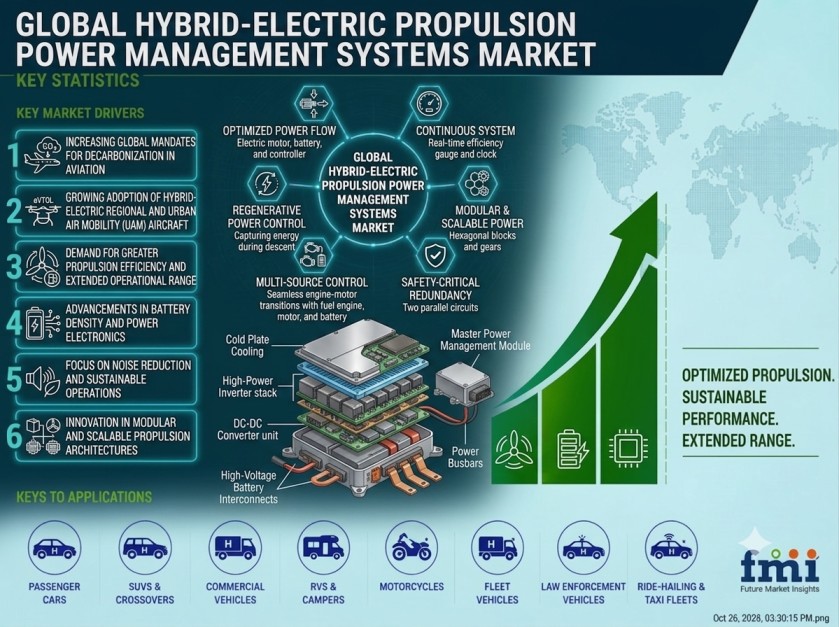
The global Hybrid-Electric Propulsion Power Management Systems Market is projected to grow from USD 338.9 million in 2026 to USD 1.66 billion by 2036, registering a remarkable compound annual growth rate (CAGR) of 17.2% during the forecast period. Rapid advancements in aircraft electrification, increasing investment in hybrid-electric propulsion technologies, and growing certification activity for next-generation aircraft are expected to drive strong market expansion through 2036.
Hybrid-electric propulsion power management systems have become a critical component of future aircraft architectures. These systems intelligently manage power flow between gas turbines, batteries, electric motors, converters, and high-voltage distribution networks, ensuring safe and efficient propulsion during every phase of flight.
As aerospace manufacturers transition from technology demonstrations to full-scale aircraft development, demand for advanced power management solutions capable of delivering reliable, high-voltage energy distribution is accelerating.
Aircraft Electrification Drives Market Growth
The aviation industry is undergoing one of its most significant technological transformations as manufacturers seek cleaner, quieter, and more fuel-efficient propulsion systems.
Hybrid-electric propulsion combines conventional turbine engines with electric motors and battery systems to reduce fuel consumption, lower emissions, and improve operational efficiency. Successfully managing these multiple power sources requires sophisticated power management systems capable of balancing energy flow while maintaining flight safety.
Aircraft manufacturers are therefore investing heavily in integrated electrical architectures that coordinate turbine-generated electricity, battery output, motor performance, and converter operation throughout various flight conditions.
The continued shift toward more-electric aircraft is expected to remain the primary driver of market growth over the next decade.
OEM Integration Dominates the Market
OEM integration is projected to account for 61.8% of the global market in 2026, making it the largest sales channel.
Unlike conventional aircraft electrical systems, hybrid-electric propulsion architectures must be integrated during the earliest stages of aircraft design. Power management software, converters, battery interface units, and high-voltage distribution systems are closely linked with propulsion, flight controls, thermal management, and certification requirements.
Consequently, aircraft manufacturers increasingly collaborate directly with electrical system suppliers to develop customized power management platforms tailored to specific aircraft programs.
Factory integration also simplifies certification while ensuring optimal performance, safety, and long-term reliability.
Regional Aircraft Lead Early Commercial Adoption
Regional aircraft are expected to represent 48.3% of market demand in 2026, positioning them as the leading aircraft platform for hybrid-electric propulsion development.
Short-haul regional routes provide an ideal environment for validating hybrid-electric technologies because they involve shorter flight durations, lower energy requirements, and more predictable operating profiles.
Numerous regional aircraft programs are already progressing from laboratory testing toward full-scale flight demonstrations, creating sustained demand for advanced power management systems capable of safely coordinating turbine and electric propulsion.
The growing number of regional hybrid aircraft demonstrators is expected to accelerate commercial adoption throughout the forecast period.
Turbine-Assist Architectures Gain Momentum
Turbine-assist propulsion systems are projected to account for 46.9% of the market in 2026.
These architectures combine conventional gas turbines with electric motors to improve overall propulsion efficiency while reducing fuel consumption and emissions. Effective management of power transfer between turbines and electric propulsion units is essential to maintaining stable aircraft operation.
Power management systems continuously monitor voltage, current, battery status, and motor demand to optimize energy distribution while preventing overloads or instability during critical flight phases.
As hybrid propulsion technologies mature, turbine-assist configurations are expected to remain the preferred solution for early commercial aircraft deployment.
Certification Progress Strengthens Industry Confidence
Certification activity is playing an increasingly important role in market development.
Aviation regulators are actively establishing certification frameworks covering electric propulsion systems, high-voltage electrical architectures, motor controllers, battery interfaces, converters, and propulsion software.
Recent certification guidance for hybrid-electric propulsion components demonstrates that power management systems are becoming recognized as safety-critical aircraft technologies. Regulatory agencies are placing greater emphasis on fault tolerance, voltage protection, software validation, thermal management, and system redundancy throughout the certification process.
These developments provide electrical system suppliers with clearer regulatory pathways while encouraging greater investment in commercial hybrid-electric aircraft programs.
Technological Innovation Enhances Power Management
Continuous innovation in power electronics is significantly improving hybrid-electric propulsion performance.
Manufacturers are developing lightweight converters, intelligent battery interface units, high-efficiency DC distribution systems, and advanced control software capable of managing megawatt-class electrical loads with exceptional reliability.
Artificial intelligence, predictive diagnostics, digital control algorithms, and real-time energy optimization are also becoming increasingly important as aircraft manufacturers seek to maximize propulsion efficiency while minimizing system weight.
Higher power density, improved thermal management, and enhanced fault detection capabilities are expected to remain major areas of technological development throughout the coming decade.
Government Programs Accelerate Industry Development
Public investment in sustainable aviation technologies continues to support rapid market expansion.
Large-scale hybrid-electric aircraft development initiatives involving government agencies, aerospace manufacturers, research institutions, and technology suppliers are accelerating commercialization efforts worldwide.
Collaborative programs focused on regional aircraft electrification, advanced propulsion architectures, and high-power electric motors are helping validate next-generation technologies while reducing technical and certification risks.
These initiatives are expected to create long-term opportunities for suppliers specializing in aircraft electrical systems, power electronics, battery integration, and propulsion control software.
North America and Europe Lead Global Innovation
The United States is projected to be the fastest-growing national market, recording an impressive CAGR of 20.4% through 2036.
Strong government support for sustainable aviation research, extensive aerospace manufacturing capabilities, defense-funded electrification programs, and ongoing collaboration between aircraft manufacturers and technology providers continue to strengthen the country’s leadership position.
France is also expected to witness substantial growth as major aerospace companies expand investments in electric propulsion systems, aircraft electrical architectures, and certification activities for hybrid-electric aircraft.
Both regions are expected to remain at the forefront of commercial hybrid-electric aviation development over the forecast period.
Competitive Landscape
Competition within the hybrid-electric propulsion power management systems market is centered on technological innovation, certification expertise, electrical integration capabilities, and high-voltage system performance.
Leading aerospace companies are investing heavily in advanced converters, battery interface units, intelligent power distribution systems, propulsion control software, and integrated electrical architectures capable of supporting future hybrid-electric aircraft.
Suppliers with proven experience in aircraft electrical systems, megawatt-class testing, certification documentation, and propulsion integration are expected to secure long-term partnerships with aircraft OEMs developing next-generation hybrid-electric platforms.
Future Outlook
The outlook for the hybrid-electric propulsion power management systems market remains exceptionally strong as commercial aviation accelerates its transition toward sustainable flight technologies.
Increasing aircraft electrification, expanding regional hybrid aircraft programs, growing regulatory support, advances in high-voltage electrical systems, and continued investment in cleaner propulsion technologies will sustain robust market growth through 2036.
As aircraft manufacturers move beyond demonstrator programs toward commercial production, power management systems will become one of the most critical enabling technologies for the future of hybrid-electric aviation.
Browse More Industry Reports
Active Suspension Damper Actuator Systems Market – https://www.openpr.com/news/4573062/active-suspension-damper-actuator-systems-market-to-reach-usd
Drive Mode-Linked Powertrain Actuator Systems Market – https://www.openpr.com/news/4573065/drive-mode-linked-powertrain-actuator-systems-market-to-reach
EGR and Emissions Control Actuator Systems Market – https://www.openpr.com/news/4573078/egr-and-emissions-control-actuator-systems-market-to-reach-usd