

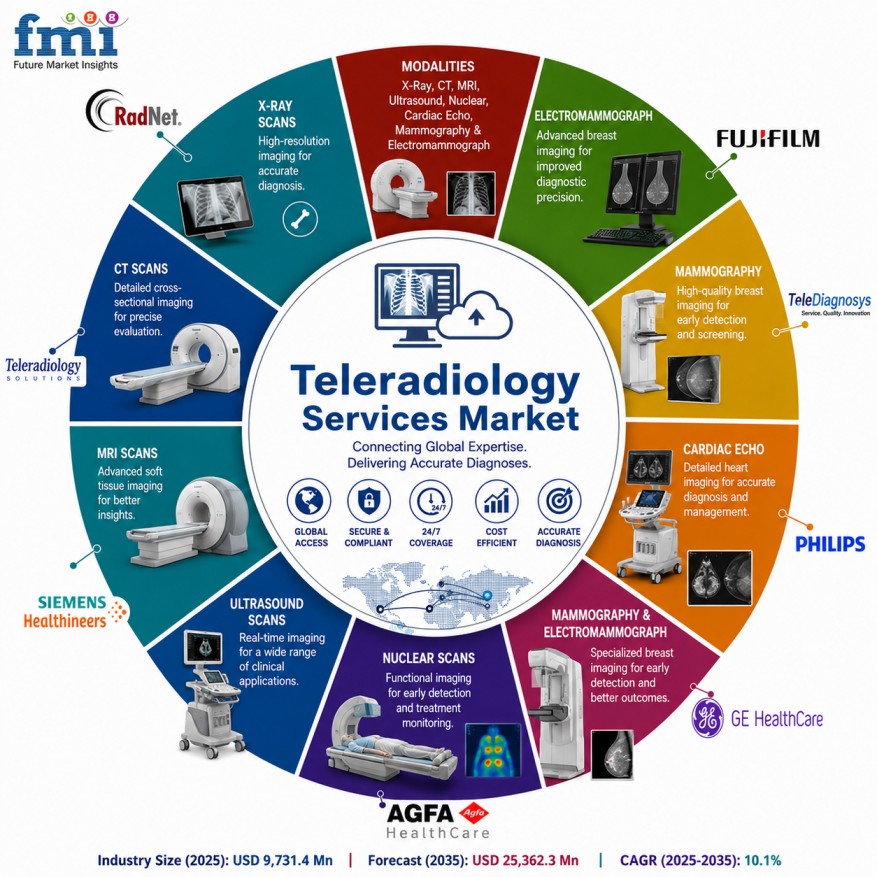
NEWARK, DE, July 8, 2026 – The global Teleradiology Services Market, according to Future Market Insights, is entering a robust growth phase as healthcare providers increasingly adopt AI-assisted radiology interpretation, cloud-based imaging platforms, and remote diagnostic services to improve efficiency and expand access to specialized radiology expertise. The market is projected to grow from USD 9,731.4 million in 2025 to USD 25,362.3 million by 2035, registering a CAGR of 10.1% during the forecast period.
The market is rapidly evolving as hospitals, diagnostic imaging centers, and healthcare networks integrate advanced Picture Archiving and Communication Systems (PACS), cloud-native imaging infrastructure, and AI-enabled workflow automation into routine radiology operations. Rising demand for 24/7 radiology reporting, increasing imaging volumes associated with chronic diseases, and persistent shortages of radiologists are accelerating adoption of outsourced and remote interpretation services.
As healthcare systems place greater emphasis on operational efficiency, diagnostic accuracy, and scalable digital infrastructure, service providers offering integrated AI analytics, secure cloud connectivity, and comprehensive radiology workflow management are expected to strengthen their competitive advantage.
Market Overview
The teleradiology services market has evolved from a simple image transmission model into a sophisticated digital healthcare ecosystem built around AI-powered diagnostics, cloud computing, secure data exchange, and continuous workflow optimization. Market value is increasingly determined by technological capabilities, cybersecurity infrastructure, and access to subspecialty radiology expertise.
The market is forecast to increase from USD 8,894.3 million in 2024 to USD 25,362.3 million by 2035, supported by expanding telehealth adoption, increasing diagnostic imaging volumes, and growing investments in remote healthcare infrastructure.
Unlike conventional radiology services, modern teleradiology requires seamless integration of cloud-based PACS platforms, secure communication networks, AI-assisted reporting tools, and real-time collaboration systems. Consequently, market leadership increasingly depends on providers capable of combining clinical expertise with advanced digital imaging infrastructure and regulatory compliance.
Key Growth Drivers
A primary growth driver is the increasing global demand for AI-assisted radiology interpretation to address growing imaging workloads while improving reporting efficiency and diagnostic consistency.
The rising prevalence of chronic diseases requiring frequent diagnostic imaging is another major factor supporting long-term market expansion. Healthcare providers increasingly rely on remote radiology services to manage growing patient volumes while maintaining rapid turnaround times.
Cloud-based imaging platforms continue to accelerate market growth by enabling secure image storage, remote accessibility, and seamless integration across healthcare networks.
Growing investments in digital healthcare transformation, remote diagnostics, and telemedicine infrastructure are further expanding market opportunities as hospitals seek scalable solutions that improve operational efficiency and patient care.
Technology & Innovation Trends
Innovation within the teleradiology services market is centered around artificial intelligence, cloud-native imaging infrastructure, and advanced workflow automation.
AI-powered diagnostic tools are improving image interpretation accuracy while reducing reporting turnaround times through automated case prioritization and clinical decision support.
Cloud-based PACS platforms are enabling secure, scalable, and real-time access to medical images across geographically distributed healthcare facilities.
Advanced imaging analytics, intelligent workflow orchestration, and automated reporting systems are streamlining radiology operations while improving collaboration between radiologists and healthcare providers.
Emerging technologies such as blockchain-enabled imaging security, federated learning for protected data sharing, and enhanced image processing software are further strengthening diagnostic quality, cybersecurity, and interoperability across healthcare systems.
Market Challenges & Restraints
Despite strong growth prospects, the market continues to face several structural challenges.
One of the most significant barriers is the substantial investment required for implementing secure cloud-based imaging infrastructure, advanced PACS integration, and enterprise-grade cybersecurity systems.
Data privacy regulations, including HIPAA and other regional healthcare compliance requirements, continue to increase operational complexity and infrastructure costs for service providers.
Cybersecurity threats targeting healthcare data remain an ongoing concern, requiring continuous investments in encryption, network monitoring, and secure communication platforms.
Additionally, reimbursement limitations, integration complexities with existing hospital systems, and varying regulatory frameworks across international markets may slow adoption in certain healthcare environments.
Segment Analysis
By Process Type
Cloud-based remote interpretation continues to represent the leading process category, supported by increasing adoption of digital imaging infrastructure and enterprise-wide PACS integration.
Other major process segments include:
- Preliminary Reads
- Final Interpretation
- Consultation Services
By Service
Emergency and after-hours radiology reporting remains a major revenue contributor due to increasing demand for continuous diagnostic support across healthcare facilities.
Other important service segments include:
- Routine Reporting
- Subspecialty Consultation
- AI-Assisted Reporting
By Modality
Computed Tomography (CT) and Magnetic Resonance Imaging (MRI) continue to generate substantial market demand due to their widespread clinical utilization and high interpretation complexity.
Other key modalities include:
- X-ray
- Ultrasound
- Mammography
- Nuclear Imaging
By End User
Hospitals remain the largest end-user segment, supported by growing investments in digital radiology infrastructure and expanding telehealth capabilities.
Other important end users include:
- Diagnostic Imaging Centers
- Specialty Clinics
- Ambulatory Surgical Centers
Regional Analysis
Regional growth continues to be influenced by healthcare digitalization, telemedicine adoption, regulatory support, and investments in advanced imaging infrastructure.
North America remains the largest regional market, driven by widespread adoption of AI-powered radiology platforms, mature telehealth ecosystems, and increasing investments in cloud-based PACS technologies. The United States continues to lead the region with expanding FDA approvals for AI-enabled imaging solutions and growing collaboration between hospitals and teleradiology providers.
Europe maintains strong market momentum through increasing healthcare investments in digital diagnostics, established radiology networks, and expanding government initiatives supporting telemedicine adoption. Germany, France, and the United Kingdom continue to lead regional growth through increasing deployment of AI-assisted workflow automation and secure cross-border image sharing.
The Asia-Pacific region is expected to witness the fastest expansion during the forecast period, supported by increasing healthcare digitalization, growing imaging volumes, expanding government support for telemedicine, and rising investments in cloud-enabled diagnostic platforms across China, India, and Japan.
Competitive Landscape
Competition within the teleradiology services market is intensifying as providers invest in:
- AI-powered diagnostic platforms
- Cloud-native imaging infrastructure
- PACS integration
- Cybersecurity and compliance
- Workflow automation
- Global remote reporting capabilities
As healthcare providers increasingly seek integrated digital radiology solutions rather than standalone interpretation services, vendors offering comprehensive technology platforms alongside clinical expertise are expected to strengthen their competitive positioning.
Leading Companies Analysis
Key market participants include RadNet, Inc., Teleradiology Solutions, Siemens Healthineers, GE Healthcare, and Agfa-Gevaert Group, all of which continue expanding their AI-enabled imaging capabilities, cloud-based platforms, and enterprise radiology workflow solutions.
These companies compete through:
- AI-assisted image interpretation
- Secure cloud imaging infrastructure
- Advanced PACS integration
- Global radiologist networks
- Comprehensive diagnostic workflow solutions
Investment & Strategic Developments
Investment activity across the market is accelerating toward AI-powered diagnostic software, advanced cloud computing platforms, cybersecurity infrastructure, and intelligent workflow management systems.
Healthcare organizations are increasingly investing in remote diagnostic capabilities to improve operational efficiency, reduce reporting delays, and address radiologist shortages through scalable digital solutions.
Strategic partnerships between healthcare providers, technology companies, and imaging platform developers are also expanding to accelerate innovation in real-time image sharing, AI-assisted diagnostics, and secure healthcare data exchange.
Long-term investments remain focused on improving automation, strengthening interoperability, enhancing cybersecurity resilience, and expanding global access to high-quality remote radiology services.
Future Outlook
The teleradiology services market is expected to become increasingly AI-driven and digitally integrated throughout the next decade.
Future growth will be shaped by:
- Expansion of AI-assisted radiology interpretation
- Growing adoption of cloud-based PACS platforms
- Increasing demand for 24/7 remote reporting
- Enhanced cybersecurity and data protection
- Growth in telemedicine and digital healthcare
- Real-time collaborative diagnostic workflows
The industry is expected to continue transitioning toward intelligent imaging ecosystems that combine advanced analytics, secure cloud infrastructure, and specialized clinical expertise to deliver faster, more accurate, and scalable diagnostic services.
Conclusion
The Teleradiology Services Market is rapidly transforming into a technology-driven healthcare segment where artificial intelligence, cloud infrastructure, and advanced workflow automation are redefining remote diagnostic care.
With the market projected to expand from USD 9.7 billion in 2025 to USD 25.4 billion by 2035, long-term growth remains supported by rising imaging demand, expanding telehealth adoption, and continued investments in digital healthcare infrastructure.
Organizations capable of integrating AI-powered diagnostics, secure cloud technologies, comprehensive workflow management, and specialized radiology expertise will be best positioned to lead the next phase of growth in the global teleradiology services market.
FMI Custom Research: Strategic Intelligence for Confident Decision-Making
In today’s rapidly evolving business environment, leadership teams need more than market data—they need clear, actionable intelligence tailored to their strategic objectives. FMI’s Custom Research solutions are designed around the specific business questions organizations need answered, enabling executives to evaluate growth opportunities, validate investments, assess competitive dynamics, and reduce uncertainty before making critical decisions. By combining deep industry expertise, primary research, and proprietary market intelligence, FMI delivers insights that help organizations move from assumptions to evidence-based strategies with greater speed and confidence.
Key Executive Benefits
- Decision-Ready Insights: Research tailored to your specific business challenges, growth plans, and investment priorities.
- Reduced Strategic Risk: Validate market opportunities, customer demand, and competitive positioning before committing resources.
- Market Entry Confidence: Assess opportunity size, regulatory barriers, channel dynamics, and competitive landscapes with precision.
- Competitive Advantage: Gain proprietary intelligence unavailable through syndicated reports or internal datasets.
- Faster Growth Decisions: Accelerate expansion, product development, portfolio optimization, and investment planning.
- Primary Market Validation: Access real-world customer, buyer, and stakeholder insights that support high-confidence decision-making.
- Global Industry Expertise: Powered by 100+ analysts, 20,000+ published reports, and 1.6 million+ hours of research experience.
- Proven Track Record: Over 7,000 market-entry engagements completed across six regions and 14 industry sectors with strong client retention.
Business Impact
FMI helps organizations transform market complexity into strategic clarity, enabling leadership teams to identify growth opportunities faster, optimize resource allocation, strengthen competitive positioning, and make high-stakes business decisions with confidence.
Economics
To explore how FMI Custom Research can support your strategic priorities, please connect with our team at – sales@futuremarketinsights.com
Related Reports:
The digital cytology market is projected to grow significantly from USD 550.4 million in 2025 to USD 3,030.4 million by 2035, registering a robust CAGR of 18.6%.
The Global Telehealth Therapy Services Market is projected to grow from USD 8,824.3 million in 2025 to USD 18,541.2 million by 2035, at a CAGR of 7.7%.
The global 5G remote surgery system market is projected to grow from USD 818.3 million in 2025 to USD 1,371.5 million by 2035, advancing at a CAGR of 5.3%.
About Future Market Insights (FMI)
Future Market Insights (FMI) is a leading provider of market intelligence and consulting services, serving clients in over 150 countries. Headquartered in Delaware, USA, with a global delivery center in India and offices in the UK and UAE, FMI delivers actionable insights to businesses across industries including automotive, technology, consumer products, manufacturing, energy, and chemicals.
An ESOMAR-certified research organization, FMI provides custom and syndicated market reports and consulting services, supporting both Fortune 1,000 companies and SMEs. Its team of 300+ experienced analysts ensures credible, data-driven insights to help clients navigate global markets and identify growth opportunities.
Contact Information
Rahul Singh
Future Market Insights
Newark, Delaware
USA
Telephone: +1-347-918-3531
Email: Email Us Here
Website: Visit Our Website
Blog: Visit Our Blog