


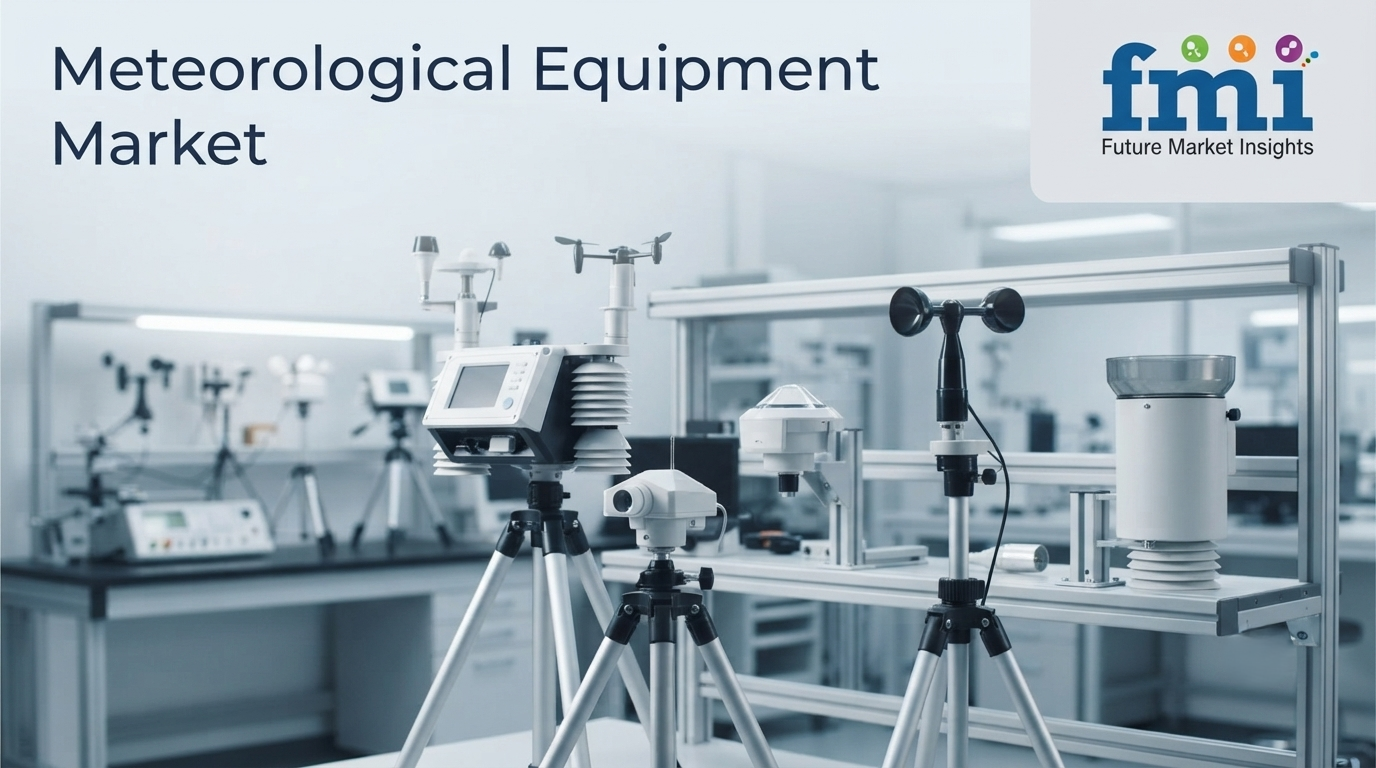
The global Meteorological Equipment Market is entering a new phase of development as weather monitoring evolves from standalone observation systems toward integrated, multi-layered sensing networks. Rather than replacing conventional weather stations, the rapid expansion of IoT-enabled environmental sensors is strengthening the overall meteorological ecosystem by increasing observation density while preserving the role of certified reference stations for high-accuracy applications.
According to FMI, the market is projected to grow from USD 4.3 billion in 2026 to USD 8.0 billion by 2036, registering a compound annual growth rate (CAGR) of 6.5% during the forecast period. Demand continues to be supported by national weather agencies, aviation authorities, research institutions, renewable energy developers, industrial operators, and precision agriculture programs seeking more accurate and localized environmental intelligence.
Market Overview
The meteorological equipment industry is undergoing structural transformation as organizations increasingly require continuous, real-time environmental intelligence across diverse operating environments. While digital connectivity has accelerated deployment of low-cost sensing technologies, traditional meteorological stations continue to serve as the benchmark for forecasting, aviation, climate records, regulatory reporting, and scientific research.
FMI projects the market to expand from USD 4.3 billion in 2026 to USD 8.0 billion by 2036, reflecting a 6.5% CAGR. The growth trajectory is supported by expanding environmental monitoring infrastructure, increasing adoption of automated weather stations, rising investments in renewable energy, and greater demand for localized weather intelligence across agriculture, industrial facilities, and urban planning.
Key Growth Drivers
- Expansion of IoT-connected environmental monitoring networks across agriculture, smart cities, and industrial operations.
- Increasing investment in renewable energy projects requiring site-specific meteorological data.
- Growing demand for automated weather stations supporting aviation, forecasting, and climate monitoring.
- Rising regulatory emphasis on standardized observations, calibration, and quality assurance.
- Higher adoption of cloud-connected weather monitoring platforms enabling real-time analytics and remote management.
- Increasing procurement of specification-compliant meteorological instruments by institutional and industrial buyers.
Technology & Innovation Trends
Digital transformation is reshaping meteorological monitoring through wireless communication, cloud computing, satellite connectivity, edge analytics, and remote sensor management. Modern weather stations increasingly integrate automatic observations with cloud-based dashboards, mobile networks, APIs, and data visualization platforms that improve accessibility for operational decision-making.
The industry is also witnessing broader deployment of distributed sensor networks capable of measuring temperature, humidity, pressure, rainfall, solar radiation, and wind conditions at high spatial resolution. These technologies support precision agriculture, urban climate management, industrial safety, logistics, and renewable energy optimization.
Market Challenges & Restraints
Despite rapid technological progress, maintaining measurement quality remains a critical industry challenge. Higher sensor density does not automatically translate into higher-quality meteorological intelligence if instruments are poorly calibrated, improperly installed, or inconsistently maintained.
Environmental influences including buildings, vegetation, reflective surfaces, local heat sources, airflow disruptions, and equipment degradation can significantly affect measurement accuracy. Low-cost sensors may also experience communication failures, battery limitations, calibration drift, and inconsistent performance over extended operating periods.
Consequently, international observation standards continue to emphasize proper siting practices, calibration procedures, quality management systems, and standardized methodologies. Suppliers must therefore balance affordability and deployment scale with long-term reliability, regulatory compliance, and trusted measurement performance.
Segment Analysis
Instrument demand remains led by anemometers, which are expected to account for 25.0% of total market demand in 2026, reflecting sustained requirements for wind monitoring across aviation, industrial safety, weather forecasting, and renewable energy projects. Wind measurement remains fundamental for operational planning, infrastructure design, and resource assessment.
From an end-user perspective, research institutes represent approximately 20.0% of market demand in 2026, highlighting continued investment in scientific observation, climate research, environmental studies, and atmospheric analysis. National meteorological agencies, airports, industrial operators, renewable developers, and agricultural organizations also continue expanding procurement of automated weather monitoring systems.
Application demand is increasingly diversified across aviation, precision agriculture, hydrological monitoring, urban infrastructure, environmental compliance, renewable energy generation, and distributed industrial monitoring. This broadening customer base is encouraging manufacturers to develop integrated product portfolios that combine certified weather stations, distributed sensing technologies, and centralized cloud-based data platforms.
Regional Analysis
Regional investments continue to prioritize modernization of meteorological infrastructure alongside expansion of localized observation capabilities. Developed economies are strengthening climate monitoring, aviation safety, and forecasting networks through upgraded automated weather stations and standardized observation systems.
Emerging economies are increasingly deploying dense sensor networks to improve agricultural productivity, disaster preparedness, flood monitoring, and urban resilience. India illustrates this trend through expanding automatic weather station and automatic rain-gauge networks that provide real-time rainfall intensity information across major cities while extending monitoring coverage into additional urban regions.
Globally, expanding renewable energy installations, climate adaptation initiatives, and environmental monitoring programs are expected to sustain long-term demand for both reference-grade instrumentation and connected sensor technologies.
Competitive Landscape
Competition is shifting beyond hardware performance toward integrated monitoring ecosystems. Manufacturers increasingly differentiate themselves through calibration services, cloud software, wireless connectivity, predictive maintenance, remote diagnostics, application-specific analytics, and long-term service capabilities.
Market participants offering complete monitoring solutions—including certified automatic weather stations, distributed IoT sensor nodes, centralized dashboards, and standardized data management—are well positioned to address the growing needs of both public-sector and commercial customers.
Leading Companies Analysis
Industry leaders are increasingly pursuing dual-market strategies that combine high-accuracy reference instrumentation with scalable IoT monitoring solutions. Suppliers focused on aviation, national weather services, research institutions, and regulated industries continue competing through measurement precision, compliance, and long-term reliability.
Meanwhile, companies serving agriculture, industrial facilities, smart cities, and renewable energy sectors are emphasizing rapid deployment, wireless communication, cloud integration, remote maintenance, and application-specific analytics. The strongest competitive positioning increasingly belongs to manufacturers capable of bridging these two operating models within a unified technology platform.
Future Outlook
Over the coming decade, meteorological monitoring is expected to become increasingly interconnected, intelligent, and application-driven. Distributed sensing networks will continue expanding across agriculture, renewable energy, logistics, industrial operations, and urban infrastructure, while certified weather stations remain indispensable for climate records, aviation operations, forecasting, and regulatory compliance.
Rather than replacing conventional systems, IoT technologies are expected to enhance observational coverage by creating layered monitoring architectures that deliver both measurement accuracy and localized environmental awareness. This hybrid approach is likely to define the industry’s next phase of innovation and investment.
Related Report:
FMI Custom Research: Strategic Intelligence for Confident Decision-Making
In today’s rapidly evolving business environment, leadership teams need more than market data—they need clear, actionable intelligence tailored to their strategic objectives. FMI’s Custom Research solutions are designed around the specific business questions organizations need answered, enabling executives to evaluate growth opportunities, validate investments, assess competitive dynamics, and reduce uncertainty before making critical decisions. By combining deep industry expertise, primary research, and proprietary market intelligence, FMI delivers insights that help organizations move from assumptions to evidence-based strategies with greater speed and confidence.
Key Executive Benefits
- Decision-Ready Insights: Research tailored to your specific business challenges, growth plans, and investment priorities.
- Reduced Strategic Risk: Validate market opportunities, customer demand, and competitive positioning before committing resources.
- Market Entry Confidence: Assess opportunity size, regulatory barriers, channel dynamics, and competitive landscapes with precision.
- Competitive Advantage: Gain proprietary intelligence unavailable through syndicated reports or internal datasets.
- Faster Growth Decisions: Accelerate expansion, product development, portfolio optimization, and investment planning.
- Primary Market Validation: Access real-world customer, buyer, and stakeholder insights that support high-confidence decision-making.
- Global Industry Expertise: Powered by 100+ analysts, 20,000+ published reports, and 1.6 million+ hours of research experience.
- Proven Track Record: Over 7,000 market-entry engagements completed across six regions and 14 industry sectors with strong client retention.
Business Impact
FMI helps organizations transform market complexity into strategic clarity, enabling leadership teams to identify growth opportunities faster, optimize resource allocation, strengthen competitive positioning, and make high-stakes business decisions with confidence.
To explore how FMI Custom Research can support your strategic priorities, please connect with our team at – sales@futuremarketinsights.com