

Food Emulsifier Selection Is Moving from Ingredient Choice to Application Performance
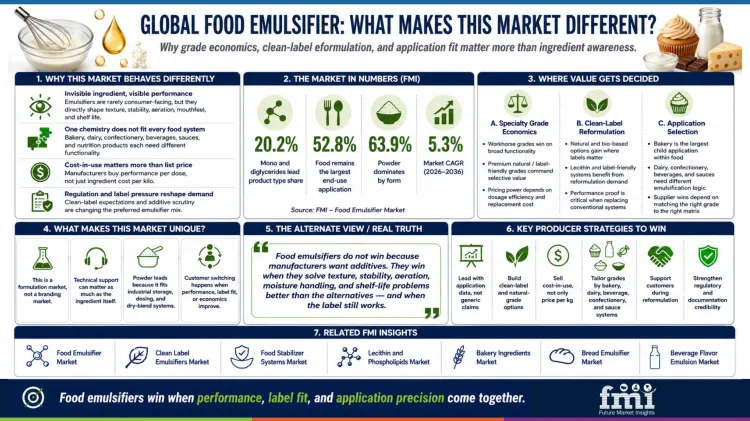
According to the latest insights by Future Market Insights, the global Food Emulsifier Market is becoming increasingly application-driven as manufacturers focus on formulation efficiency, clean-label expectations, cost-in-use economics, and consistent product performance.
Food emulsifier selection is no longer based only on ingredient availability or familiarity. Manufacturers are evaluating emulsifier systems based on how effectively they solve specific formulation challenges.
Key evaluation factors include:
- Functional performance
• Processing compatibility
• Regulatory compliance
• Label expectations
• Supply reliability
• Total formulation economics
Industry experts highlight that emulsifiers are not simple additives. They are formulation tools designed to improve texture, stability, shelf life, and consumer acceptance.
The Same Emulsifier Performs Differently Across Applications
Different food categories require different emulsification strategies.
Bakery products require:
- Softness improvement
• Volume enhancement
• Aeration support
• Anti-staling performance
Confectionery applications require:
- Fat dispersion
• Viscosity control
• Flow improvement
• Processing stability
Dairy and plant-based products require:
- Mouthfeel enhancement
• Emulsion stability
• Fat distribution
• Freeze-thaw resistance
Beverage applications require:
- Suspension stability
• Flavor dispersion
• Cloud control
• Long shelf-life performance
The same emulsifier cannot always deliver identical results across different food systems.
Food Emulsifiers Become Critical Formulation Tools
The food industry has traditionally focused on emulsifiers through product categories such as:
- Mono and diglycerides
• Lecithin
• Sorbitan esters
• Polysorbates
• SSL
• DATEM
• PGPR
• Aerating emulsifier systems
However, the future of emulsifier selection depends on understanding the application challenge rather than choosing ingredients by name.
Manufacturers must identify whether they need to solve:
- Poor dispersion
• Weak aeration
• Texture instability
• Fat separation
• Short shelf life
• Processing inconsistency
The best emulsifier is the one that performs effectively within the complete formulation system.
Bakery Applications Require Texture and Shelf-Life Control
Bakery remains one of the most important application areas for food emulsifiers.
Bread manufacturers use emulsifiers to support:
- Dough handling
• Gas retention
• Loaf volume
• Crumb softness
• Sliceability
• Shelf-life extension
Cake and sweet bakery applications require:
- Batter stability
• Aeration
• Fine crumb structure
• Moisture retention
• Consistent volume
A successful bakery emulsifier system must perform under real production conditions including mixing, proofing, baking, cooling, packaging, and distribution.
Confectionery Needs Precision in Fat and Viscosity Management
Confectionery products follow a different emulsifier selection approach.
Chocolate, coatings, fillings, spreads, and confectionery masses depend on:
- Fat interaction
• Viscosity control
• Flow behavior
• Crystallization management
• Processing efficiency
Emulsifiers such as lecithin and PGPR-type systems can improve processing performance, but the ideal solution depends on:
- Fat composition
• Sugar particle size
• Cocoa solids
• Processing temperature
• Final product requirements
The right emulsifier must support both manufacturing efficiency and sensory quality.
Dairy and Plant-Based Products Increase Formulation Complexity
Dairy and dairy alternative products require advanced emulsifier systems.
Applications such as:
- Ice cream
• Yogurt drinks
• Creamers
• Desserts
• Processed cheese
• Plant-based dairy alternatives
depend on:
- Mouthfeel
• Fat stabilization
• Air incorporation
• Heat stability
• Freeze-thaw performance
Plant-based formulations create additional challenges because emulsifiers often interact with:
- Proteins
• Fibers
• Starches
• Gums
• Oils
An emulsifier system must be optimized for the complete ingredient matrix.
Emulsifier-Stabilizer Systems Gain Importance
Many modern food products do not rely on emulsifiers alone.
Manufacturers increasingly use combined systems involving:
- Emulsifiers
• Stabilizers
• Hydrocolloids
• Proteins
• Fibers
• Starches
The objective is not only to create an emulsion but to achieve:
- Desired texture
• Stable appearance
• Longer shelf life
• Better consumer experience
The future competitive advantage will come from integrated formulation solutions.
Beverage Applications Demand Stability and Consistency
Beverage manufacturers face unique emulsification challenges.
Food emulsions must manage:
- Droplet size
• Sedimentation
• Flavor release
• Cloud stability
• pH variation
• Heat processing
• Storage conditions
A beverage that appears stable during production but separates during transportation or retail storage can negatively impact consumer acceptance.
Therefore, emulsifier selection requires real-world validation.
Processing Validation Becomes a Key Supplier Advantage
Food manufacturers increasingly require more than ingredient supply.
Preferred suppliers provide:
- Application testing
• Pilot trials
• Technical guidance
• Regulatory documentation
• Troubleshooting support
Laboratory results alone may not predict commercial performance.
Processing factors such as:
- Mixing intensity
• Temperature
• Shear conditions
• Line speed
• Packaging
• Storage environment
can influence final product quality.
Clean Label and Regulatory Requirements Shape Market Decisions
Modern food manufacturers must consider:
- Non-GMO requirements
• Allergen considerations
• Vegan expectations
• Organic standards
• Regional regulations
• Consumer label preferences
The best emulsifier is not only technically effective. It must align with:
- Brand positioning
• Consumer expectations
• Regulatory requirements
• Market strategy
Cost-in-Use Becomes More Important Than Ingredient Price
A low-cost emulsifier does not always provide the best value.
A premium emulsifier system may reduce:
- Production losses
• Reformulation needs
• Quality failures
• Shelf-life issues
Manufacturers increasingly evaluate:
- Dosage efficiency
• Processing reliability
• Waste reduction
• Overall production economics
The winning approach is optimizing total cost-in-use rather than selecting the lowest-priced ingredient.
The Future of Food Emulsifier Competition
The future of the Food Emulsifier Market will depend on balancing:
- Functional performance
• Clean-label innovation
• Cost efficiency
• Processing reliability
• Consumer expectations
The strongest suppliers will be those that help manufacturers select, test, and scale emulsifier systems that perform under real production conditions.
Food emulsifiers will continue evolving from basic functional ingredients into strategic formulation solutions that influence texture, stability, and product success.
FMI Custom Research: Strategic Intelligence for Confident Decision-Making
In today’s rapidly evolving business environment, leadership teams need more than market data—they need clear, actionable intelligence tailored to their strategic objectives.
FMI’s Custom Research solutions are designed around the specific business questions organizations need answered, enabling executives to evaluate growth opportunities, validate investments, assess competitive dynamics, and reduce uncertainty before making critical decisions.
By combining deep industry expertise, primary research, and proprietary market intelligence, FMI delivers insights that help organizations move from assumptions to evidence-based strategies with greater speed and confidence.
Key Executive Benefits
- Decision-Ready Insights
• Reduced Strategic Risk
• Market Entry Confidence
• Competitive Advantage
• Faster Growth Decisions
• Primary Market Validation
• Global Industry Expertise
• Proven Track Record
Business Impact
FMI helps organizations transform market complexity into strategic clarity, enabling leadership teams to identify opportunities faster, strengthen competitive positioning, optimize investments, and make confident business decisions.
To explore how FMI Custom Research can support your strategic priorities, connect with our team at: sales@futuremarketinsights.com
Explore More Related Studies Published by FMI Research:
The Bakery Ingredients Market is segmented by Product (Flour, Sweeteners, Fats and Oils, Leavening Agents, Additives and Improvers), Application (Bread, Cakes and Pastries, Biscuits and Cookies, Others), End Use (Commercial Bakeries, Household, Foodservice Industry), Distribution Channel (Direct Sales, Retail Distribution, Online Platforms), Formulation (Conventional Ingredients, Organic Ingredients, Clean Label Ingredients), and Region. Forecast for 2026 to 2036.
Bread Emulsifier Market is segmented by Source (Plant-based Emulsifiers, Animal-based Emulsifiers), Application (Frozen Bread Products, Artisanal Bread Production, Industrial Bread Production, Gluten-free Bread Production), Product Type (Lecithin, DATEM (Diacetyl Tartaric Acid Esters of Mono- and Diglycerides), SSL (Sodium Stearoyl Lactylate), Monoglycerides and Diglycerides, Distilled Monoglycerides, Others), and Region. Forecast for 2026 to 2036.
Bakery Emulsions Market : Global Industry Analysis and Opportunity Assessment, 2035
Activated Cake Emulsifier Market : Global Industry Analysis and Opportunity Assessment, 2036
About Future Market Insights (FMI)
Future Market Insights, Inc. (FMI) is an ESOMAR-certified, ISO 9001:2015 market research and consulting organization, trusted by Fortune 500 clients and global enterprises.
With operations in the U.S., UK, India, and Dubai, FMI provides data-backed insights and strategic intelligence across 30+ industries and 1200 markets worldwide.
Contact Us:
Future Market Insights Inc.
Christiana Corporate, 200 Continental Drive,
Suite 401, Newark, Delaware – 19713, USA
T: +1-347-918-3531
Why FMI: https://www.futuremarketinsights.com/why-fmi
Website: https://www.futuremarketinsights.com