

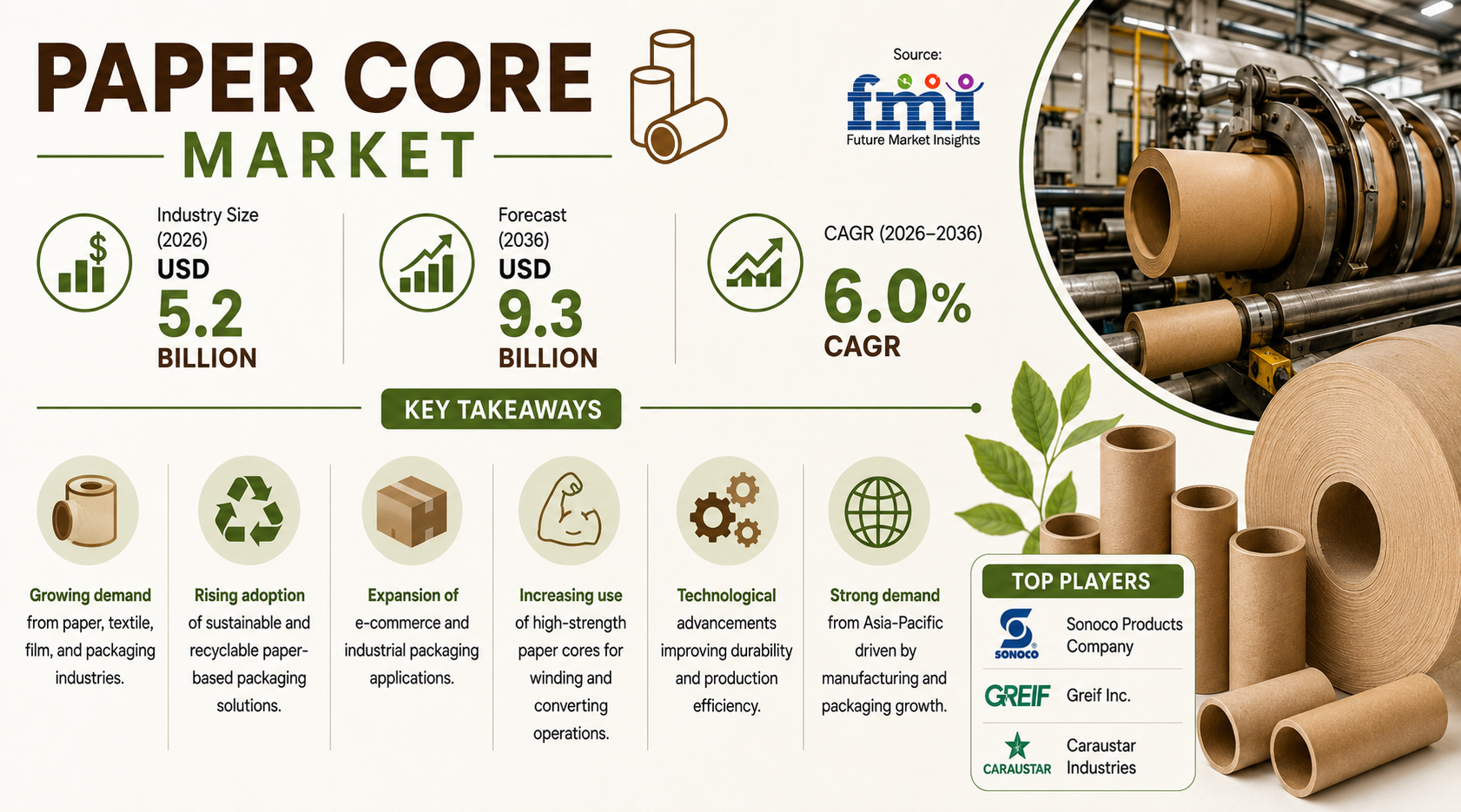
The global paper core market is projected to witness robust growth over the next decade as demand from packaging, paper, textile, film, and industrial manufacturing sectors continues to expand. According to the latest market analysis, the paper core market is estimated at USD 5.2 billion in 2026 and is expected to reach USD 9.3 billion by 2036, registering a CAGR of 6.0% during the forecast period. Despite strong demand fundamentals, the industry faces growing challenges related to kraft pulp price volatility, recovered fiber shortages, rising energy costs, and freight disruptions. These factors are reshaping sourcing strategies, pricing models, and supplier relationships across the value chain. As a result, paper core manufacturers are increasingly focusing on operational efficiency, raw material optimization, and supply chain resilience to maintain profitability and competitiveness.
Featured Snippet: Key Market Answer
Q: What is driving growth in the paper core market?
A: Growth is primarily driven by expanding demand from flexible packaging, paper converting, textiles, aluminum foil, films, and industrial winding applications. Increasing industrial production, rising packaging consumption, and the need for high-performance winding solutions continue to support market expansion. At the same time, manufacturers are investing in cost optimization strategies to manage pulp, energy, and logistics volatility.
Quick Stats of Paper Core Market
- Market Size (2026): USD 5.2 Billion
- Forecast Market Value (2036): USD 9.3 Billion
- CAGR (2026–2036): 6.0%
- Leading Core Type: Spiral Wound Cores (48%)
- Key Growth Regions: Asia Pacific, North America, Europe
- Major Trend: Supply Chain and Cost Optimization
Market Overview: Cost Management Becomes a Strategic Priority
Paper cores serve as essential support and winding structures across numerous industries, including packaging films, paper products, textiles, tapes, labels, aluminum foil, and specialty materials. While demand remains strong, profitability within the sector is increasingly influenced by external factors such as pulp pricing, energy costs, and transportation expenses. many packaging products, paper core manufacturing relies heavily on raw material economics. Virgin and recycled kraft pulp represent the largest share of production costs, making manufacturers particularly vulnerable to fluctuations in global pulp markets. Combined with changing energy costs and logistics challenges, these factors are encouraging companies to adopt more flexible sourcing and pricing strategies.
Key Growth Drivers
- Expanding Flexible Packaging Industry: The growth of flexible packaging continues to generate strong demand for paper cores used in film, laminates, labels, and specialty packaging materials. Increasing consumption of packaged goods worldwide supports sustained demand across this segment.
- Industrial Manufacturing Growth: Paper cores play a critical role in the production and transportation of textiles, tapes, paper rolls, aluminum foils, and industrial materials. Rising industrial output across developing economies continues to strengthen demand.
- Growth in E-commerce and Consumer Packaging: The expansion of e-commerce and consumer goods packaging is increasing demand for packaging materials that rely on paper core solutions during production and distribution processes.
- Technological Improvements in Core Performance: Manufacturers are developing stronger and lighter paper core solutions capable of meeting the requirements of high-speed converting operations, supporting wider adoption across advanced industrial applications.
Market Trends Shaping the Industry
- Rising Importance of Raw Material Management: Kraft pulp accounts for approximately 55% to 70% of variable manufacturing costs, making raw material sourcing a key strategic priority. Manufacturers are increasingly monitoring global pulp markets to manage cost exposure.
- Greater Use of Recycled Fiber: Sustainability initiatives are encouraging greater use of recycled fiber in paper core production. However, variability in fiber quality remains a challenge, particularly for high-performance applications requiring consistent strength characteristics.
- Energy Cost Pass-Through Mechanisms: Energy-intensive manufacturing processes are leading suppliers to implement pricing agreements linked to electricity and fuel indices. These mechanisms help manage cost volatility while improving pricing transparency.
- Shift Toward Regional Supply Networks: Rising freight costs and container imbalances are encouraging converters to source paper cores from regional suppliers. Delivered cost is becoming a more important purchasing factor than production cost alone.
Segment Insights
Spiral Wound Cores Lead the Market
Spiral wound cores are expected to account for approximately 48% of total market demand.
Their popularity is supported by:
- High strength-to-weight ratio
- Cost-efficient production
- Versatility across industries
- Superior performance in winding applications
- Compatibility with high-speed converting equipment
Packaging and Film Applications Dominate Demand
Flexible packaging films, labels, tapes, and specialty materials remain major consumers of paper cores. These industries require high-quality cores capable of maintaining dimensional stability under demanding operating conditions.
Competitive Landscape
The paper core market remains moderately fragmented, with leading companies focusing on product quality, manufacturing efficiency, and supply chain management.
Key market participants include:
- Sonoco Products Company
- Greif Inc.
- Caraustar Industries
- VPK Packaging Group
- Smurfit Kappa Group
- Paramount Tube
- Valk Industries
- Albert Eger GmbH
- LCH Paper Tube and Core
- Rae Products and Chemicals
Competition increasingly centers on raw material sourcing capabilities, energy efficiency, product consistency, and customer service performance.
Expert Insight
The future of the paper core market will depend not only on demand growth but also on manufacturers’ ability to manage increasingly volatile cost structures. Pulp pricing, recovered fiber availability, energy expenses, and freight costs now play a central role in profitability and customer relationships. Companies that successfully balance raw material flexibility, operational efficiency, and supply chain resilience will be better positioned to capitalize on growing demand while maintaining healthy margins. As converters seek reliable partners capable of ensuring consistent quality and stable supply, strategic sourcing and transparent pricing mechanisms are expected to become key competitive advantages.
Conclusion
The paper core market is entering a period of sustained growth supported by expanding packaging, industrial, and converting applications worldwide. However, increasing exposure to pulp, energy, and logistics volatility is reshaping the industry’s economics. With the market forecast to reach USD 9.3 billion by 2036, manufacturers that invest in supply chain optimization, sustainable fiber utilization, and efficient production technologies will be best positioned to strengthen their market presence. As demand continues to rise across Asia Pacific, North America, and Europe, paper core producers will need to combine operational excellence with strategic cost management to remain competitive in the evolving global marketplace.
Related Research Reports
Paper Band Market: The market is set to reach USD 641.8 million by 2026-end and grow at a CAGR of 2.7% between 2026-2036 to reach USD 837.7 million by 2036.
Paperboard Packaging Market: The market is set to reach USD 171.5 billion by 2026-end and grow at a CAGR of 2.7% between 2026-2036 to reach USD 223.9 billion by 2036.
Paper Edge Protector Market: The market is set to reach USD 4.4 billion by 2026-end and grow at a CAGR of 6.0% between 2026-2036 to reach USD 7.8 billion by 2036.
About Future Market Insights (FMI)
Future Market Insights is a leading provider of market intelligence, consulting services, and syndicated research reports. FMI delivers actionable insights across packaging, logistics, industrial manufacturing, food and beverage, healthcare, chemicals, and emerging technologies, helping organizations identify growth opportunities and make informed strategic decisions in rapidly evolving markets.
Contact
Future Market Insights Inc.
Christiana Corporate
200 Continental Drive, Suite 401
Newark, Delaware 19713, USA
Email: sales@futuremarketinsights.com
Website: www.futuremarketinsights.com