

According to the latest insights by Future Market Insights, the global Emergency Medical Services (EMS) industry is undergoing a significant transformation as governments, healthcare providers, and emergency response organizations prioritize rapid intervention capabilities, healthcare accessibility, and disaster preparedness. In 2026, increasing investments in ambulance modernization, digital emergency response platforms, telemedicine integration, and public health resilience programs are strengthening the operational effectiveness of EMS providers worldwide.
Industry analysts note that while emergency response capacity has traditionally focused on ambulance availability and workforce expansion, long-term success is increasingly determined by technological integration, response efficiency, infrastructure readiness, and healthcare system resilience. Organizations capable of balancing operational efficiency with emergency preparedness are expected to achieve a competitive advantage in an increasingly complex healthcare landscape.
Health Emergencies Expose Vulnerabilities in Global Healthcare Supply Networks
Recent public health crises have highlighted the risks associated with concentrated global manufacturing and international dependence for critical healthcare products.
Export restrictions, logistics disruptions, and supply shortages during health emergencies revealed vulnerabilities affecting vaccines, diagnostics, pharmaceuticals, and medical equipment. Many countries experienced delays in securing essential healthcare products as governments prioritized domestic requirements over international commitments.
The experience demonstrated that healthcare resilience depends not only on treatment capacity but also on secure supply chains, emergency response infrastructure, and rapid deployment capabilities.
As a result, governments are increasingly evaluating emergency preparedness through a broader lens that incorporates manufacturing security, emergency response readiness, and healthcare system flexibility.
Domestic Healthcare Manufacturing Strengthens Emergency Response Readiness
Healthcare policymakers increasingly recognize domestic manufacturing as a strategic asset supporting emergency preparedness.
Local production capabilities for vaccines, diagnostics, critical medicines, and emergency medical equipment provide several advantages:
- Faster emergency response deployment
• Reduced dependency on international suppliers
• Greater supply chain visibility
• Enhanced regulatory oversight
• Improved healthcare security during crises
Countries with domestic production capabilities demonstrated stronger resilience during recent public health emergencies, often achieving faster access to critical products than import-dependent markets.
Governments are therefore expanding support for regional healthcare manufacturing ecosystems to strengthen long-term preparedness.
Technology Modernization Becomes a Strategic EMS Priority
Digital transformation is rapidly changing the operational landscape of emergency medical services.
EMS providers are increasingly investing in:
- Real-time dispatch optimization systems
• GPS-enabled ambulance fleet management
• Artificial intelligence-assisted triage solutions
• Telemedicine-enabled emergency consultations
• Electronic patient care reporting platforms
• Drone-assisted medical delivery systems
Advanced communication technologies allow emergency responders to coordinate resources more effectively while reducing response times and improving patient outcomes.
As emergency incidents become more complex, technology integration is becoming a key determinant of operational performance and service quality.
Healthcare Infrastructure Investments Drive Long-Term Market Growth
Healthcare infrastructure modernization remains a critical growth driver across the EMS industry.
Governments and healthcare organizations are expanding investments in:
- Advanced ambulance fleets
• Emergency operations centers
• Rural healthcare accessibility programs
• Critical care transport services
• Disaster response infrastructure
• Mobile emergency healthcare units
Growing urbanization, aging populations, and rising prevalence of chronic diseases continue to increase demand for rapid emergency medical intervention.
The expansion of healthcare infrastructure supports both routine emergency response requirements and large-scale public health emergency preparedness initiatives.
Balancing Resilience and Cost Efficiency Remains a Major Industry Challenge
While domestic manufacturing and expanded emergency preparedness capabilities improve healthcare resilience, they also introduce higher operational and capital costs.
Key challenges include:
- Maintaining underutilized surge capacity during stable periods
• Higher labor and compliance expenses
• Facility modernization requirements
• Workforce training investments
• Stockpile management costs
• Advanced technology deployment expenses
Healthcare systems are increasingly adopting hybrid models that balance global sourcing efficiencies with strategic domestic capacity and emergency preparedness investments.
These approaches seek to optimize healthcare resilience while maintaining sustainable long-term operating costs.
Government Policy Initiatives Accelerate Industry Transformation
Public policy is playing a central role in shaping the future of emergency medical services and healthcare preparedness.
Governments are implementing:
- Strategic medical stockpile programs
• Domestic manufacturing incentives
• Emergency preparedness mandates
• Public-private healthcare partnerships
• Supply chain diversification strategies
• Healthcare infrastructure funding programs
Procurement frameworks are increasingly incorporating supply security and resilience metrics alongside traditional cost considerations.
This shift is fundamentally changing how healthcare organizations evaluate suppliers, manufacturers, and emergency response partners.
Quality and Response Performance Drive Competitive Differentiation
As healthcare systems demand higher standards of emergency care, EMS providers are increasingly focusing on service quality and operational excellence.
Organizations are developing specialized capabilities for:
- Critical care transport
• Trauma response services
• Infectious disease emergencies
• Mass casualty incident management
• Community paramedicine programs
• Integrated telehealth support
Performance metrics such as response time, patient outcomes, operational reliability, and emergency preparedness readiness are becoming key competitive differentiators.
Future Outlook
The future of the Emergency Medical Services industry will be increasingly shaped by healthcare resilience, technological innovation, domestic manufacturing capabilities, and emergency preparedness investments. Governments and healthcare organizations are expected to continue expanding support for strategic healthcare infrastructure, digital emergency response technologies, and resilient supply chains.
Growing concerns regarding infectious disease outbreaks, natural disasters, aging populations, and healthcare accessibility are expected to create substantial opportunities across global EMS markets. Organizations capable of combining rapid response capabilities with advanced technology integration and resilient operational strategies will be best positioned to capitalize on evolving healthcare demands.
As the industry continues to modernize, emergency preparedness, operational excellence, and healthcare system resilience are expected to remain the defining factors driving success in the global Emergency Medical Services market.
Key Takeaways
- Health emergencies continue to expose vulnerabilities associated with concentrated global healthcare manufacturing and international supply dependence.
- Domestic production capabilities improve healthcare security and supply assurance but introduce higher capital and operational costs.
- Global supply chains provide efficiency during stable periods but face significant challenges during demand surges, export restrictions, and logistics disruptions.
- Governments increasingly rely on incentives, stockpiles, and strategic manufacturing programs to balance resilience with economic efficiency.
- Long-term healthcare policy reforms are reshaping procurement strategies, supplier relationships, and manufacturing footprint decisions worldwide.
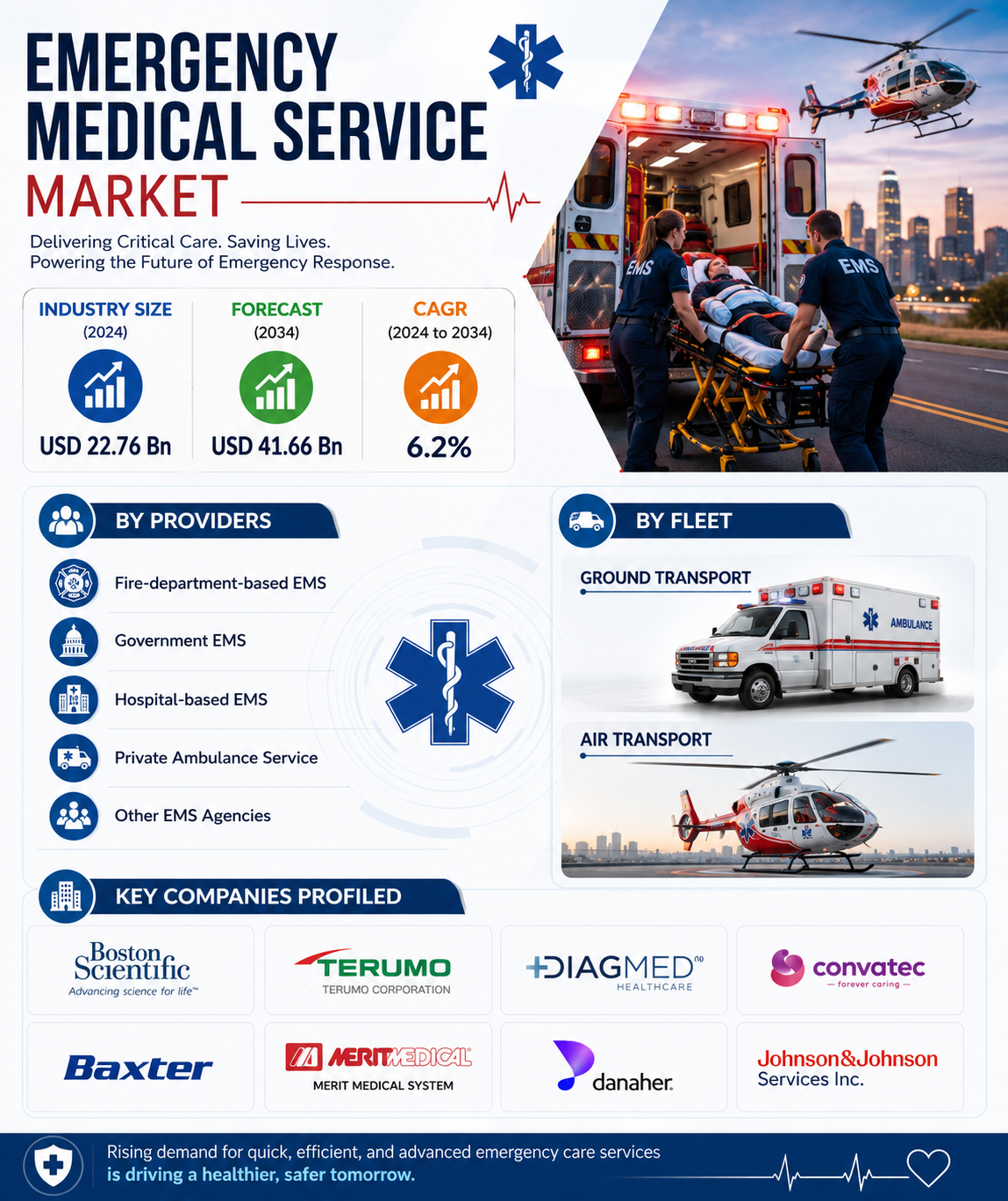
Emergency Medical Service Market Snapshot
| Attributes | Key Insights |
| Estimated Market Size (2024) | USD 22.76 Billion |
| Projected Market Value (2034) | USD 41.66 Billion |
| CAGR (2024 to 2034) | 6.2% |
Related Reports:
- The global Medical Waste Management System Market is projected to grow from USD 9.1 billion in 2025 to USD 17.24 billion by 2035, at a CAGR of 6.6%.
- Manufacturing on Demand for Medical Market is projected to grow from USD 800.00 billion in 2025 to USD 2375.47 billion by 2036, at a CAGR of 10.4%.
- The healthcare cold chain logistics market is projected to grow from USD 65.3 billion in 2025 to USD 154.7 billion by 2035, at a CAGR of 9.0%.
About Future Market Insights (FMI)
Future Market Insights, Inc. (FMI) is an ESOMAR-certified, ISO 9001:2015 market research and consulting organization, trusted by Fortune 500 clients and global enterprises. With operations in the U.S., UK, India, and Dubai, FMI provides data-backed insights and strategic intelligence across 30+ industries and 1200 markets worldwide.
Contact Us:
Future Market Insights Inc.
Christiana Corporate, 200 Continental Drive,
Suite 401, Newark, Delaware – 19713, USA
T: +1-347-918-3531
Why FMI: https://www.futuremarketinsights.com/why-fmi
For Sales Enquiries: sales@futuremarketinsights.com
Website: https://www.futuremarketinsights.com
LinkedIn| Twitter| Blogs | YouTube