

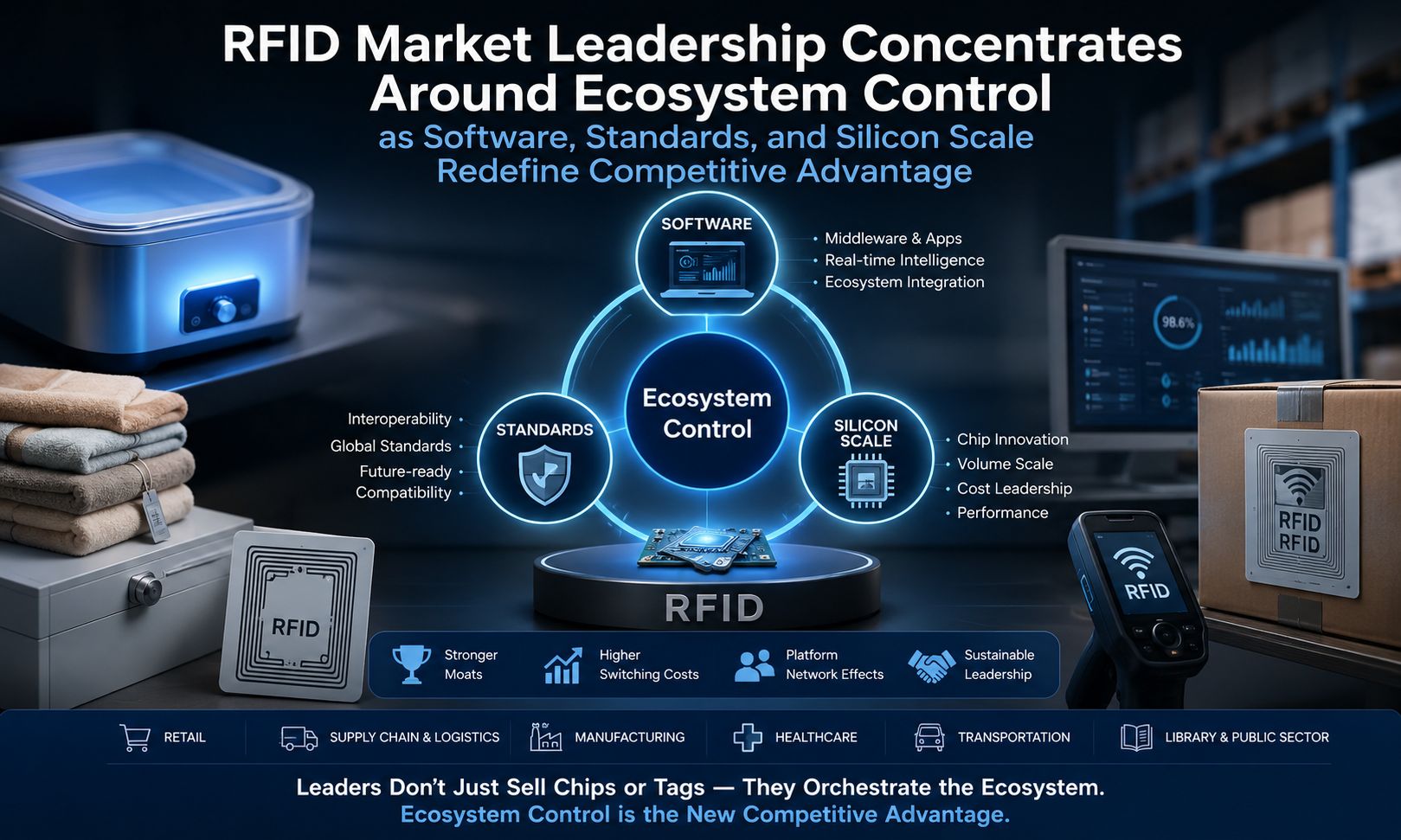
According to the latest analysis by Future Market Insights, the global Radio Frequency Identification (RFID) Market is entering a new phase of strategic consolidation as ecosystem control increasingly determines competitive leadership. While RFID adoption continues to expand across retail, logistics, manufacturing, healthcare, and supply chain operations, market influence is becoming concentrated among a small group of companies capable of controlling tag silicon production, reader infrastructure, software platforms, and standards participation.
The RFID industry has evolved far beyond hardware deployment. Today, enterprises are seeking end-to-end solutions that combine identification technologies with data intelligence, cloud integration, and operational visibility. As a result, leadership is no longer determined solely by reader shipments or hardware sales but by the ability to create integrated ecosystems that generate long-term customer dependence and recurring value.
As deployment complexity increases and enterprise digitization accelerates, companies with control across multiple layers of the RFID value chain are strengthening their market positions while creating significant barriers for emerging competitors.
Quick Market Highlights
- RFID leadership increasingly driven by ecosystem ownership rather than standalone hardware sales
- Growing importance of software platforms, analytics, and enterprise integration capabilities
- Tag IC manufacturing scale emerging as a major source of competitive advantage
- Standards participation influencing interoperability and long-term technology direction
- Strong enterprise preference for end-to-end RFID deployment platforms
- Recurring software and data-service revenues reshaping industry profitability
Ecosystem Control Emerges as a Key Growth Driver
The RFID market is witnessing a structural shift in which ecosystem ownership has become more valuable than individual product leadership.
Enterprise customers increasingly prefer vendors capable of delivering integrated solutions that include tag silicon, readers, middleware, cloud platforms, analytics, and ongoing technical support. This integrated approach simplifies deployment, reduces implementation risks, and improves long-term operational performance.
As RFID deployments expand across complex global supply chains, organizations are prioritizing interoperability, reliability, and scalability. Vendors capable of supporting multinational operations while maintaining technology consistency are gaining a significant competitive edge.
Industry analysts note that ecosystem control is rapidly becoming one of the most important determinants of long-term market leadership and pricing power.
Tag IC Scale Creates a Powerful Competitive Advantage
One of the strongest barriers to entry in RFID remains tag integrated circuit manufacturing.
The economics of RFID tag production favor manufacturers capable of achieving massive production volumes. High-volume fabrication allows companies to reduce per-unit costs, improve manufacturing yields, and continuously invest in next-generation chip architectures.
Large-scale RFID silicon producers benefit from:
- Lower production costs through economies of scale
- Enhanced protocol optimization capabilities
- Continuous investment in research and development
- Improved manufacturing efficiency and yield performance
- Greater flexibility across multiple RFID standards
As global RFID adoption accelerates, manufacturing scale is becoming increasingly important for maintaining profitability while supporting aggressive pricing strategies.
The ability to ship billions of tag ICs annually enables market leaders to strengthen their competitive positions while funding future technology innovation.
Enterprise Infrastructure Drives Adoption Momentum
While tag manufacturing creates scale advantages, reader infrastructure remains essential to enterprise RFID success.
Organizations deploying RFID systems across warehouses, distribution centers, retail environments, and manufacturing facilities require highly reliable infrastructure capable of operating under demanding conditions. Reader performance, durability, and integration capabilities often determine deployment outcomes.
Enterprise customers increasingly evaluate RFID infrastructure based on:
- Operational reliability
- Remote device management capabilities
- Integration with existing enterprise systems
- Global service support
- Long-term scalability
As deployment footprints expand, infrastructure providers that offer comprehensive management platforms are becoming central to enterprise RFID strategies.
The growing complexity of large-scale RFID implementations is creating sustained demand for advanced reader ecosystems that combine hardware, software, and lifecycle support services.
Standards Participation Strengthens Market Leadership
Industry standards continue to play a critical role in shaping RFID competitive dynamics.
Participation in standards organizations allows companies to influence protocol development, certification requirements, and interoperability frameworks that govern future deployments. Early involvement in standards evolution often provides strategic advantages that extend across multiple technology generations.
Key benefits of standards participation include:
- Influence over protocol development
- Early visibility into technology roadmaps
- Faster product alignment with emerging standards
- Improved certification readiness
- Enhanced interoperability across global deployments
As RFID ecosystems become increasingly interconnected, standards governance is emerging as a major factor influencing long-term competitive positioning.
Organizations that actively contribute to standards development are often better positioned to anticipate market shifts and align innovation strategies with future industry requirements.
Software Platforms Drive the Next Wave of Value Creation
The RFID industry is increasingly transitioning from hardware-centric deployments toward software-driven business models.
Modern RFID platforms transform raw identification data into actionable business intelligence, enabling organizations to improve inventory visibility, optimize supply chains, reduce operational inefficiencies, and enhance decision-making processes.
Key technology priorities include:
- Cloud-based RFID management platforms
- Advanced analytics and reporting capabilities
- Machine learning-driven operational insights
- API-enabled enterprise integrations
- Real-time asset tracking and visibility solutions
Software capabilities are becoming a primary source of differentiation as hardware components gradually mature and commoditize.
The ability to convert RFID-generated data into measurable business outcomes is helping platform providers strengthen customer retention while creating recurring revenue opportunities through subscription-based services.
Integration Expertise Remains Critical for Long-Term Success
Despite strong growth prospects, successful RFID implementation requires more than technology investment alone.
Organizations must carefully evaluate integration requirements, deployment complexity, workforce readiness, and operational workflows before initiating large-scale RFID programs. Enterprise deployments frequently involve connections with warehouse management systems, enterprise resource planning platforms, inventory management applications, and custom business processes.
Industry experts emphasize that deployment success increasingly depends on:
- Integration expertise
- System interoperability
- Process optimization
- Workforce training
- Ongoing technical support
As RFID ecosystems become more sophisticated, implementation capabilities are becoming nearly as important as the underlying technology itself.
Competitive Landscape Focuses on Platform Expansion
Competition across the RFID market continues to intensify as leading vendors expand beyond traditional hardware offerings.
Market participants are increasingly investing in:
- Advanced RFID silicon innovation
- Enterprise-grade reader platforms
- Cloud-based software ecosystems
- Analytics and machine learning capabilities
- Global service and support networks
- Industry-specific deployment solutions
Companies capable of delivering complete RFID ecosystems are expected to capture a growing share of enterprise spending as customers prioritize integrated solutions over fragmented technology deployments.
The convergence of hardware, software, data services, and standards influence is creating a new competitive framework that favors comprehensive platform providers.
Outlook: RFID Evolves into a Strategic Enterprise Intelligence Platform
Looking ahead to 2035, RFID is expected to become an increasingly important component of enterprise digital transformation strategies.
As organizations seek greater supply chain visibility, inventory accuracy, asset utilization, and operational efficiency, RFID technologies will continue expanding beyond identification functions toward intelligence-driven business applications.
The next decade is likely to favor companies capable of combining manufacturing scale, standards influence, infrastructure expertise, software innovation, and ecosystem ownership into unified value propositions.
As software, analytics, and cloud integration become central to deployment success, RFID leadership will increasingly be defined not by hardware shipments alone, but by the ability to control the broader ecosystem that powers enterprise visibility and automation.
Related Reports:
- Radio Frequency Identification Market
- Smart Label Market
- Asset Tracking and Inventory Management Solutions Market
Have Specific Requirements or Budget Constraints?
Contact our team for customized insights, pricing assistance, or tailored research solutions.
📧 sales@futuremarketinsights.com
About Future Market Insights (FMI)
Future Market Insights, Inc. (FMI) is an ESOMAR-certified, ISO 9001:2015 market research and consulting organization trusted by Fortune 500 companies and global enterprises. With operations across the U.S., UK, India, and Dubai, FMI delivers data-driven intelligence and strategic insights across 30+ industries and more than 1200 markets worldwide.
Contact Us
Future Market Insights Inc.
Christiana Corporate, 200 Continental Drive,
Suite 401, Newark, Delaware – 19713, USA
T: +1-347-918-3531
Why FMI: https://www.futuremarketinsights.com/why-fmi
For Sales Enquiries: sales@futuremarketinsights.com
Website: https://www.futuremarketinsights.com
LinkedIn | Twitter | Blogs | YouTube