

Global Food Diagnostics Services Market Outlook
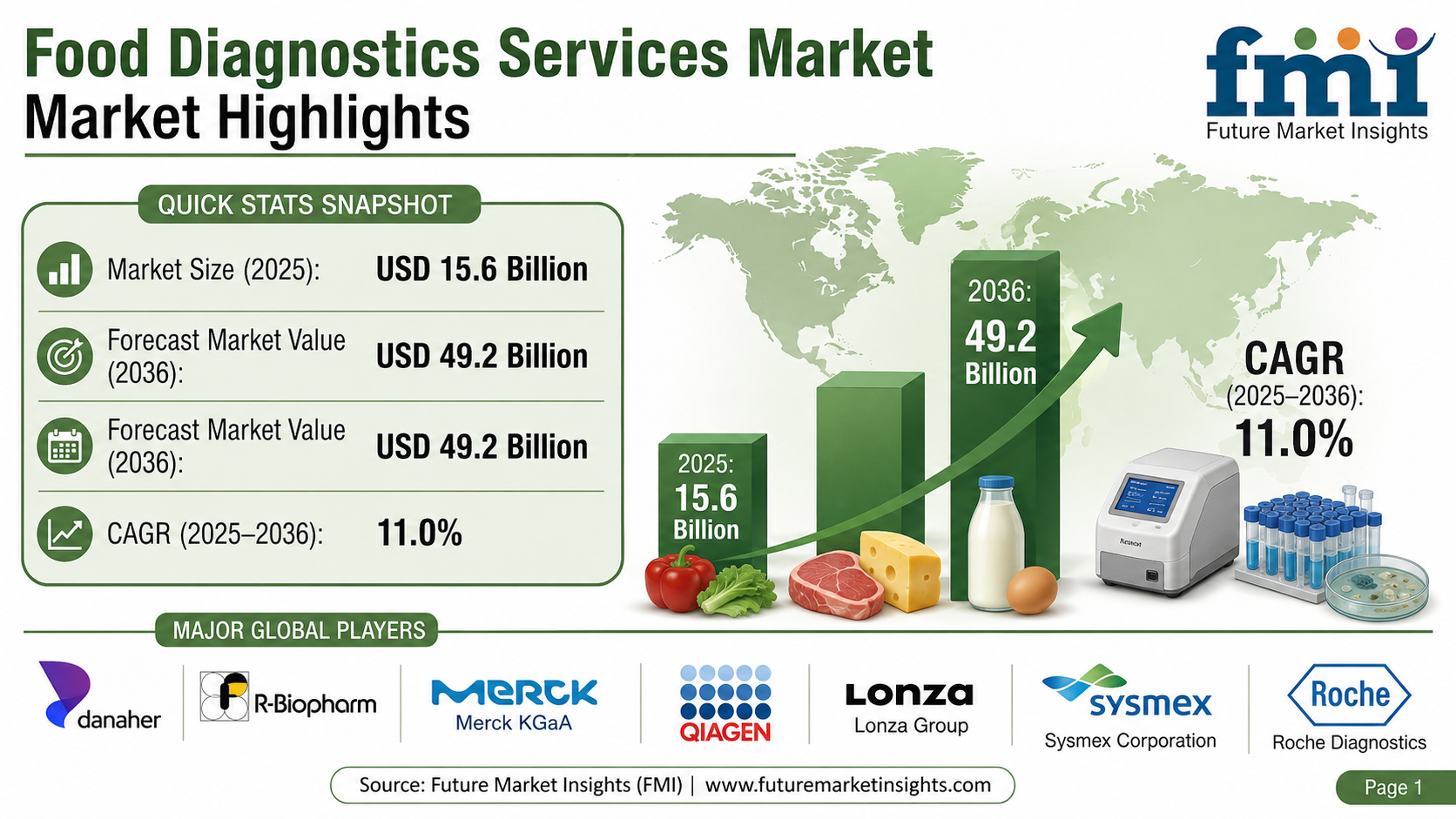
The global food diagnostics services market is entering a transformative growth phase as food manufacturers, regulators, and supply chain operators prioritize proactive food safety and verifiable biosecurity. According to the latest analysis, the market is valued at USD 15.6 billion in 2025 and is projected to reach USD 49.2 billion by 2036, expanding at a CAGR of 11.0%.
The market’s rapid expansion reflects a fundamental shift from traditional compliance-focused testing toward integrated diagnostic ecosystems that combine pathogen detection, traceability, data analytics, and regulatory reporting. As food supply chains become increasingly complex, organizations are investing in advanced diagnostic services to protect brand reputation, ensure regulatory compliance, and strengthen consumer trust.
Featured Snippet: Key Market Answer
Q: What is driving the growth of the food diagnostics services market?
A: Growth is being driven by stricter food safety regulations, increasing consumer demand for transparency, rising foodborne illness concerns, expanding global supply chains, and the adoption of advanced technologies such as PCR testing, Whole Genome Sequencing (WGS), AI-driven analytics, and digital traceability platforms.
Quick Stats of Food Diagnostics Services Market
- Market Size (2025): USD 15.6 Billion
- Forecast Market Value (2036): USD 49.2 Billion
- CAGR (2025–2036): 11.0%
- Leading Technology: PCR-Based Testing (39.0%)
- Leading Application: Food Safety & Quality Control (34.0%)
- Fastest Emerging Trend: Predictive Biosecurity and AI-Driven Diagnostics
Market Overview: The Rise of Verifiable Biosecurity
The food diagnostics services market encompasses testing, monitoring, validation, and analytical services used to detect pathogens, allergens, GMOs, contaminants, and quality parameters throughout the food production lifecycle.
Demand is being reshaped by three major forces:
- Growing regulatory oversight and traceability mandates
- Rising consumer expectations for food transparency and safety
- Rapid advancements in molecular diagnostics and digital food safety testing platforms
Together, these factors are transforming food diagnostics from a periodic compliance requirement into a continuous operational necessity.
Key Growth Drivers
- Increasing Regulatory Scrutiny
Global food safety agencies are implementing stricter compliance standards and traceability requirements.
Regulations such as the FDA’s Food Safety Modernization Act (FSMA) and enhanced outbreak investigation programs are compelling food producers to invest in advanced testing and monitoring services.
- Growing Adoption of Molecular Diagnostics
PCR-based testing remains the dominant technology due to its accuracy, speed, and ability to detect pathogens at low concentrations.
Advanced diagnostic methods are helping manufacturers reduce contamination risks while accelerating product release cycles.
- Expansion of Global Food Supply Chains
International sourcing and distribution networks have increased food safety complexity.
Food diagnostics services help organizations maintain visibility, compliance, and risk control across geographically dispersed operations.
- Consumer Demand for Transparency
Consumers increasingly expect evidence-backed claims regarding food safety, allergen management, and ingredient sourcing.
This trend is encouraging food manufacturers to invest in traceability systems and diagnostic validation programs.
Market Trends Shaping the Industry
Rise of Predictive Biosecurity
Companies are moving beyond contamination detection toward predictive risk management using AI-powered analytics and environmental monitoring systems.
Whole Genome Sequencing (WGS) Adoption
WGS is emerging as a critical tool for outbreak investigation and source attribution, enabling highly precise contamination tracking.
Digital Food Safety Transformation
Organizations are replacing paper-based records with integrated digital platforms that support automated reporting and compliance management.
Traceability as a Competitive Advantage
Food safety data is increasingly being used as a marketing and brand differentiation tool rather than solely for regulatory compliance.
Integrated Compliance Ecosystems
Demand is rising for unified platforms that combine testing, traceability, analytics, and regulatory reporting capabilities.
Segment Insights
Technology Leadership: PCR-Based Testing (39.0%)
PCR-based diagnostics continue to dominate due to:
- High sensitivity and accuracy
- Rapid turnaround times
- Regulatory acceptance across global markets
- Compatibility with pathogen, allergen, and GMO testing workflows
Application Leadership: Food Safety & Quality Control (34.0%)
Food safety and quality control remain the largest application segment because of:
- Regulatory compliance requirements
- Risk mitigation priorities
- Continuous monitoring needs
- Brand protection initiatives
Related Food Diagnostics Segments
Food Pathogen Testing
- Market Value (2025): USD 23.5 Billion
- Forecast Value (2035): USD 55.8 Billion
- CAGR: 8.7%
Growth is supported by increasing concerns over Salmonella, Listeria, and E. coli contamination.
Food Allergen Testing
- Market Value (2025): USD 970.3 Million
- Forecast Value (2035): USD 2.06 Billion
- CAGR: 7.8%
Demand is rising due to stricter labeling regulations and growing consumer awareness of food allergies.
GMO Testing Services
- Market Value (2025): USD 2.81 Billion
- Forecast Value (2036): USD 6.69 Billion
- CAGR: 8.2%
Expansion is driven by mandatory labeling requirements and retailer-led transparency initiatives.
Regional Insights
North America
North America remains a leading market due to:
- Strong regulatory frameworks
- Advanced testing infrastructure
- High adoption of digital compliance technologies
- Significant investment in food safety innovation
Europe
Europe continues to experience robust growth supported by:
- Stringent food safety regulations
- Traceability requirements
- Consumer demand for transparency
- Advanced laboratory networks
Asia-Pacific
Asia-Pacific is expected to witness the strongest long-term growth owing to:
- Rapid industrialization of food production
- Increasing food exports
- Expanding packaged food consumption
- Strengthening food safety regulations
Emerging Markets
Countries including India, China, and Southeast Asian nations are investing heavily in food safety modernization, creating substantial opportunities for diagnostics providers.
Competitive Landscape
The food diagnostics services market is evolving toward integrated technology-driven solutions that combine laboratory expertise with digital compliance and analytics capabilities.
Key Players
- Neogen Corporation
- Thermo Fisher Scientific Inc.
- Mérieux NutriSciences
- SGS SA
- Eurofins Scientific
- Bureau Veritas
- Intertek Group plc
- ALS Limited
- Lineage Logistics
- TÜV SÜD
Competitive Differentiation Factors
- Whole Genome Sequencing capabilities
- Digital traceability solutions
- Compliance automation
- Data integrity and cybersecurity
- Real-time monitoring and analytics
- Global laboratory networks
Recent Developments
- Expansion of Whole Genome Sequencing-based food safety programs
- Increased investment in AI-powered contamination prediction systems
- Growth of digital traceability platforms supporting FSMA compliance
- Strategic acquisitions aimed at building end-to-end food safety ecosystems
- Enhanced integration between laboratory diagnostics and cloud-based compliance platforms
Expert Insight
The food diagnostics services market is entering what can be described as the “Forensic Accountability Era,” where food safety is no longer measured solely by compliance audits but by continuous, verifiable, and data-driven biosecurity.
Organizations that invest in predictive diagnostics, integrated traceability, and advanced analytics will be better positioned to reduce operational risks, strengthen regulatory readiness, and build lasting consumer trust.
FAQs
- What is the future outlook for the food diagnostics services market?
The market is projected to reach USD 49.2 billion by 2036, growing at a CAGR of 11.0% as food safety requirements and traceability standards continue to evolve.
- Which technology dominates the market?
PCR-based testing leads the market with a 39.0% share due to its speed, sensitivity, and broad regulatory acceptance.
- Why are food companies increasing investment in diagnostics services?
Companies are seeking to reduce contamination risks, comply with regulations, improve supply chain transparency, and protect brand reputation.
- What are the key challenges facing the industry?
- Complex regulatory requirements
- Data management and integration challenges
- Rising testing volumes
- Need for real-time traceability
- Cybersecurity and data integrity concerns
- Which regions offer the strongest growth opportunities?
Asia-Pacific offers the highest long-term growth potential, while North America and Europe continue to lead in technology adoption and regulatory-driven demand.
Conclusion
The food diagnostics services market stands at the center of the global food industry’s transformation toward proactive risk management and verifiable biosecurity. As regulations become more stringent and consumers demand greater transparency, advanced diagnostics will become an essential component of food production and supply chain management.
Organizations that embrace predictive testing technologies, integrated compliance systems, and data-driven food safety strategies are expected to gain a significant competitive advantage in the years ahead, positioning food diagnostics services as a cornerstone of the future food ecosystem.
Related Research Reports:
Food Safety Testing Services Market is segmented by Test Type (Microbiological Testing, Allergen Testing, Residue Testing, Chemical & Nutritional Testing), Application (Meat, Poultry & Seafood, Dairy Products, Processed Foods, Beverages, Cereals & Grains), and Region. Forecast for 2026 to 2036.
Food Allergen Testing Market is projected to grow from USD 970.3 million in 2025 to USD 2,062.6 million by 2035, at a CAGR of 7.8%. PCR-based testing is expected to lead the technology segment with a 35.4% share, while processed food is anticipated to lead the application segment with a 28% market share in 2025
About Future Market Insights (FMI)
Future Market Insights is a leading provider of market intelligence, consulting services, and syndicated research reports. FMI delivers actionable insights across food and beverage, consumer goods, healthcare, chemicals, biotechnology, industrial products, and emerging technologies, helping organizations identify growth opportunities and make informed strategic decisions in rapidly evolving markets.
Contact
Future Market Insights Inc.
Christiana Corporate
200 Continental Drive, Suite 401
Newark, Delaware 19713, USA
Email: sales@futuremarketinsights.com
Website: www.futuremarketinsights.com