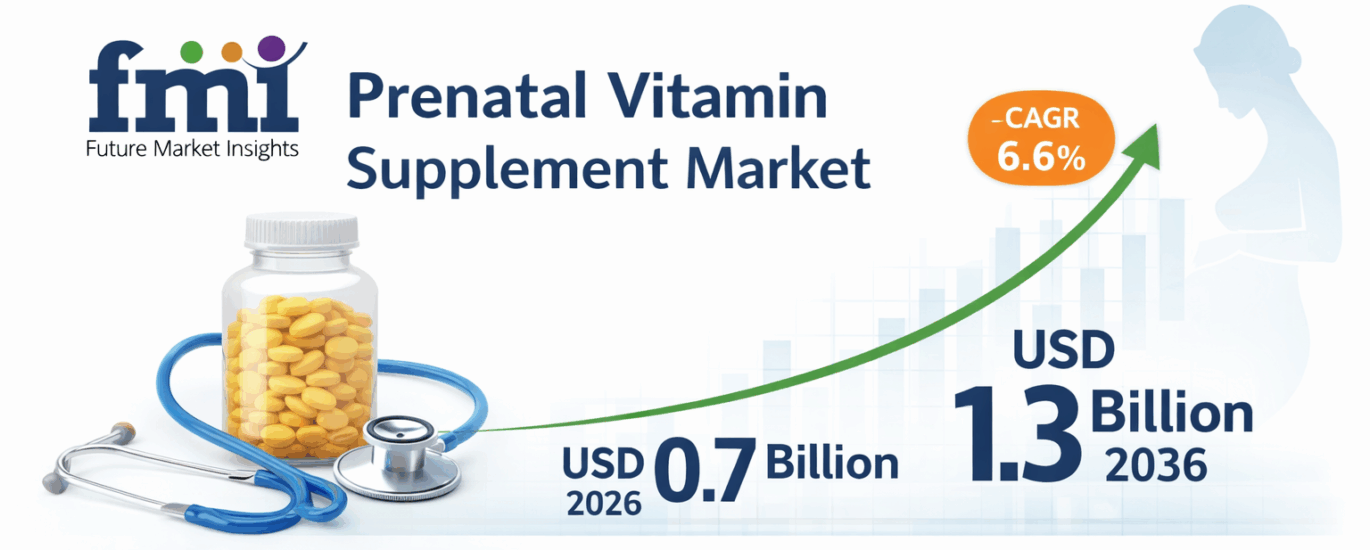
The global prenatal vitamin supplement market is projected to grow from USD 0.7 billion in 2026 to USD 1.3 billion by 2036, registering a CAGR of 6.6% during the forecast period. Growth is being driven by increasing awareness of maternal health, rising focus on personalized nutrition, and growing concerns regarding nutrient deficiencies during pregnancy. The demand for scientifically formulated prenatal supplements is rising as healthcare systems and consumers prioritize improved maternal and fetal outcomes.
The market is also benefiting from increasing clinical evidence highlighting nutritional gaps. Studies indicate that a significant proportion of pregnant women fail to meet recommended intake levels for essential nutrients such as choline and folate. This is driving manufacturers to develop advanced formulations with improved bioavailability and targeted nutrient profiles.
Get detailed market forecasts, competitive benchmarking, and pricing trends: https://www.futuremarketinsights.com/reports/sample/rep-gb-15109
Growing Demand for Personalized and Functional Prenatal Nutrition
The prenatal supplement market is shifting away from generic multivitamins toward stage-specific and personalized nutrition solutions. Consumers are increasingly seeking products tailored to different pregnancy phases, including preconception, trimester-specific, and postnatal recovery formulations.
Manufacturers are integrating AI-driven tracking tools and digital health platforms to improve adherence and optimize nutrient intake. Functional ingredients such as methylfolate, choline, omega-3 fatty acids, and probiotics are being incorporated to address specific maternal and fetal health needs.
Capsules/Tablets and Pharmacies Lead Market Segments
Capsules and tablets are expected to dominate the market, accounting for approximately 45% share, due to their ability to deliver a wide range of nutrients in stable and precise dosages. These formats are preferred for their clinical efficacy and ability to include essential minerals such as iron and folate.
Drug stores and pharmacies are projected to hold around 30% share of the sales channel segment. Consumers rely on these outlets for trusted recommendations and immediate product availability, supported by pharmacist guidance and physician prescriptions.
Speak to Analyst: Customize insights for your business strategy – https://www.futuremarketinsights.com/customization-available/rep-gb-15109
Regional Highlights and Growth Trends
North America is witnessing strong growth driven by clean-label trends, personalized nutrition, and increasing consumer awareness. The United States market is expected to grow significantly, supported by rising maternal health concerns and demand for clinically validated supplements.
Asia-Pacific is emerging as a high-growth region, particularly in countries such as India and China. Rising awareness of nutritional deficiencies, government initiatives, and improving healthcare infrastructure are driving adoption of prenatal supplements in these markets.
Europe remains a steady market, with countries such as Germany and the United Kingdom focusing on organic, plant-based, and sustainable prenatal nutrition products.
Market Trends and Innovation Landscape
Key trends shaping the prenatal vitamin supplement market include increasing demand for clean-label products, expansion into postnatal and lactation support, and the development of advanced delivery formats. Gummy supplements are gaining popularity due to ease of consumption, although capsules remain dominant for nutrient density.
Innovation in fermentation-based nutrients, algae-derived DHA, and plant-based formulations is improving product differentiation. Transparency, third-party testing, and traceable sourcing are becoming critical factors influencing consumer trust and purchasing decisions.
Competitive Landscape
Major companies operating in the prenatal vitamin supplement market include Vitabiotics, Bayer AG, Church & Dwight, Abbott Laboratories, Swisse, Garden of Life, Nordic Naturals, MegaFood, New Chapter, Rainbow Light, SmartyPants, Thorne Research, and Nature Made. These players are focusing on product innovation, clinical validation, and strategic partnerships to strengthen their market presence.
Analyst Outlook
The prenatal vitamin supplement market is expected to witness steady growth through 2036, supported by advancements in nutritional science, rising healthcare awareness, and increasing demand for personalized health solutions. Companies that emphasize clinical efficacy, transparency, and tailored formulations are likely to gain a competitive advantage.
Unlock 360° insights for strategic decision making and investment planning: https://www.futuremarketinsights.com/checkout/15109
Future Opportunities
Future opportunities lie in the development of AI-powered nutrition platforms, expansion into emerging markets, and innovation in functional ingredients. As maternal health becomes a global priority, prenatal supplements are expected to play a critical role in preventive healthcare and long-term wellness strategies.
About FMI
Future Market Insights (FMI) is a globally recognized provider of market intelligence, delivering actionable insights across industries including food and beverage, healthcare, chemicals, and advanced manufacturing. Through a combination of primary research, proprietary data models, and in-depth analysis, FMI empowers business leaders, investors, and policymakers to make informed strategic decisions in an increasingly complex global marketplace.
Contact Us
Future Market Insights Inc.
Christiana Corporate, 200 Continental Drive,
Suite 401, Newark, Delaware – 19713, USA
T: +1-347-918-3531
For Sales Enquiries: sales@futuremarketinsights.com
Website: https://www.futuremarketinsights.com
LinkedIn | Twitter | Blogs | YouTube