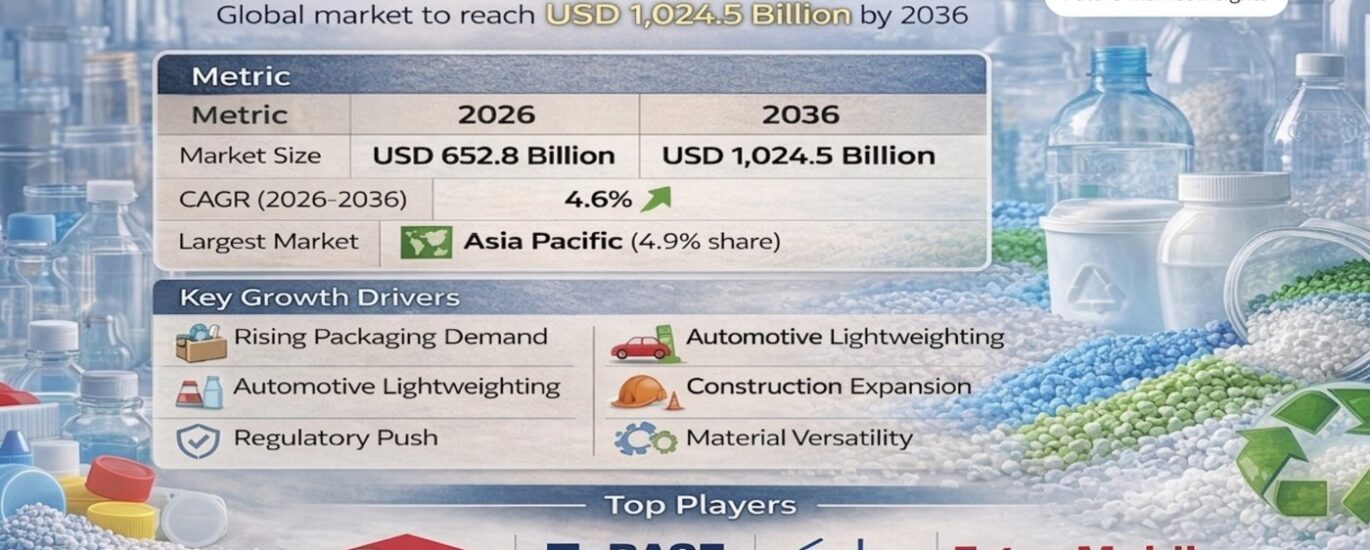
The global plastic market is projected to reach USD 652.8 billion in 2026 and expand to USD 1,024.5 billion by 2036, registering a CAGR of 4.6%. Growth is driven by increasing demand across packaging, automotive, construction, and consumer goods industries, where plastics offer superior design flexibility, durability, and cost efficiency. Regulatory frameworks are playing a critical role in shaping the market, with strong emphasis on chemical safety, environmental protection, and circular economy integration.
Governments worldwide are enforcing strict standards on material safety, particularly for applications involving food contact, healthcare, and consumer products. These regulations ensure plastics meet safety thresholds related to chemical migration, toxicity, and environmental impact.
Key Growth Drivers
- Rising Packaging Demand: Extensive use in food packaging, beverages, and protective materials
- Automotive Lightweighting: Plastics enable fuel efficiency and improved vehicle performance
- Construction Expansion: Increasing use in pipes, insulation, and structural components
- Regulatory Push: Compliance with safety, environmental, and recycling standards
- Material Versatility: High adaptability across multiple industries and applications
Request For Sample Report | Customize Report |purchase Full Report – https://www.futuremarketinsights.com/reports/sample/rep-gb-15157
Market Segmentation Insights
By Application:
- Packaging: 39.2% (dominant segment)
- Automotive: 18.6%
- Construction: 16.3%
- Consumer Goods: 13.8%
- Others: 12.1%
By Material Type:
- Polyethylene: 28.4% (largest share)
- Polypropylene: 23.7%
- Polyvinyl Chloride (PVC): 18.2%
- Polystyrene: 12.9%
- Other thermoplastics: 16.8%
Regional Insights
Asia Pacific leads the global plastic market, driven by strong manufacturing activity in China and India, along with expanding industrial and packaging sectors. North America remains a key market due to advanced production technologies and high consumption across diverse industries. Europe emphasizes sustainability and regulatory compliance, promoting recyclable and eco-friendly plastic materials.
Emerging economies such as Brazil and Southeast Asian countries are witnessing increased demand due to industrial growth, infrastructure development, and rising consumer markets.
Key Trends
- Growing focus on recyclability and circular economy initiatives
- Increased adoption of bio-based and recycled plastics
- Expansion of advanced polymer processing technologies
- Rising demand for high-performance engineering plastics
- Strengthening of global trade and supply chains
Market Challenges
- Volatility in raw material prices (petrochemical feedstocks)
- Environmental concerns related to plastic waste
- Regulatory complexity across regions
- Supply chain disruptions and logistics constraints
Trade & Supply Chain Insights
The global plastic market operates within a highly interconnected trade network. China dominates exports due to large-scale production capacity, while the United States, Germany, South Korea, and Saudi Arabia contribute significantly through advanced polymer manufacturing.
On the import side, China, India, the United States, and Germany are major consumers of specialty plastics. Countries such as Mexico, Vietnam, and other Southeast Asian nations are increasing imports to support manufacturing and export-driven industries. Europe serves as a major logistics hub due to its well-established chemical infrastructure.
Competitive Landscape
The plastic market is highly competitive, with major players focusing on product innovation, quality, and supply chain integration. Leading companies include Dow Chemical Company, BASF SE, ExxonMobil Chemical, SABIC, LyondellBasell Industries, DuPont de Nemours Inc., Formosa Plastics Corporation, and Ineos Group. These companies maintain strong market positions through advanced material development, global distribution networks, and strategic partnerships.
Future Outlook
The plastic market is expected to experience steady growth through 2036, driven by increasing industrial applications and advancements in material science. Sustainability will remain a central focus, with growing adoption of recycled and bio-based plastics to address environmental concerns.
Technological innovation, combined with regulatory alignment and supply chain optimization, will shape the future of the market. Companies investing in sustainable solutions, high-performance materials, and regional expansion strategies will be best positioned to capture emerging opportunities in the evolving global plastic industry.
About Future Market Insights (FMI)
Future Market Insights, Inc. (ESOMAR certified, recipient of the Stevie Award, and a member of the Greater New York Chamber of Commerce) offers profound insights into the driving factors that are boosting demand in the market. FMI stands as the leading global provider of market intelligence, advisory services, consulting, and events for the Packaging, Food and Beverage, Consumer Technology, Healthcare, Industrial, and Chemicals markets. With a vast team of over 400 analysts worldwide, FMI provides global, regional, and local expertise on diverse domains and industry trends across more than 110 countries.
Contact Us:
Future Market Insights Inc.
Christiana Corporate, 200 Continental Drive,
Suite 401, Newark, Delaware – 19713, USA
T: +1-347-918-3531
For Sales Enquiries: sales@futuremarketinsights.com
Website: https://www.futuremarketinsights.com
LinkedIn| Twitter| Blogs | YouTube