

Market Overview: Growth Driven by Sustainability, Plastic Reduction, and Circular Economy Goals
The global molded fiber containers market is witnessing steady and sustainable growth, projected to expand from USD 5.1 billion in 2025 to USD 7.3 billion by 2035, registering a CAGR of 3.7% during the forecast period. This growth reflects a global shift toward eco-friendly packaging solutions, as industries actively move away from single-use plastics and embrace renewable, biodegradable materials.
Molded fiber containers manufactured using recycled paper, cardboard, and natural fibers have emerged as a preferred packaging alternative across industries such as foodservice, electronics, healthcare, and industrial goods. Their compostable nature, low environmental impact, and compliance with evolving regulations are making them indispensable in modern packaging ecosystems.
As governments enforce stricter environmental policies and consumers demand greener solutions, the market is undergoing a transformation driven by innovation in material science, automation, and design flexibility.
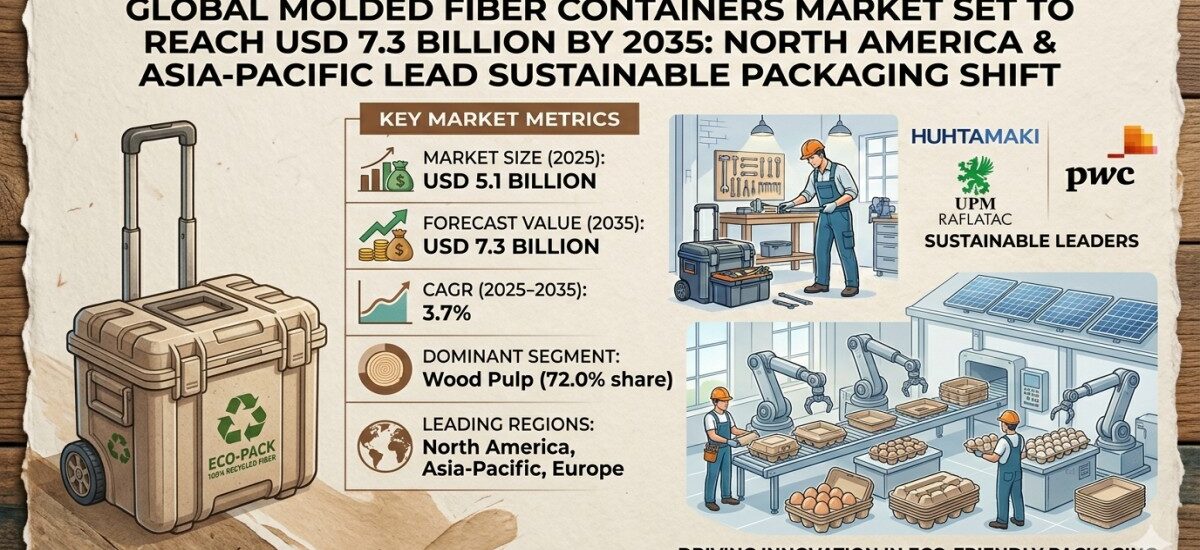
Key Market Metrics
- Market Size (2025): USD 5.1 Billion
- Forecast Value (2035): USD 7.3 Billion
- CAGR (2025–2035): 3.7%
- Dominant Segment: Wood Pulp (72.0% share)
- Leading Regions: North America, Asia-Pacific, Europe
Get detailed market forecasts, competitive benchmarking, and pricing trends:
https://www.futuremarketinsights.com/reports/sample/rep-gb-13486
Key Demand Drivers
- Rising Demand for Sustainable Packaging
Environmental concerns and global initiatives to reduce plastic waste are pushing industries toward molded fiber packaging. These containers are biodegradable, recyclable, and aligned with circular economy principles, making them an attractive solution for eco-conscious brands.
- Regulatory Push Against Single-Use Plastics
Governments across Europe, North America, and Asia-Pacific are implementing bans and restrictions on plastic packaging. This regulatory pressure is accelerating the adoption of fiber-based alternatives, particularly in foodservice and retail sectors.
- Growth of Foodservice and Takeaway Culture
The expansion of quick-service restaurants (QSRs), food delivery platforms, and institutional catering has significantly increased demand for disposable yet sustainable packaging. Molded fiber containers offer thermal insulation, grease resistance, and safety for direct food contact.
- Advancements in Material and Manufacturing Technologies
Innovations in molding precision, drying techniques, and barrier coatings have enhanced product durability, moisture resistance, and visual appeal. These advancements are enabling molded fiber packaging to compete with traditional plastic solutions in performance and aesthetics.
Supply Chain Analysis: Who Supplies Whom
The molded fiber containers market operates through an integrated and sustainability-driven value chain:
- Raw Material Suppliers: Provide recycled paper, wood pulp, and alternative fibers such as bamboo
- Packaging Manufacturers: Convert fibers into molded containers using advanced forming technologies
- Technology Providers: Supply automated molding, drying, and finishing systems
- End Users: Foodservice providers, electronics manufacturers, healthcare companies, and industrial firms
- Recycling & Waste Management Networks: Enable circular lifecycle and reuse of materials
This ecosystem supports scalability, cost-efficiency, and continuous innovation across global markets.
Pricing Trends & Cost Dynamics
- Raw Material Costs: Fluctuations in pulp and recycled paper prices impact production costs
- Automation Efficiency: Advanced machinery reduces labor dependency and improves output
- Premium for Coated Products: Moisture-resistant and high-performance containers command higher pricing
- Sustainability Investment: Eco-friendly materials may have higher upfront costs but deliver long-term environmental and brand value
Segmentation Insights
By Source Type
- Wood Pulp (Leading – 72.0%)
- Non-Wood Pulp (including bamboo and agricultural residues)
Wood pulp dominates due to its strength, availability, and compatibility with various molding processes. Its clean appearance and biodegradability further enhance its adoption across industries.
By Molded Type
- Transfer Molded (Leading – 32.0%)
- Thick Wall
- Thermoformed
- Processed
Transfer molding is gaining traction for its ability to produce high-precision, smooth-surface containers suitable for premium packaging applications.
By Application
- Food Packaging (Leading – 30%)
- Food Service
- Electronics
- Healthcare
- Industrial
- Others
Food packaging remains the dominant application, driven by increasing demand for compostable and safe packaging solutions in takeaway and delivery services.
Regional Analysis
North America: Market Leader with Strong Foodservice Demand
North America holds a significant share of the molded fiber containers market, driven by a large number of foodservice outlets, rising disposable incomes, and increasing consumer awareness regarding sustainable packaging.
The U.S. and Canada are witnessing rapid adoption due to regulatory support and a growing preference for eco-friendly alternatives in retail and food delivery.
Asia-Pacific: Fastest Growing Sustainable Packaging Hub
Asia-Pacific is emerging as a high-growth region due to rapid urbanization, expanding food industries, and increasing environmental awareness. Countries like India and China are adopting molded fiber packaging to address plastic waste challenges and meet sustainability goals.
Europe: Regulation-Driven Adoption
Europe continues to lead in environmental regulations, with strict policies limiting plastic use. The region’s focus on recycling and waste management is driving widespread adoption of molded fiber containers across industries.
Unlock 360° insights for strategic decision making and investment planning: https://www.futuremarketinsights.com/checkout/13486
Competitive Landscape
The molded fiber containers market is moderately fragmented, with key players focusing on sustainability, innovation, and product diversification.
Key Players
- Brødrene Hartmann A/S
- PAPACKS Sales GmbH
- Huhtamaki Fiber and Foodservice E-A-O
- UFP Technologies
- Genpak LLC
- Eco-Products
- Pro-Pac Packaging
- Sabert Corporation
Strategic Focus Areas
- Development of compostable and recyclable packaging solutions
- Investment in automation and high-efficiency manufacturing
- Expansion into emerging markets
- Product innovation for customized and premium packaging
- Partnerships with foodservice and retail companies
Technology & Innovation Trends
- Advanced Fiber Molding: High-precision and scalable production techniques
- Barrier Coatings: Water-based and biodegradable coatings for moisture resistance
- Automation & Industry 4.0: Smart manufacturing and process optimization
- Custom Design Capabilities: Tailored packaging for branding and functionality
- Alternative Fibers: Use of bamboo and agricultural waste for sustainable sourcing
Challenges
- Performance Limitations: Compared to plastics in certain high-moisture applications
- Higher Initial Costs: Equipment and technology investments can be significant
- Supply Chain Constraints: Dependence on pulp availability
- Consumer Perception: Limited awareness in some regions
Opportunities & Investment Outlook
- Sustainable Packaging Demand: Strong growth potential across industries
- Emerging Markets Expansion: Asia-Pacific and Latin America offer untapped opportunities
- Food Industry Growth: Increasing demand for safe and eco-friendly packaging
- Innovation in Materials: Development of high-performance fiber solutions
- Circular Economy Integration: Recycling and reuse initiatives
Speak to Analyst: Customize insights for your business strategy: https://www.futuremarketinsights.com/customization-available/rep-gb-13486
Future Outlook (2025–2035)
The molded fiber containers market is transitioning into a core pillar of sustainable packaging. Over the next decade, the industry is expected to witness:
- Wider adoption of biodegradable and compostable materials
- Increased use of non-wood fibers like bamboo
- Integration of smart and functional packaging features
- Expansion into new applications such as electronics and healthcare
- Stronger collaboration across the value chain
By 2035, companies that successfully align sustainability with performance and cost-efficiency will emerge as leaders in this evolving packaging landscape.
Why FMI: https://www.futuremarketinsights.com/why-fmi
About Future Market Insights (FMI)
Future Market Insights, Inc. (FMI) is an ESOMAR-certified, ISO 9001:2015 market research and consulting organization, trusted by Fortune 500 clients and global enterprises. With operations in the U.S., UK, India, and Dubai, FMI provides data-backed insights and strategic intelligence across 30+ industries and 1200 markets worldwide.
Contact Us:
Future Market Insights Inc., Christiana Corporate, 200 Continental Drive, Suite 401, Newark, Delaware – 19713, USA
T: +1-347-918-3531
For Sales Enquiries: sales@futuremarketinsights.com
Website: https://www.futuremarketinsights.com
LinkedIn| Twitter| Blogs | YouTube




