The ASEAN organic cosmetics market is often discussed through the lens of ethics, sustainability, and consumer intent. Surveys routinely show strong interest in “clean,” “green,” and “organic” beauty. Yet when products reach the shelf, pricing tells a more complex—and more commercial—story. For manufacturers, both established players and new entrants, understanding how organic cosmetics are priced versus conventional alternatives is critical for sustainable expansion and technology development in the region.
Key Takeaways for Manufacturers
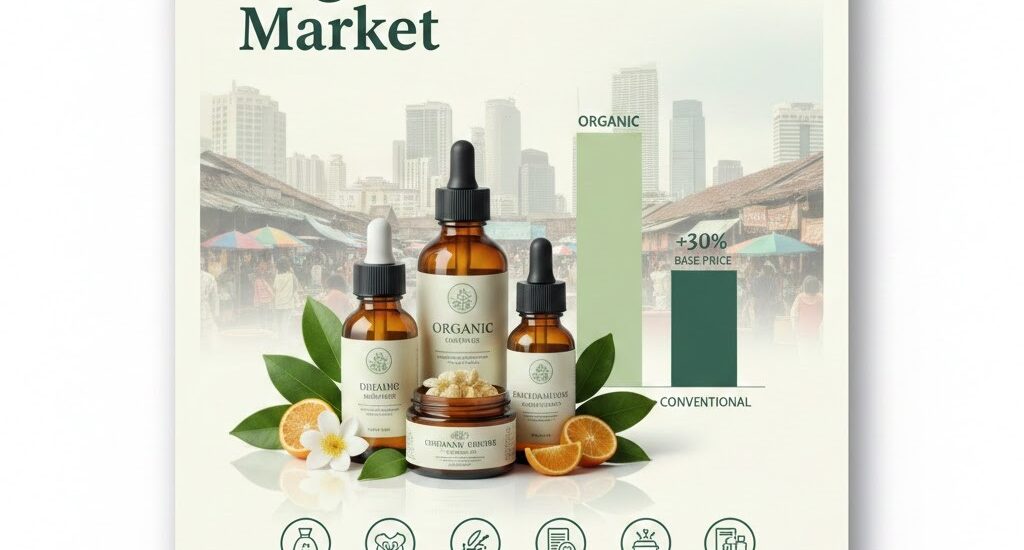
Organic cosmetics command visibly higher price points in ASEAN because their cost base is structurally inflated, while the true addressable consumer base is narrower than attitude surveys suggest. The market can realistically absorb a premium in the range of 15–30 percent. Once prices approach 2x–3x conventional products, organic cosmetics slip into a marginal niche rather than a scalable category.
The core cost pressures sit upstream—certified ingredients, restricted formulation tools, imported sourcing, and weak economies of scale. Downstream, channel selection and price signalling often amplify premiums rather than correct them. As a result, ASEAN demand for organic cosmetics is segmented more by economic capacity than by stated ethical preference.
How Are Organic Cosmetics Priced Versus Conventional in ASEAN?
A practical starting point for analysis is the visible price ladder across modern trade, pharmacies, and premium beauty retail. Across ASEAN markets, organic cosmetics consistently occupy a premium tier above mass conventional SKUs.
Direct datasets on ASEAN organic price premiums are limited, so pricing expectations must be triangulated using three indicators:
- Observable shelf price gaps
- Willingness-to-pay benchmarks from adjacent or comparable markets
- Elasticity patterns in categories where safety and purity signalling matter
When these signals are anchored together, a 15–30 percent premium emerges as the most realistic range for products that are genuinely organic yet still intended for mainstream purchase. Data from South Korea—while not ASEAN—offers an important ceiling. If a wealthy, highly developed beauty market struggles to sustain premiums above ~20 percent, expecting materially higher sustainable premiums in ASEAN is commercially unrealistic.
Consumer behaviour reinforces this conclusion. In markets such as Vietnam and Thailand, the gap between expressed interest in organic cosmetics and repeat purchasing widens sharply once prices cross the comfort threshold of middle-income consumers. This does not reflect rejection of organic principles. Instead, consumers respond rationally to total wallet impact.
For manufacturers, the implication is clear: moderate premiums enable coexistence with mass beauty, while excessive premiums push brands into a thin, urban, high-income niche.
Why Are Organic Cosmetics More Expensive Than Conventional in ASEAN?
From a cost-structure perspective, organic cosmetics pricing is driven by tangible, unavoidable factors.
- Higher Material Inputs
Certified botanical oils, plant extracts, and surfactants come from thinner supply bases. While ASEAN produces many botanicals, certified organic acreage remains limited, resulting in structurally higher cost-per-kilogram inputs.
- Restricted Formulation Options
Organic standards limit the use of common preservatives, stabilisers, and surfactants. Formulators compensate by using costlier alternatives or higher inclusion rates, directly increasing cost of goods sold.
- Certification Overhead
Audits, documentation, renewals, and compliance requirements introduce fixed overheads. While not always large in percentage terms, these costs are unavoidable for brands claiming legitimacy.
- Scale Disadvantage
Most fully organic cosmetic brands in ASEAN are either imported or produced by small to mid-sized local manufacturers. Both profiles lack procurement scale. Shipping costs, duties, and distributor margins further widen the price gap versus conventional mass brands.
- Channel Amplification
Organic cosmetics are primarily sold through pharmacies, specialty beauty retailers, and premium urban formats. These channels carry higher operating costs, reinforcing rather than diluting the price premium.
- Price Signalling in Low-Trust Environments
In markets where label scepticism exists, price itself becomes a quality signal. Brands often maintain a deliberate differential to distance themselves from counterfeit or “pseudo-natural” products. This is not simple mark-up inflation—it is a signalling equilibrium shaped by market trust dynamics.
What This Means for Established and New Manufacturers
For established manufacturers, the opportunity lies in process innovation and scale—investing in localized certified supply chains, modular formulations, and hybrid product lines that deliver organic credibility without extreme cost escalation.
For new manufacturers and startups, success depends on precision positioning. Products priced within the moderate premium band can tap into growing urban middle-class demand, especially when paired with clear certification, transparent storytelling, and selective channel strategies.
Across both groups, technology development—whether in preservation systems, ingredient processing, or traceability—will be the key lever to control costs while maintaining organic integrity.
Final Outlook on the ASEAN Organic Cosmetics Market
The ASEAN organic cosmetics market is not constrained by consumer ethics—it is constrained by economics. Brands that respect price elasticity, manage cost drivers intelligently, and align innovation with realistic purchasing power will be best positioned to expand sustainably in the region.
Read the Full Article Today – https://www.futuremarketinsights.com/articles/what-does-pricing-analysis-reveal-about-organic-cosmetics-versus-conventional-cosmetics-in-asean