

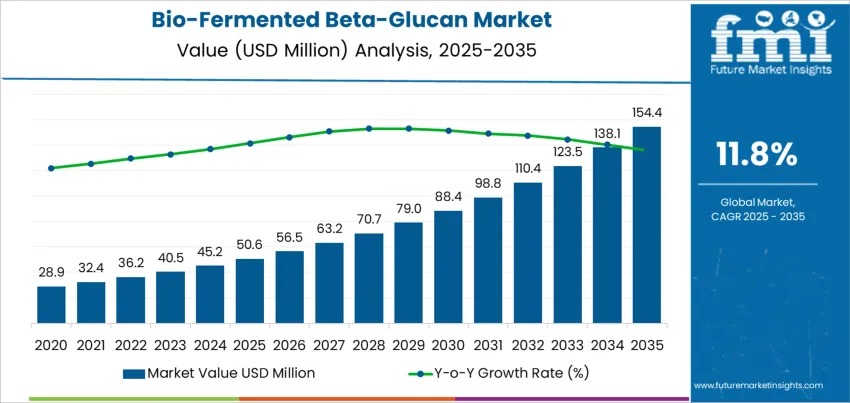
The global demand for bio-fermented beta-glucan is set for robust expansion, rising from USD 50.6 million in 2025 to USD 154.4 million by 2035, registering an impressive CAGR of 11.8%. This surge is driven by rising interest in natural immunomodulators, expanding applications in skincare, functional foods, and dietary supplements, and accelerating adoption of clean-label bio-derived ingredients.
Bio-fermented beta-glucan—produced through controlled microbial fermentation—has become a preferred ingredient among manufacturers seeking high-purity, science-backed actives. Its clinically recognized immune-boosting and anti-inflammatory properties are strengthening its position in global wellness, beauty, and nutrition portfolios.
Explore trends before investing – request a sample report today! https://www.futuremarketinsights.com/reports/sample/rep-gb-29324
A Decade of Stable, Predictable Growth
Between 2025 and 2029, the market will grow steadily from USD 50.6 million to USD 79.0 million, reflecting low volatility and consistent adoption across industries. Market momentum continues through the 2030s, ultimately reaching USD 154.4 million by 2035, supported by heightened consumer interest in preventive health and natural functional ingredients.
Quick Market Stats (Updated: 04 Dec 2025)
- 2025 Market Value: USD 50.6 million
- 2035 Forecast Value: USD 154.4 million
- Forecast CAGR (2025–2035): 11.8%
- Top Product Form: Powder (15.5%)
- Leading End-Use: Skin care (9.9%)
- High-Growth Markets: India, China, Japan, UK, Germany, USA
- Key Players: BASF SE, Croda International, Evonik Industries, Symrise, Dow Inc., Ashland, Clariant, Seppic
Why Global Demand Is Accelerating
The surge in demand for bio-fermented beta-glucan is directly linked to rising consumer focus on preventive wellness. Its benefits—including immune support, antioxidant protection, gut health enhancement, and cardiovascular support—have amplified its adoption in nutraceuticals and functional foods.
Manufacturers are increasingly formulating the ingredient into:
- Dietary supplements
- Functional beverages
- Nutraceutical blends
- Beauty-from-within products
- Anti-aging and sensitive-skin skincare
Advancements in fermentation, extraction, and purification technologies have also improved consistency, purity, and scalability, enabling broader commercial adoption.
Application Leaders: Skin Care and Nutrition
Skin care leads the application landscape, capturing 9.9% of global market share. Known for its skin-soothing, barrier-strengthening, and moisturizing properties, bio-fermented beta-glucan is widely used in serums, moisturizers, masks, and clinical-grade formulations.
Growing concerns around skin sensitivity, pollution, and aging are fueling the need for gentle yet high-performance actives—an area where beta-glucan perfectly fits.
Powder remains the dominant product form, accounting for 15.5% of the market. Its stability, longer shelf life, and formulary flexibility make it the preferred format for high-performance skincare, supplements, and functional food products.
Regional Outlook: Asia-Pacific Leads the Growth Curve
Global adoption is expanding rapidly, with Asia-Pacific markets showing extraordinary momentum.
Top Regional CAGRs (2025–2035):
- India: 15.9%
- China: 14.8%
- Japan: 13.6%
- UK: 12.4%
- Germany: 11.2%
- USA: 10.0%
India leads worldwide growth due to rising health awareness, a booming supplements market, and strong preference for natural wellness solutions.
China continues to drive demand as immunity-focused nutrition and premium functional foods gain mass appeal.
Japan’s strong appetite for science-backed skincare and longevity-focused supplements supports multi-sector adoption.
In the UK, Germany, and the USA, clean-label beauty and preventive health trends accelerate demand for premium-grade beta-glucan, especially within nutraceutical and skincare applications.
Market Drivers and Emerging Trends
Key forces propelling the market include:
- Rising global interest in immune health and preventive wellness
- Expansion of clean beauty, microbiome-friendly skincare, and anti-inflammatory formulations
- Advances in fermentation technologies enabling high-quality, scalable production
- Growing popularity of “beauty-from-within” and holistic wellness trends
- Increased demand for vegan, bio-derived, sustainable ingredients
The market is also witnessing growth in multifunctional ingredient blends pairing beta-glucan with hyaluronic acid, botanical antioxidants, and peptides—resulting in high-value synergies for both ingestible and topical products.
Challenges Limiting Adoption
Despite strong momentum, the market faces structural hurdles:
- High production costs for premium-grade fermented beta-glucan
- Variability in molecular weight and purity impacting performance
- Regulatory complexity across food, supplement, and cosmetic categories
- Consumer preference in some segments for faster-acting synthetic actives
These factors underline the need for continued innovation and stringent quality control among suppliers.
Competitive Landscape
Global supply is dominated by leading specialty ingredient manufacturers. Key players—BASF SE, Croda International, Evonik Industries, Symrise, Dow Inc., Ashland, Clariant, and Seppic—compete on purity, molecular consistency, sustainable sourcing, and fermentation efficiency.
Companies offering high-molecular-weight beta-glucan, clean-label certifications, and multifunctional active blends are best positioned to capture future demand.
