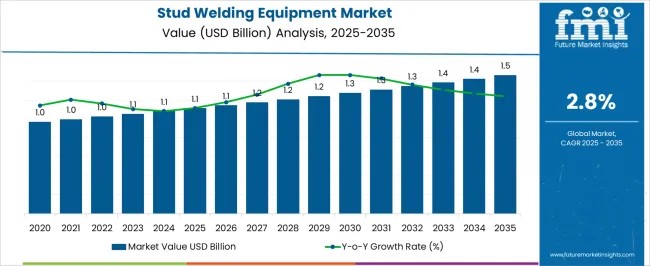
The global Stud Welding Equipment Market, currently valued at approximately USD 1.1 billion in 2025, is forecasted to grow steadily to reach USD 1.5 billion by 2035. This marks a compound annual growth rate (CAGR) of 2.8% over the next decade. A mix of established industry leaders and innovative new entrants are driving this growth, leveraging technological advancements and catering to rising demand across sectors such as automotive, construction, metal fabrication, and renewable energy.
Subscribe for Year-Round Insights → Stay ahead with quarterly and annual data updates – https://www.futuremarketinsights.com/reports/sample/rep-gb-18395
Market Dynamics and Key Growth Drivers
The stud welding equipment market is experiencing stable expansion as industries increasingly prioritize efficient, high-strength fastening solutions. This growth is underpinned by several critical factors:
- Advancements in Automation and Digital Control: Integration of automated and robotic stud welding systems is revolutionizing production processes by boosting precision, reducing labor costs, and improving weld consistency.
- Sustainability and Energy Efficiency: Manufacturers are investing in energy-efficient stud welding equipment that aligns with environmental regulations and sustainability goals, appealing to clients aiming for green certifications.
- Broader Industrial Applications: Expanding usage in lightweight structural assemblies, prefabrication in construction, and renewable energy infrastructure projects is accelerating market penetration globally.
Highlighting Market Leaders and Emerging Innovators
The competitive landscape is shaped by a blend of longstanding market giants and nimble, tech-driven newcomers aiming to capture niche segments:
- Established Players such as Nelson Stud Welding (Doncasters Group), Taylor Studwelding Systems Ltd., HBS Stud Weldings, and Stanley Engineered Fastening leverage extensive distribution networks and deep industry expertise to maintain market dominance.
- Emerging Manufacturers like Ivostud GmbH and Image Industries are introducing innovative solutions such as IoT-enabled equipment, USB-connectivity features for easy welding program storage, and enhanced multi-metal welding capabilities, pushing the boundaries of traditional stud welding technology.
Technological Trends Transforming the Market
Several cutting-edge trends are shaping the future of stud welding equipment:
- Collaborative Robots (Cobots): Cobots are being integrated into stud welding processes to enhance workplace safety, flexibility, and operational agility, enabling seamless human-robot collaboration.
- Industry 4.0 and Wireless Connectivity: The rise of IoT in welding equipment facilitates real-time monitoring, remote control, and data analytics, enabling predictive maintenance and smarter factory operations.
- Energy-Efficient Designs: Demand for equipment that reduces power consumption and meets stringent environmental standards is driving innovation in product development.
Market Segmentation Insights: Key Segments Driving Growth
The latest market report breaks down the stud welding equipment market into vital segments, reflecting the diverse industry needs and product preferences:
By Product Type:
- Short Cycle/Drawn-Arc Stud Welder (53.4% market share in 2025): Leading due to versatility, efficiency, and ability to weld both small and large diameter studs, this segment dominates with applications spanning automotive, construction, and manufacturing.
- Capacitor Discharge Stud Welder: Preferred for precise, low-heat welding tasks in electronics and delicate assembly lines.
By Operation Mode:
- Automatic Operation (61.2% market share): The growth in automated stud welding is propelled by the need for high productivity, reduced manual labor, and integration with robotic assembly lines.
- Semi-Automatic Operation: Still relevant in smaller workshops or specialized manufacturing settings.
By Stud Range:
- 3 to 12 mm Stud Range (47.8% market share): This range offers a balance of strength and flexibility, widely used in automotive, electronics, and construction sectors.
By End Use Industry:
- Automotive
- Construction
- Metal Fabrication
- Shipbuilding
- Decorative and Consumer Items
- Electric Items
- Furniture
- Others
Regional Outlook: Growth Hotspots and Opportunities
The market’s global expansion is largely driven by demand in key regions:
- North America: Growth is projected at a 2.5% CAGR, spurred by defense and aerospace sectors requiring high-precision stud welding for critical components.
- Europe: Countries like the UK and Germany are experiencing steady growth (2.3%-2.5% CAGR) due to infrastructure projects, offshore wind energy development, and advanced automotive manufacturing.
- Asia-Pacific: Leading the market with robust growth—India at 3.6% CAGR and China at 3.4% CAGR—fueled by rapid urbanization, renewable energy projects, and government-led infrastructure investments.
Industry Challenges and Future Prospects
While the market is poised for continued growth, several challenges exist:
- High Initial Equipment Costs and Training Requirements: The upfront investment and operator training can be barriers for smaller firms.
- Competition from Alternative Joining Technologies: Emerging techniques may disrupt traditional stud welding methods.
- Selective Adoption of Industry 4.0 Technologies: Some manufacturers are hesitant to fully embrace digital transformation, limiting the potential benefits of automation and data analytics.
Despite these challenges, exciting opportunities lie ahead:
- Subscription and Equipment-as-a-Service Models: These flexible business models are gaining traction, lowering the barrier for entry and enabling easier access to advanced welding technologies.
- Renewable Energy Sector Expansion: The growing offshore wind and solar energy infrastructure opens new markets for corrosion-resistant and durable stud welding equipment.
- Integration with Building Information Modeling (BIM): This improves project planning and coordination, making stud welding integral to modern construction workflows.
Recent Industry Developments
- In September 2024, Ivostud GmbH acquired OBTEC, enhancing its product portfolio and market reach.
- HBS Bolzenschweiss-Systeme launched the Visar 1200, a versatile stud welder supporting steel, stainless steel, and aluminum with USB connectivity for program management.
Looking Ahead: The Road to 2035
As the stud welding equipment market approaches USD 1.5 billion by 2035, industry players—both veterans and new entrants—are focusing on innovation, sustainability, and automation to seize growth opportunities. The interplay of emerging technologies, expanding end-use applications, and shifting market dynamics positions the stud welding sector for robust, sustained growth well into the future.
Why FMI: https://www.futuremarketinsights.com/why-fmi
About Future Market Insights (FMI)
Future Market Insights, Inc. (FMI) is an ESOMAR-certified, ISO 9001:2015 market research and consulting organization, trusted by Fortune 500 clients and global enterprises. With operations in the U.S., UK, India, and Dubai, FMI provides data-backed insights and strategic intelligence across 30+ industries and 1200 markets worldwide.
Contact Us:
Future Market Insights Inc.
Christiana Corporate, 200 Continental Drive,
Suite 401, Newark, Delaware – 19713, USA
T: +1-347-918-3531
For Sales Enquiries: sales@futuremarketinsights.com
Website: https://www.futuremarketinsights.com
LinkedIn| Twitter| Blogs | YouTube