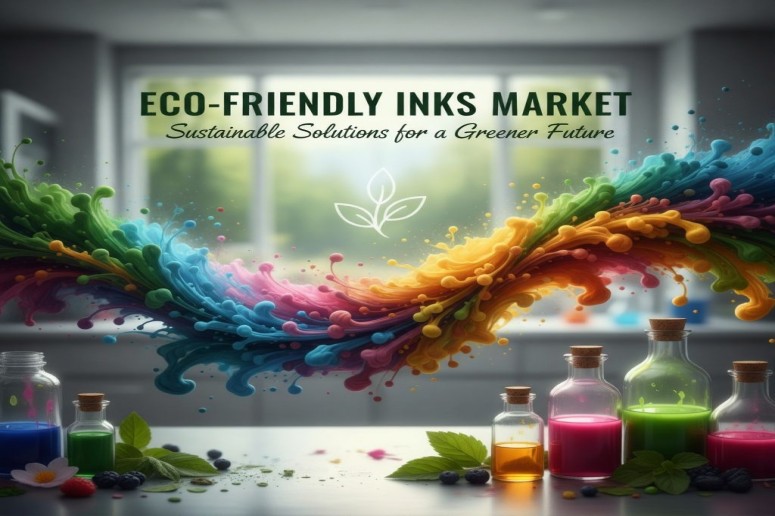
The global eco-friendly inks market is entering a defining decade of transformation. Valued at USD 4.2 billion in 2025, the market is forecast to nearly double, reaching USD 8.9 billion by 2035 a robust CAGR of 7.8%. This remarkable rise underscores the accelerating global shift toward sustainable, non-toxic, and high-performance printing solutions. As industries align with environmental regulations and consumer expectations evolve, eco-friendly inks are becoming indispensable across commercial printing, packaging, and publishing sectors.
Eco-friendly inks refer to printing inks formulated using natural, biodegradable, or renewable materials such as water, soy, vegetable oils, and bio-based resins. These inks minimize the use of volatile organic compounds (VOCs) and heavy metals, significantly reducing environmental and health impacts. They are engineered to maintain print quality, color precision, and substrate versatility—key attributes demanded by modern printing environments.
From water-based and soy-based inks to UV-curable and bio-derived alternatives, each formulation category plays a critical role in supporting industries’ transition toward responsible printing practices.
Key Growth Drivers of the Eco-Friendly Inks Market
- Rising Environmental Awareness: Businesses and consumers alike are prioritizing sustainability. Eco-friendly inks enable companies to minimize carbon footprints while maintaining brand reputation and print excellence.
- Stringent Environmental Regulations: Governments worldwide are enforcing stricter controls on VOC emissions and hazardous waste disposal. This regulatory momentum is compelling printers and manufacturers to transition to greener formulations.
- Technological Advancements in Ink Formulation: Innovations in bio-based chemistry and renewable solvent systems are enhancing ink adhesion, color vibrancy, and performance consistency—expanding eco-friendly inks’ compatibility across printing technologies.
- Packaging Industry Expansion: The packaging sector, accounting for 61.2% of total demand in 2025, continues to drive adoption as brands seek sustainable packaging solutions aligned with circular economy goals.
Challenges and Restraints
Despite strong momentum, the market faces challenges such as formulation complexity, higher production costs, and compatibility limitations with certain printing technologies. However, ongoing advancements in ink chemistry, resin systems, and production efficiency are expected to mitigate these barriers and improve adoption rates.
Trends Defining the Market’s Future
- Integration of Bio-Based and Renewable Systems: Ink manufacturers are investing in renewable resources such as algae oils, soy derivatives, and plant-based resins to minimize dependence on petroleum-based components.
- Shift Toward Circular Economy Models: Companies are embedding recyclability and biodegradability into their ink design to support closed-loop printing and packaging ecosystems.
- Digital and 3D Printing Applications: Eco-friendly inks compatible with digital and UV-curable technologies are seeing rising demand, particularly for short-run, high-quality, and customized printing.
- Premiumization and Performance Enhancement: As brands focus on visual excellence and environmental messaging, the demand for premium eco-friendly formulations offering enhanced color vibrancy, adhesion, and weather resistance is growing.
Competitive Landscape
The eco-friendly inks market is shaped by intense competition and continuous innovation. Key players include: Sun Chemical Corporation, Flint Group, Siegwerk Druckfarben AG, Toyo Ink Group, and INX International Ink Co.
These companies are at the forefront of developing low-VOC, bio-based, and renewable solvent formulations, aligning with global sustainability objectives. Their investments in R&D, product differentiation, and digital printing compatibility are setting new performance benchmarks across commercial and industrial printing sectors.
Additionally, emerging companies are entering the market with specialized product lines—offering custom eco-friendly inks for digital, textile, and packaging applications—further intensifying competitive dynamics.
Get this Report at $5,000 Only | Exclusive Discount Inside!
https://www.futuremarketinsights.com/reports/sample/rep-gb-7971
Checkout Now to Access Market Forecasts:
https://www.futuremarketinsights.com/checkout/7971
Market Segmentation Overview
By Ink Type
The market is segmented into water-based, soy-based, UV-curable, vegetable oil-based, and bio-based inks.
Among these, water-based inks dominate with 44.7% market share in 2025, owing to their low VOC content, cost-effectiveness, and broad application versatility. Their compatibility across substrates and printing formats positions them as the backbone of green printing strategies.
By Application
The packaging segment remains the largest consumer of eco-friendly inks, followed by publishing, labels, and textile printing. Packaging brands increasingly integrate eco-friendly inks to meet both consumer expectations and ESG (Environmental, Social, and Governance) commitments.
By End-Use Industry
Key industries adopting eco-friendly inks include food & beverage, pharmaceuticals, cosmetics, and automotive. The need for safe, non-toxic, and sustainable labeling solutions is particularly strong in regulated sectors like food packaging and healthcare.
By Region
The market’s key growth regions include North America, Europe, and Asia Pacific, each demonstrating distinct momentum:
- China leads with a 9.1% CAGR, fueled by large-scale packaging production and stringent green policies.
- The USA follows at 7.2% CAGR, leveraging its strong commercial printing base and sustainability initiatives.
- Germany and the UK maintain steady growth at 6.8% and 6.5%, supported by advanced engineering and publishing sophistication.
- Japan, with its precision-driven printing industry, grows at 5.9% CAGR, reflecting steady adoption of quality-focused ink technologies.
About Future Market Insights (FMI)
Future Market Insights, Inc. (ESOMAR certified, recipient of the Stevie Award, and a member of the Greater New York Chamber of Commerce) offers profound insights into the driving factors that are boosting demand in the market. FMI stands as the leading global provider of market intelligence, advisory services, consulting, and events for the Packaging, Food and Beverage, Consumer Technology, Healthcare, Industrial, and Chemicals markets. With a vast team of over 400 analysts worldwide, FMI provides global, regional, and local expertise on diverse domains and industry trends across more than 110 countries.
Contact Us:
Future Market Insights Inc.
Christiana Corporate, 200 Continental Drive,
Suite 401, Newark, Delaware – 19713, USA
T: +1-347-918-3531
For Sales Enquiries: sales@futuremarketinsights.com
Website: https://www.futuremarketinsights.com
LinkedIn| Twitter| Blogs | YouTube