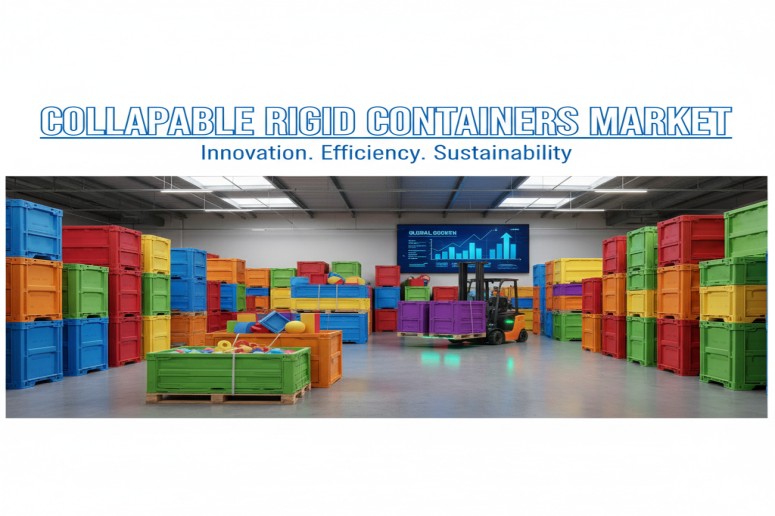
The global Collapsible Rigid Containers Market is entering a transformative growth phase, fueled by mounting demand for reusable, space-efficient packaging systems and accelerated investments in circular economy solutions. Valued at USD 1.9 billion in 2025, the market is projected to reach USD 3.0 billion by 2035, expanding at a CAGR of 4.9%. This steady rise reflects a significant 1.6x increase in market size over the decade, supported by the growing importance of eco-friendly logistics and the rapid adoption of smart material innovations.
Reusable Packaging Sets the Stage for Sustainable Logistics
Collapsible rigid containers have emerged as the cornerstone of next-generation logistics—combining durability, reusability, and space-saving functionality. These containers offer up to 70–80% space savings when collapsed, significantly lowering transport and storage costs while aligning with corporate sustainability goals. Their ability to withstand 10–15 years of use cycles makes them ideal for automotive, pharmaceutical, and food & beverage industries under pressure to reduce packaging waste and carbon footprints.
Government regulations promoting extended producer responsibility (EPR) and eco-friendly packaging are accelerating adoption, particularly in high-regulation sectors like pharmaceuticals and automotive supply chains. However, despite strong market momentum, high upfront costs and the need for robust reverse logistics infrastructure remain challenges for smaller distributors and emerging markets.
Innovation and Expansion Define the 2025–2035 Growth Trajectory
Between 2025 and 2030, the market is expected to rise from USD 1.9 billion to USD 2.4 billion, accounting for nearly 45.5% of the decade’s total growth. This first wave will be driven by heightened investment in lightweight polymer engineering, IoT-enabled tracking systems, and closed-loop logistics integration across e-commerce and industrial sectors.
From 2030 to 2035, the market is forecast to add another USD 0.6 billion, marking 54.5% of the decade’s expansion. This phase will be defined by temperature-controlled collapsible systems, automated handling-compatible designs, and strategic collaborations between container manufacturers and logistics providers. Circular economy principles will remain central, with manufacturers investing in carbon footprint reduction technologies and smart asset management platforms.
Evolving Distribution Models: Direct Partnerships and Rental Pooling
Direct sales remain the backbone of the industry, accounting for 70% of total transactions in 2025, underscoring the strong link between manufacturers and large-scale industrial end-users. Leading manufacturers are forming long-term supply agreements with automotive OEMs, pharmaceutical distributors, and logistics giants to ensure quality, traceability, and supply continuity.
In parallel, indirect sales channels including packaging distributors and rental pooling providers—are gaining traction among small and mid-sized enterprises. This model offers flexibility through rental-based programs and asset-light operations, particularly appealing to businesses seeking to avoid upfront capital investment while accessing reusable container infrastructure.
Regional Insights: Asia Pacific Leads the Expansion Wave
Geographically, the Asia Pacific region remains the growth engine of the global collapsible rigid containers market, led by China and India, which record projected CAGRs of 6.6% and 6.1%, respectively.
- China dominates due to its extensive manufacturing infrastructure, e-commerce boom, and circular economy policies, fostering wide adoption of reusable packaging in automotive and electronics supply chains.
- India, propelled by the Make in India initiative and rising retail modernization, is witnessing rapid adoption across automotive manufacturing zones and organized retail networks, with increasing partnerships between local producers and global technology providers.
In Europe, Germany remains the anchor market, showcasing deep integration of collapsible systems within its automotive and industrial ecosystems, supported by Industry 4.0 practices and environmental compliance standards. The United Kingdom and France follow closely, each leveraging collapsible containers for retail and food distribution efficiency.
The United States represents the most advanced market in e-commerce-driven logistics adoption, posting a CAGR of 4.7% through 2035. American manufacturers and retailers are investing in eco-friendly packaging mandates and IoT-enabled fleet tracking systems, reinforcing their commitment to sustainability and cost-efficient fulfillment operations.
In contrast, Japan’s precision manufacturing sector continues to emphasize dimensional accuracy, automated handling compatibility, and kaizen-based waste reduction, driving adoption of premium-grade collapsible container systems across automotive and electronics industries.
Technology and Smart Systems Transform Market Dynamics
Across all regions, innovation remains the defining force. Manufacturers are rapidly deploying IoT-integrated containers, embedded with RFID and GPS tracking to monitor usage patterns, location, and maintenance schedules in real time. These smart systems enhance fleet visibility, reduce losses, and support data-driven logistics optimization.
Emerging trends include antimicrobial coatings, easy-clean surfaces, and temperature-resistant designs—critical for pharmaceutical and food applications. Together, these advancements position collapsible rigid containers as an essential component of sustainable, tech-enabled logistics ecosystems.
Competitive Landscape: Collaboration and Technology Define Leadership
The global market features a moderately fragmented structure, with approximately 25–30 key players. The top three—Brambles Limited, Supreme Industries Limited, and Schoeller Allibert Services B.V.—command an estimated 38–42% of global market share. Their competitive edge lies in global pooling networks, IoT innovation, and vertically integrated service models that combine container production, maintenance, and asset management under unified logistics platforms.
Emerging challengers such as DS Smith plc and SSI Schäfer AG are investing in specialized designs, particularly in retail and automotive packaging, focusing on material diversification and regional manufacturing capabilities. Meanwhile, new entrants across China, India, and South Korea are leveraging proximity to key industrial hubs and forming technology alliances with global leaders to accelerate market penetration and local innovation.
Buy Now at $5,000 | Hurry—Special Discount Ends Soon!
https://www.futuremarketinsights.com/reports/sample/rep-gb-8967
Checkout Now to Access Market Forecasts:
https://www.futuremarketinsights.com/checkout/8967
Collapsible Rigid Containers Market by Segments
Material Type:
- Plastic
- Metal
- Others
Product Type:
- Crates
- Foldable IBCs
- Pallets Boxes
- Jerry Cans
Sales Channel:
- Direct
- Indirect
End Use:
- Automobile
- Pharmaceutical
- Chemical
- Agriculture
- Food & Beverage
- Shipping & Logistics
- Other Manufacturing
About Future Market Insights (FMI)
Future Market Insights, Inc. (ESOMAR certified, recipient of the Stevie Award, and a member of the Greater New York Chamber of Commerce) offers profound insights into the driving factors that are boosting demand in the market. FMI stands as the leading global provider of market intelligence, advisory services, consulting, and events for the Packaging, Food and Beverage, Consumer Technology, Healthcare, Industrial, and Chemicals markets. With a vast team of over 400 analysts worldwide, FMI provides global, regional, and local expertise on diverse domains and industry trends across more than 110 countries.
Contact Us:
Future Market Insights Inc.
Christiana Corporate, 200 Continental Drive,
Suite 401, Newark, Delaware – 19713, USA
T: +1-347-918-3531
For Sales Enquiries: sales@futuremarketinsights.com
Website: https://www.futuremarketinsights.com
LinkedIn| Twitter| Blogs | YouTube