The European sodium lactate market is on a steady upward trajectory, valued at USD 54.6 million in 2025 and forecast to reach USD 99.6 million by 2035, marking a strong CAGR of 6.2% over the decade. This expansion is being driven by dynamic demand across multiple end-use sectors — particularly in food preservation, pharmaceuticals, beverages, and personal care — where sodium lactate has become an essential ingredient for both performance and regulatory compliance.
Across the European Union, sodium lactate’s versatility and natural origin are making it indispensable to manufacturers striving for clean-label credentials and product differentiation. As European consumers increasingly favor transparency and reduced synthetic additives, sodium lactate offers an effective and natural alternative to chemical preservatives, aligning perfectly with modern sustainability and health-conscious trends.
Food Preservation and Clean-Label Movement Lead Demand
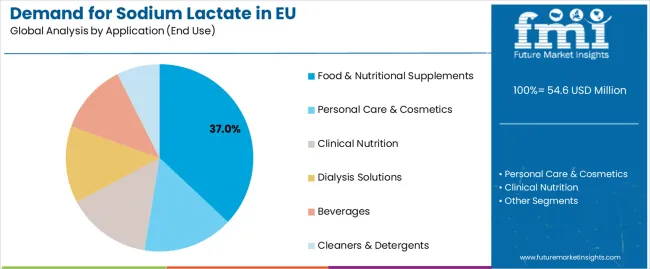
Food and beverage processors account for the largest share of sodium lactate use in Europe, representing 37% of total demand in 2025. The ingredient’s natural antimicrobial properties and ability to extend shelf life without compromising flavor or texture have made it a cornerstone in meat processing, ready-to-eat meals, bakery products, and functional beverages.
As consumer preference shifts toward “free-from” products, European food manufacturers are reformulating legacy brands and launching new lines that emphasize natural preservation and reduced sodium content. Sodium lactate enables processors to meet these objectives while ensuring safety, moisture retention, and enhanced taste stability. Its recognition as a fermentation-derived, clean-label ingredient has elevated it from a simple additive to a strategic component of next-generation food formulation.
Large-scale processors across Germany, France, and Italy have been particularly active in integrating sodium lactate into their product portfolios. In Germany, premium meat brands emphasize sodium lactate’s ability to maintain freshness during extended distribution, while in France, charcuterie producers and bakery manufacturers are reformulating with lactate-based preservatives to comply with evolving EU food safety standards.
Pharma and Healthcare Applications Accelerate Market Expansion
While food remains the primary market driver, pharmaceutical applications are emerging as the most promising growth segment. Sodium lactate’s critical role in parenteral nutrition, dialysis solutions, and intravenous hydration is transforming it from a niche ingredient to a vital component in clinical formulations.
Pharma-grade sodium lactate provides essential electrolytes, metabolic energy support, and pH balance, which are crucial for patient care. As Europe’s healthcare systems expand their focus on clinical nutrition and renal therapy, certified manufacturers with GMP-compliant production facilities are scaling up output to meet rising pharmaceutical-grade standards.
The Netherlands and Germany have become regional leaders in this domain, leveraging their robust pharmaceutical infrastructure and precision fermentation capabilities. By 2035, pharmaceutical applications are expected to account for a significant portion of incremental market growth, driven by expanding medical protocols that rely on sodium lactate’s purity and biocompatibility.
Liquid Sodium Lactate Maintains Dominance Across Industries
By product type, liquid sodium lactate remains the dominant segment, capturing 66% of total sales in 2025 and projected to sustain its leadership through 2035. Liquid formulations offer superior solubility, ease of handling, and compatibility with existing production systems in food, cosmetic, and medical facilities.
Its ready-to-use format simplifies processing, enabling seamless incorporation into meat brines, sauces, beverages, and intravenous solutions. Producers in France, Spain, and the Rest of Europe benefit from well-developed logistics networks that facilitate the bulk transportation of liquid sodium lactate, ensuring consistent supply to regional manufacturing hubs.
Emerging Trends in Personal Care and Cosmetics
Beyond food and pharmaceuticals, personal care and cosmetics represent a rising opportunity for European sodium lactate suppliers. The compound’s natural humectant properties and pH regulation abilities make it a favored ingredient in moisturizers, cleansers, and hair care formulations.
Clean beauty brands across Western and Northern Europe are increasingly substituting synthetic moisturizers with lactate-based alternatives derived from natural fermentation processes. The trend aligns with Europe’s ongoing shift toward eco-certified and vegan formulations. This diversification is helping established sodium lactate producers — as well as innovative startups — secure new revenue streams outside traditional markets.
Regional Performance: Germany, France, and the Netherlands Lead
Across the European Union, Germany remains the largest market, accounting for nearly a quarter of sodium lactate sales in 2025. Its advanced food processing infrastructure and established pharmaceutical production base create a stable demand foundation. Germany’s strong regulatory oversight ensures consistent quality and drives preference for certified, high-purity lactate solutions.
France follows closely with a CAGR of 6.3%, underpinned by progressive food safety regulations, a mature processed meat industry, and a growing pharmaceutical sector. French charcuterie and bakery producers are increasingly turning to sodium lactate to ensure both safety and clean-label compliance.
Meanwhile, the Netherlands is emerging as a key innovation hub, with an emphasis on pharmaceutical manufacturing and sustainable ingredient sourcing. The country’s integrated logistics infrastructure supports efficient distribution across northern Europe, reinforcing its position as a critical node in the continent’s sodium lactate value chain.
The Rest of Europe category — encompassing smaller and emerging markets — is forecast to post the fastest CAGR of 6.5% through 2035. This growth reflects expanding processed food sectors, strengthening pharmaceutical capabilities, and rising consumer awareness of natural preservation methods in Eastern and Southern European countries.
Purchase this Report for USD 5,000 Only | Get an Exclusive Discount Instantly! https://www.futuremarketinsights.com/checkout/27239
Everything You Need—within Your Budget. Request a Special Price Now! https://www.futuremarketinsights.com/reports/sample/rep-gb-27239
Technology and Sustainability Drive Production Innovation
Despite strong demand, the EU sodium lactate industry faces moderate supply constraints due to its dependence on fermentation-based production. Output levels are linked to agricultural feedstock availability, primarily sugar and starch sources, creating cyclical pricing challenges. To mitigate these pressures, manufacturers are investing in process optimization, yield improvement, and waste minimization technologies.
Companies like Corbion, Jungbunzlauer, and Galactic are leading this technological evolution. Corbion commands roughly 22% of EU market share, leveraging vertically integrated fermentation systems and a diversified portfolio spanning food- and pharma-grade sodium lactate. Jungbunzlauer follows with an 18% share, supported by decades of fermentation expertise and cost-efficient production facilities across Central Europe. Belgium-based Galactic, holding 12%, specializes in lactic acid derivatives and maintains deep partnerships with both food processors and pharmaceutical firms.
These established players are being joined by a wave of smaller fermentation specialists and bio-based startups aiming to improve sustainability metrics and reduce carbon footprints. New entrants are experimenting with renewable energy integration, circular fermentation by-products, and advanced purification systems designed to meet tightening EU environmental regulations.
About Future Market Insights (FMI)
Future Market Insights, Inc. (ESOMAR certified, recipient of the Stevie Award, and a member of the Greater New York Chamber of Commerce) offers profound insights into the driving factors that are boosting demand in the market. FMI stands as the leading global provider of market intelligence, advisory services, consulting, and events for the Packaging, Food and Beverage, Consumer Technology, Healthcare, Industrial, and Chemicals markets. With a vast team of over 400 analysts worldwide, FMI provides global, regional, and local expertise on diverse domains and industry trends across more than 110 countries.
Contact Us:
Future Market Insights Inc.
Christiana Corporate, 200 Continental Drive,
Suite 401, Newark, Delaware – 19713, USA
T: +1-347-918-3531
For Sales Enquiries: sales@futuremarketinsights.com
Website: https://www.futuremarketinsights.com
LinkedIn| Twitter| Blogs | YouTube