The global emulsion stabilizers market is poised for strong and consistent growth, with its value projected to rise from USD 3.7 billion in 2025 to USD 6.3 billion by 2035, reflecting a compound annual growth rate (CAGR) of 5.5%. As industries worldwide seek reliable solutions to enhance product stability, texture, and longevity, emulsion stabilizers have become indispensable in applications ranging from textiles and coatings to food, beverages, pharmaceuticals, and personal care. The industry is witnessing dynamic expansion, driven by new technological advancements, sustainability goals, and the continuous push for improved product quality and performance.
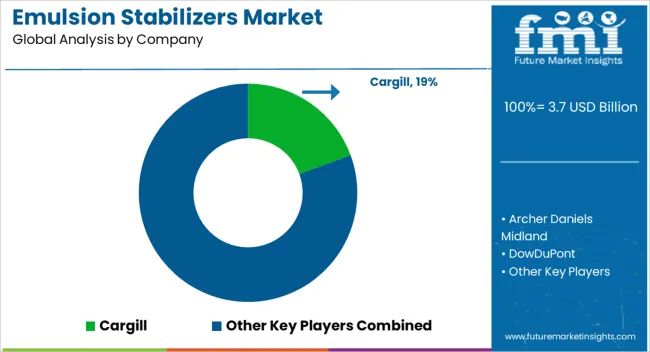
In 2025, powder-based emulsion stabilizers are set to lead the market, capturing 42.6% of total revenue due to their superior shelf stability, easy handling, and versatility across industries. Meanwhile, North America, Asia-Pacific, and Europe remain key growth regions, collectively supporting the global demand surge. Major players such as Cargill, Archer Daniels Midland, DowDuPont, Ashland, Royal DSM, Tate & Lyle, CP Kelco, Ingredion, Fufeng Group, and Palsgaard A/S are actively expanding their production capacities and forming strategic collaborations to strengthen their global footprints.
Industrial Growth Anchored by Versatility and Performance
The emulsion stabilizers market is experiencing significant traction owing to its critical role in ensuring consistency and stability in emulsified formulations. As products become more sophisticated across industries, the need for reliable stabilizers that maintain uniformity, prevent phase separation, and improve texture has intensified. This has especially been true in textile manufacturing, where emulsion stabilizers ensure uniform application of coatings, finishes, and dyes—essential for achieving durability and smoothness in fabrics.
In 2025, the textile industry is projected to account for 46.8% of the global market share, making it the largest end-use segment. Manufacturers are increasingly using stabilizers to produce softer, more durable, and visually appealing fabrics while improving processing efficiency. The growing demand for sustainable textile production has also encouraged companies to adopt eco-friendly stabilizer formulations that reduce waste and energy consumption.
Beyond textiles, the personal care and cosmetics sector continues to embrace emulsion stabilizers for lotions, creams, and hair products that require long-term stability and desirable sensory attributes. The food and beverage industry, another major consumer, depends on natural stabilizers like pectin, starch, and xanthan gum to ensure consistent texture and extended shelf life in products such as yogurt, sauces, dressings, and beverages. The pharmaceutical industry, too, relies heavily on these compounds for creams, ointments, and suspensions that require controlled viscosity and prolonged stability.
Innovation in Liquid Silicone and Natural Formulations
Among the key material categories, liquid-type silicone stabilizers are expected to dominate with a 49.6% market share in 2025, driven by their exceptional performance in maintaining consistent emulsion quality. These stabilizers have become a preferred choice in the coatings, textile, and personal care industries, where they enhance texture, viscosity, and aesthetic properties. Their easy integration into existing production processes without major modification has encouraged widespread adoption, particularly in industrial applications where precision and uniformity are paramount.
Manufacturers are also focusing on developing biodegradable and naturally derived stabilizers, such as pectin, xanthan gum, and gellan gum, to meet growing environmental and regulatory standards. The global shift toward sustainability has accelerated the replacement of petroleum-based stabilizers with natural alternatives that offer excellent performance with minimal ecological impact. Established players like CP Kelco and Tate & Lyle have been pioneers in this transition, introducing bio-based stabilizers for food, beverage, and personal care applications. Meanwhile, newer entrants are investing in research and development to engineer hybrid formulations that balance cost efficiency with eco-friendly attributes.
Technological Advancements and Manufacturing Efficiency
Recent technological advancements are transforming the production and application of emulsion stabilizers. Automation and process optimization have led to higher efficiency, reduced production costs, and improved product consistency. Manufacturers are integrating smart monitoring systems that ensure precise control over formulation and mixing conditions, resulting in uniform quality across large-scale operations.
Companies such as DowDuPont and Ashland are focusing on polymer modification technologies that enhance stabilizer compatibility with diverse emulsions. These innovations enable stabilizers to perform efficiently even under challenging environmental conditions, such as varying temperatures and pH levels. Royal DSM and Ingredion are investing heavily in biotechnology-based solutions, creating stabilizers that are both high-performing and environmentally sustainable.
Furthermore, the development of advanced nanoemulsion technologies is opening new frontiers, particularly in the pharmaceutical and cosmetic sectors. Nano-sized emulsions enhance the delivery of active ingredients, improve product appearance, and extend shelf life—factors that are driving interest among manufacturers eager to differentiate their offerings in competitive markets.
Purchase this Report for USD 5,000 Only | Get an Exclusive Discount Instantly! https://www.futuremarketinsights.com/checkout/7944
Everything You Need—within Your Budget. Request a Special Price Now! https://www.futuremarketinsights.com/reports/sample/rep-gb-7944
Regional Analysis: Asia-Pacific Leads the Charge
The Asia-Pacific region is expected to remain the fastest-growing market for emulsion stabilizers, fueled by industrialization, urbanization, and expansion in key sectors like textiles, food processing, and personal care. China leads the global market with a projected CAGR of 7.4%, followed by India at 6.9%, as both countries continue to strengthen their manufacturing and export capabilities.
In Europe, countries such as Germany (CAGR 6.3%) and France (CAGR 5.8%) are experiencing steady growth, driven by high-quality production standards, regulatory compliance, and sustainability initiatives. The United Kingdom remains a key hub for advanced formulations, posting a CAGR of 5.2%. The United States, with a forecast CAGR of 4.7%, continues to be a dominant player due to its strong industrial base, technological advancements, and growing consumer demand for premium and sustainable products.
Emerging markets in Latin America and the Middle East & Africa are gradually gaining momentum as governments promote industrial diversification and modernization. Brazil, while posting a relatively modest CAGR of 4.1%, demonstrates steady demand from its food and beverage industry, reflecting the broader global trend toward cleaner, stable, and high-quality formulations.
Competitive Landscape: Established Leaders and Emerging Innovators
The emulsion stabilizers market features a balanced mix of established global leaders and ambitious new entrants. Industry giants such as Cargill, Archer Daniels Midland, and DowDuPont continue to dominate through expansive distribution networks, large-scale production, and innovation-driven product portfolios. Ashland and Royal DSM are focusing on advanced polymer chemistry and environmentally compliant solutions, while Tate & Lyle, CP Kelco, and Ingredion are leveraging their expertise in bio-based stabilizers to address the growing preference for natural ingredients.
Emerging companies like Fufeng Group and Palsgaard A/S are rapidly gaining ground through strategic partnerships and R&D investments that emphasize cost-effective and customizable stabilizer solutions. These companies are actively expanding their regional presence in Asia and Europe to serve the growing demand from textile, food, and industrial sectors. Collaborative ventures, mergers, and technology-sharing initiatives are reshaping the competitive landscape, promoting innovation and ensuring consistent product quality across global markets.
About Future Market Insights (FMI)
Future Market Insights, Inc. (ESOMAR certified, recipient of the Stevie Award, and a member of the Greater New York Chamber of Commerce) offers profound insights into the driving factors that are boosting demand in the market. FMI stands as the leading global provider of market intelligence, advisory services, consulting, and events for the Packaging, Food and Beverage, Consumer Technology, Healthcare, Industrial, and Chemicals markets. With a vast team of over 400 analysts worldwide, FMI provides global, regional, and local expertise on diverse domains and industry trends across more than 110 countries.
Contact Us:
Future Market Insights Inc.
Christiana Corporate, 200 Continental Drive,
Suite 401, Newark, Delaware – 19713, USA
T: +1-347-918-3531
For Sales Enquiries: sales@futuremarketinsights.com
Website: https://www.futuremarketinsights.com
LinkedIn| Twitter| Blogs | YouTube