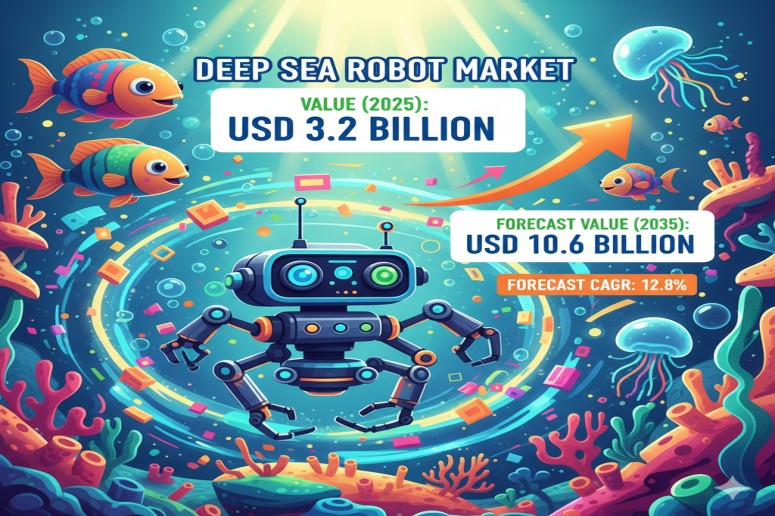
The global Deep Sea Robot market is poised for significant expansion, with its valuation projected to rise from USD 3.2 billion in 2025 to USD 10.6 billion by 2035, reflecting a robust compound annual growth rate (CAGR) of 12.8% over the forecast period. This remarkable growth trajectory highlights the increasing adoption of sophisticated underwater robotic systems across industries, including offshore oil and gas, marine research, environmental monitoring, and deep ocean resource exploration.
Market Dynamics and Growth Drivers
The surge in the Deep Sea Robot market is fueled by advancements in automation, artificial intelligence, and sensor integration, enabling these robots to operate at extreme depths with unprecedented precision. These intelligent systems serve as cost-effective and safer alternatives to human divers, particularly in hazardous underwater conditions. Innovations in navigation systems, autonomous operational software, and real-time data acquisition are enhancing both the efficiency and reliability of deep sea robots, paving the way for broader applications.
Investment in oceanic infrastructure and research initiatives, especially in Europe and the Asia-Pacific (APAC) regions, has opened new avenues for deep sea robotic solutions. As industries and governments prioritize exploration and sustainable management of ocean resources, the demand for deep sea robots that combine high functionality with robust operational performance continues to strengthen.
Segment Insights: Dominance of Remotely Operated Vehicles (ROVs)
Within the market, Remotely Operated Vehicles (ROVs) are projected to dominate, accounting for 51.6% of market revenue in 2025. ROVs are highly versatile systems capable of executing complex underwater tasks under remote supervision, making them indispensable for operations in environments where human access is limited or unsafe.
Industries such as offshore oil and gas, subsea infrastructure inspection, and marine scientific research are increasingly relying on ROVs for their high reliability and operational flexibility. Modular designs and compatibility with diverse sensor systems allow for rapid deployment and adaptability across multiple applications. Furthermore, technological advancements in propulsion, navigation, and remote control systems continue to reinforce the position of ROVs as a preferred solution for deep sea operations.
Functional Capabilities: Task Performance Leads the Way
From a functional perspective, the Task Performance segment is projected to contribute 39.4% of the Deep Sea Robot market revenue in 2025. This segment reflects the growing need for robotic systems capable of executing precise and complex operations with minimal supervision. Applications span subsea construction, salvage operations, environmental monitoring, and scientific exploration, where accuracy and consistency are paramount.
Innovations in AI-driven operational algorithms, automated manipulation systems, and enhanced sensor integration have significantly improved task execution efficiency, reducing reliance on human intervention. The ability to integrate advanced task performance capabilities across different robot types without extensive hardware modifications underscores the versatility and scalability of modern deep sea robotic systems.
Technological Evolution in Deep Sea Robotics
Historically, deep sea exploration relied on analog tools such as Niskin bottles and nets to collect water and marine specimens. The advent of deep sea robots has revolutionized this methodology, enabling researchers to map ocean floors, explore marine life, and conduct environmental monitoring on a scale previously unattainable.
Autonomous Underwater Vehicles (AUVs) are now extensively used to chart deep reefs and observe aquatic ecosystems. Meanwhile, remotely operated systems allow scientists to discover, study, and classify new marine species at varying ocean depths. Collaborations between research organizations and industrial players are further expanding applications, including monitoring deep sea oil rigs and underwater infrastructure, highlighting the intersection of scientific inquiry and commercial operations.
Regional Market Outlook: APAC and Europe at the Forefront
The Deep Sea Robot market exhibits diverse growth patterns across geographies. China leads with a projected CAGR of 17.3%, followed closely by India at 16.0%, reflecting rapid adoption driven by industrial expansion, oceanographic research, and government initiatives in marine exploration. Developed European markets, including Germany (14.7% CAGR), France (13.4%), and the UK (12.2%), demonstrate steady growth, supported by advanced manufacturing capabilities and substantial investments in subsea technologies.
The USA, valued at USD 1.2 billion in 2025, is anticipated to reach USD 3.2 billion by 2035, growing at a CAGR of 10.9%. Japan and South Korea are emerging markets within the Asia-Pacific, with valuations projected at USD 158.7 million and USD 91.8 million, respectively, in 2025. Brazil posts the lowest CAGR among key markets at 9.6%, yet its steady growth underscores the global appetite for deep sea robotic solutions.
Key Players and Innovation Leaders
The competitive landscape of the Deep Sea Robot market is defined by a mix of established industry giants and emerging innovators. Leading companies include Oceaneering International, Inc., Fugro N.V., Saab AB, Teledyne Marine, Kongsberg Maritime, Bluefin Robotics, Atlas Elektronik GmbH, Soil Machine Dynamics (SMD), and Subsea 7.
Order Now for $5,000 | Unlock Insights with a Special Discount!
https://www.futuremarketinsights.com/reports/sample/rep-gb-7912
Checkout Now to Access Industry Insights:
https://www.futuremarketinsights.com/checkout/7912
About Future Market Insights (FMI)
Future Market Insights, Inc. (ESOMAR certified, recipient of the Stevie Award, and a member of the Greater New York Chamber of Commerce) offers profound insights into the driving factors that are boosting demand in the market. FMI stands as the leading global provider of market intelligence, advisory services, consulting, and events for the Packaging, Food and Beverage, Consumer Technology, Healthcare, Industrial, and Chemicals markets. With a vast team of over 400 analysts worldwide, FMI provides global, regional, and local expertise on diverse domains and industry trends across more than 110 countries.
Contact Us:
Future Market Insights Inc.
Christiana Corporate, 200 Continental Drive,
Suite 401, Newark, Delaware – 19713, USA
T: +1-347-918-3531
For Sales Enquiries: sales@futuremarketinsights.com
Website: https://www.futuremarketinsights.com
LinkedIn| Twitter| Blogs | YouTube