

Competition in the long-acting implantable GLP-1 obesity devices market is shaped by controlled-release technology, peptide stability, biomaterial compatibility, clinical validation and intellectual property protection. Pharmaceutical developers and platform owners are competing to develop implantable systems capable of delivering GLP-1 therapies continuously over several months, reducing dependence on frequent injections and improving treatment persistence.
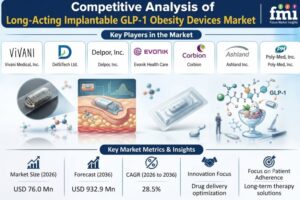
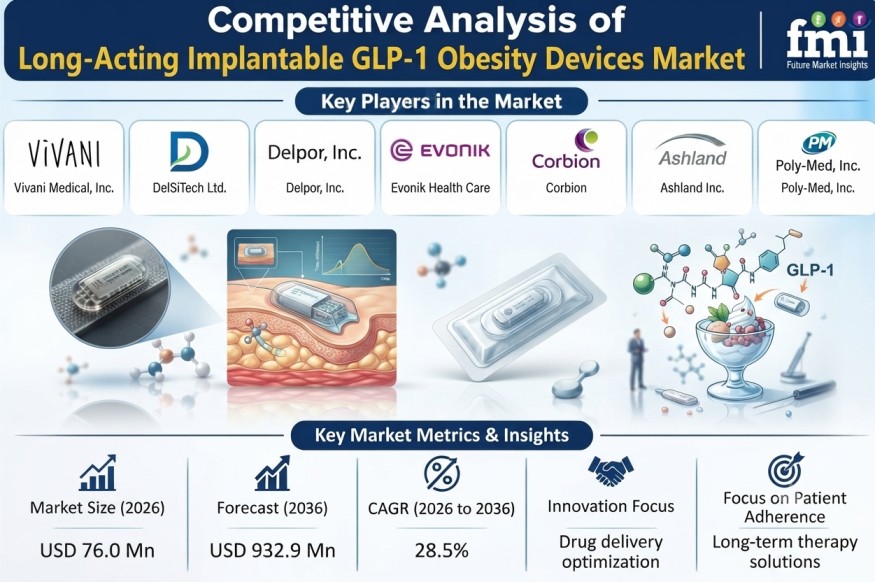
Vivani Medical, DelSiTech and Delpor are among the leading technology developers identified by Future Market Insights (FMI). Evonik Health Care, Corbion and Ashland strengthen the competitive ecosystem through specialized biomaterials and polymer technologies. The market is moving from early clinical validation toward next-generation semaglutide implants, longer-duration delivery systems and pharmaceutical licensing partnerships.
Get detailed market forecasts, competitive benchmarking, and pricing trends:
https://www.futuremarketinsights.com/reports/sample/rep-gb-32361
Competitive Landscape of the Long-Acting Implantable GLP-1 Obesity Devices Market
The market includes specialized implant developers, controlled-release technology companies, biomaterial manufacturers and pharmaceutical development partners. Their competitive priorities differ according to proprietary delivery architectures, peptide formulation capabilities and clinical development requirements.
Unlike conventional GLP-1 injectables, implantable devices are designed to release active pharmaceutical ingredients continuously over multiple months. This creates a distinct competitive environment in which manufacturers must demonstrate reliable release kinetics, tissue compatibility, predictable drug exposure and safe device retrieval or degradation.
Exenatide implants represent the leading molecule category, accounting for 54.0% of market revenue in 2026. Six-month implants dominate the duration profile with a 58.0% share. Pharma partnership and licensing agreements represent the leading distribution channel, accounting for 48.0% of revenue.
The United States represents the largest national market, capturing 48.0% of global revenue in 2026. Its position reflects the concentration of clinical development activity, pharmaceutical investment and specialist obesity treatment infrastructure.
Key Companies and Competitive Positioning
Vivani Medical, Inc. is a leading developer of miniature, ultra-long-acting drug implants using its proprietary NanoPortal technology. The company is developing NPM-115, an exenatide implant, and NPM-139, a semaglutide implant for chronic weight management. Its strategy focuses on controlled drug release, implant miniaturization and the development of long-duration delivery systems.
Vivani’s August 2025 clinical milestone for its exenatide implant strengthened its position in early-stage GLP-1 implant development. In November 2026, the company reported positive top-line Phase 1 results from its SLIM-1 trial evaluating NPM-139. This development represents an important advancement in the clinical validation of semaglutide-based implant technology.
DelSiTech Ltd. participates in the competitive landscape through its controlled-release biomaterial and silica-based delivery technology capabilities. The company’s technology positioning is relevant to pharmaceutical developers seeking sustained drug release, biodegradable delivery platforms and specialized implant formulation solutions.
Delpor, Inc. is another important participant in long-acting drug delivery technology. Its competitive relevance is associated with implantable delivery systems designed to provide extended therapeutic exposure. Proprietary device architecture and formulation capabilities are important differentiation factors in this emerging market.
Evonik Health Care contributes to the competitive ecosystem through specialized pharmaceutical excipients, biomaterials and polymer-related capabilities. High-purity materials and consistent manufacturing quality are important requirements for companies developing implantable peptide delivery systems.
Corbion participates through its biomaterials and specialty polymer capabilities. Biocompatible and biodegradable polymer technologies are relevant to developers evaluating matrix-based implant platforms and long-duration drug release.
Ashland Inc. is another identified participant in the biomaterial supply ecosystem. Its specialty materials expertise supports the broader development environment for pharmaceutical formulations and controlled-release technologies.
Other companies identified by FMI include Poly-Med, Inc., which contributes to the specialized biomaterials and medical polymer ecosystem.
These participants occupy different positions in the value chain. Vivani Medical and Delpor are associated with proprietary implant delivery development, while Evonik, Corbion and Ashland provide important materials capabilities. This distinction is essential when evaluating competitive positioning because platform developers and biomaterial suppliers do not necessarily compete for the same commercial contracts.
Recent Competitive Developments
Recent developments highlight clinical progress, pharmaceutical partnerships and growing interest in semaglutide-based implant platforms.
- March 2025 – Vivani Medical: Reported the first human implantation of its NPM-115 exenatide implant, marking an important milestone for long-acting GLP-1 delivery development.
- August 2025 – Vivani Medical: Reported that its NPM-115 implant met its primary safety endpoint, supporting further development of its proprietary implant technology.
- August 2026 – Vivani Medical: Reported progress in its first-in-human Phase 1 study of NPM-139, a miniature, ultra-long-acting semaglutide implant. The company also announced a non-exclusive agreement with Novo Nordisk to evaluate NPM-139 and its NanoPortal technology.
- November 2026 – Vivani Medical: Announced positive top-line Phase 1 results from the SLIM-1 study evaluating its semaglutide implant for chronic weight management.
These developments demonstrate the transition from initial exenatide platform validation toward semaglutide-based clinical development and broader pharmaceutical collaboration.
Technology Differentiation and Implant Development Requirements
Technology differentiation is central to competition in the long-acting implantable GLP-1 obesity devices market. Developers must demonstrate that their platforms can maintain consistent drug release without compromising peptide stability, tissue compatibility or patient safety.
Subdermal NanoPortal-type solid implants account for 41.0% of the technology platform segment. Their competitive advantage is associated with controlled diffusion, structural integrity and the potential for device retrieval.
Biodegradable matrix implants provide an alternative approach by using polymer degradation and drug diffusion to achieve extended release. Passive reservoir-based systems also offer opportunities for developers seeking alternative implant architectures.
Key technology and procurement requirements include:
- Predictable and sustained drug-release kinetics.
- Peptide stability during prolonged implantation.
- Biocompatibility and tissue tolerability.
- Reliable implant insertion and positioning.
- Safe retrieval or predictable biodegradation.
- Manufacturing consistency and cGMP compliance.
- Clinical validation and regulatory pathway readiness.
Six-month implants currently lead because their duration aligns with established clinical monitoring and treatment review intervals. However, 12-month implants are expected to grow faster, registering a projected CAGR of 34.5% through 2036.
Semaglutide implants are also projected to expand at a 30.5% CAGR, exceeding the overall market growth rate. Their development reflects the opportunity to combine established obesity-treatment molecules with extended-release implant technologies.
Regional Competitive Dynamics
Regional competition is influenced by obesity treatment demand, clinical trial infrastructure, regulatory pathways and the availability of specialist healthcare facilities.
The United States represents the largest market, accounting for 48.0% of global revenue in 2026. The country is projected to register a CAGR of 29.8% through 2036, supported by pharmaceutical development investment, clinical research activity and established obesity treatment networks.
China is expected to record the highest country-level growth rate, with a projected CAGR of 32.4%. India’s market is forecast to expand at 31.6%, reflecting opportunities associated with expanding private healthcare infrastructure and specialist metabolic treatment facilities.
Australia is projected to grow at 31.2%, supported by its clinical research environment and early involvement in human studies of long-acting GLP-1 implant technologies.
In Europe, the United Kingdom is expected to register a CAGR of 28.6%, while Germany is projected to grow at 27.9%. Established specialist treatment infrastructure and ambulatory procedure capabilities provide opportunities for implant developers and pharmaceutical partners.
For international developers, regional expansion will depend on clinical evidence, regulatory approvals, local pharmaceutical partnerships and the development of qualified implant insertion networks.
Access Full Report: https://www.futuremarketinsights.com/reports/long-acting-implantable-glp-1-obesity-devices-market
Competitive Outlook
The long-acting implantable GLP-1 obesity devices market is projected to increase from USD 76.0 million in 2026 to USD 932.9 million by 2036, registering a CAGR of 28.5%.
Competition is expected to intensify around semaglutide implant development, next-generation incretin delivery platforms and longer-duration formulations. Vivani Medical’s clinical progress highlights the importance of first-in-human evidence and proprietary delivery technology in establishing competitive differentiation.
Pharmaceutical licensing agreements will remain important because specialized implant developers require access to drug-development expertise, clinical trial resources and commercialization networks. Biomaterial suppliers may also strengthen their positions through partnerships with platform developers seeking validated polymer manufacturing capabilities.
However, clinical development risks, regulatory requirements, manufacturing complexity and reimbursement uncertainty will influence commercialization timelines. The availability of effective oral GLP-1 treatments also creates a competitive challenge for implant developers targeting patients who prefer to avoid injections or minor surgical procedures.
Ultimately, competitive performance through 2036 will depend on clinical safety, sustained-release consistency, intellectual property protection, pharmaceutical partnerships and the ability to demonstrate meaningful treatment-persistence advantages.
Research Methodology
The competitive analysis draws on Future Market Insights’ Long-Acting Implantable GLP-1 Obesity Devices Market report, company disclosures, clinical development updates and biomaterial technology assessments.
The evaluation considers proprietary delivery platforms, molecule development pipelines, implant duration profiles, clinical milestones, biomaterial manufacturing capabilities and pharmaceutical licensing strategies.
Primary research includes interviews with chief scientific officers, biomaterial engineering specialists, clinical investigators, pharmaceutical development executives and contract manufacturing stakeholders. Secondary research incorporates company announcements, regulatory information, clinical trial developments and industry publications.
The companies included in the competitive landscape are representative participants identified by FMI and do not indicate a numerical market-share ranking. Most implant platforms remain in clinical development, and inclusion in the competitive landscape does not imply commercial approval or availability.
Related Reports:
- Autism Diagnostics Market – https://www.futuremarketinsights.com/reports/autism-diagnostics-market
- Bio-Stimulation Therapies Market – https://www.futuremarketinsights.com/reports/bio-stimulation-therapies-market
- Centesis Catheters Market – https://www.futuremarketinsights.com/reports/centesis-catheters-market