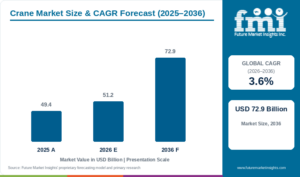


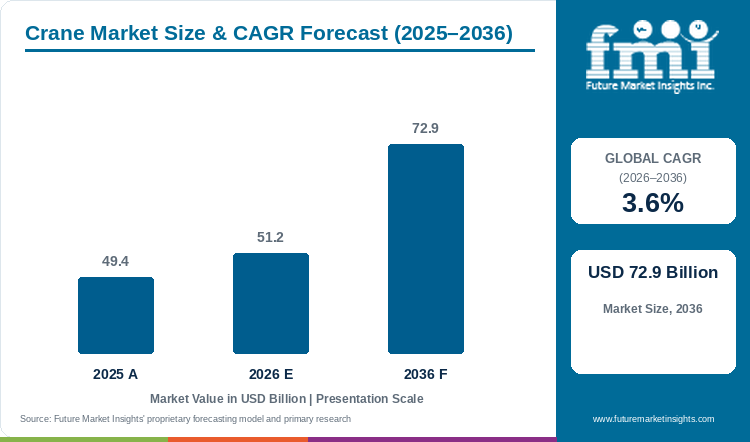
The global crane market is estimated to reach USD 51.2 billion in 2026, compared with USD 49.4 billion in 2025. The market is projected to grow to USD 72.9 billion by 2036, registering a compound annual growth rate (CAGR) of 3.6% from 2026 to 2036, according to Future Market Insights (FMI).
Cranes are essential equipment across construction, infrastructure development, manufacturing, ports, shipyards, and industrial facilities. Their ability to lift and move heavy loads makes them critical to project execution and material handling operations. As project requirements become more diverse, buyers are evaluating crane configurations based on lifting capacity, working radius, site conditions, operating environments, inspection requirements, and long-term maintenance commitments.
Get detailed market forecasts, competitive benchmarking, and pricing trends: https://www.futuremarketinsights.com/reports/sample/rep-gb-2922
Crane Market: Key Metrics
- Market Size (2026): USD 51.2 billion
- Market Size (2025): USD 49.4 billion
- Forecast Value (2036): USD 72.9 billion
- Growth Rate (2026–2036):6% CAGR
- Leading Crane Type: Tower cranes
- Leading Application: Construction
What Is Driving Demand for Cranes?
Demand for cranes is supported by ongoing construction activity, infrastructure investment, industrial expansion, and the need to move heavy materials safely and efficiently.
Construction projects require different crane configurations depending on building height, lifting capacity, available space, and working radius. Tower cranes are important for large-scale building projects, while mobile cranes offer flexibility across construction sites and infrastructure operations.
Industrial facilities and shipyards have different lifting requirements, often involving repetitive material movement, specialized load handling, and established operating layouts. These applications create demand for industrial and specialized crane systems designed around specific operational conditions.
Equipment reliability is also an important purchasing consideration. Crane owners must account for regular inspections, rope condition, structural component deterioration, preventive maintenance, and periods when equipment is unavailable for service.
Five Key Trends Shaping the Crane Market
- Growing Demand for Tower Cranes in Construction
Tower cranes lead the market’s crane-type classification in 2026. Their ability to lift materials at height and serve large construction sites supports their importance in building and infrastructure projects.
- Increasing Requirements for Mobile Crane Flexibility
Mobile cranes support lifting operations across different project locations. Their flexibility makes them relevant for construction, infrastructure maintenance, industrial facilities, and applications requiring equipment relocation.
- Greater Focus on Load Capacity and Working Radius
Crane selection increasingly depends on the relationship between load weight, reach, boom configuration, and operating conditions. Buyers must assess rated capacity across the intended lifting configuration rather than relying on headline capacity alone.
- Rising Importance of Inspection and Preventive Maintenance
Regular inspection of ropes, structural components, and critical operating systems is essential to maintaining equipment reliability. Fleet owners are placing greater emphasis on maintenance planning and equipment availability.
- Diversification of Industrial and Specialized Crane Applications
Shipyards, manufacturing facilities, ports, and other industrial environments require crane systems suited to specific operating layouts and load-handling patterns. This supports demand for specialized lifting configurations beyond conventional construction equipment.
Opportunities Across Crane Applications
The crane market offers opportunities across several industries:
- Construction: Tower and mobile cranes support building projects, infrastructure development, and heavy material movement.
- Manufacturing: Industrial cranes facilitate material handling, equipment positioning, and movement of heavy components within production facilities.
- Ports and Shipyards: Specialized cranes support cargo handling, shipbuilding, vessel maintenance, and movement of large structures.
- Infrastructure Development: Crane systems are required for bridges, roads, power facilities, and other large-scale construction activities.
- Industrial Maintenance: Lifting equipment supports machinery installation, replacement, and maintenance operations in industrial environments.
Competitive Landscape
Competition in the global crane industry is shaped by lifting capacity, equipment reliability, technology integration, product customization, service networks, safety features, and lifecycle support.
Companies operating across the broader crane and lifting equipment industry include:
- Liebherr Group
- Konecranes
- Terex Corporation
- XCMG Group
- SANY Group
- Zoomlion Heavy Industry Science & Technology
- Tadano Ltd.
- Manitowoc Company
- Kobelco Construction Machinery
- Sumitomo Heavy Industries
These companies represent participants across crane manufacturing and lifting equipment markets; the list is not a ranking of market share in the crane market.
What This Means for Industry Participants
Crane manufacturers, equipment rental companies, construction contractors, and industrial operators can benefit from the market’s expansion by focusing on equipment suitability, operational reliability, and lifecycle performance.
Key priorities include:
- Developing crane configurations suited to different load capacities and working radii.
- Improving equipment inspection and preventive maintenance capabilities.
- Strengthening service networks and spare-parts availability.
- Offering application-specific solutions for construction, industrial, and port operations.
- Supporting fleet owners in reducing equipment downtime and improving utilization.
Companies that combine reliable lifting performance with strong after-sales service, maintenance support, and application-specific engineering may be better positioned to address evolving customer requirements.
Future Outlook for the Crane Market
The global crane market is projected to grow from USD 51.2 billion in 2026 to USD 72.9 billion by 2036, registering a CAGR of 3.6%. Continued construction activity, infrastructure investment, industrial operations, and specialized material handling requirements are expected to support market development.
As crane buyers increasingly evaluate lifting capacity alongside working radius, operating conditions, inspection needs, and equipment availability, manufacturers will need to deliver solutions that address complete operational requirements. Equipment reliability and lifecycle support are expected to remain important factors in purchasing decisions through 2036.
Explore the Full Report: https://www.futuremarketinsights.com/reports/crane-market
About the Crane Market Report
Future Market Insights’ report provides an assessment of the global crane market, covering market size, growth outlook, industry trends, and competitive developments.
- Report Title: Crane Market
- Forecast Period: 2026–2036
- Market Size (2026): USD 51.2 billion
- Market Size (2025): USD 49.4 billion
- Projected Market Value (2036): USD 72.9 billion
- CAGR:6%
- Leading Crane Type: Tower cranes
- Leading Application: Construction
- Report Length: 250 pages
Frequently Asked Questions
- How big is the crane market in 2026?
The global crane market is estimated to reach USD 51.2 billion in 2026.
- What was the market size in 2025?
The market was valued at USD 49.4 billion in 2025.
- What is the projected market value by 2036?
The crane market is forecast to reach USD 72.9 billion by 2036.
- What is the expected CAGR of the crane market?
The market is projected to grow at a CAGR of 3.6% between 2026 and 2036.
- Which crane type leads the market?
Tower cranes lead the crane-type classification in 2026.
Related Reports
Underground Mining Equipment Market Share Analysis – https://www.futuremarketinsights.com/reports/underground-mining-equipment-market-share-analysis
Vapour Recovery Units Market Share Analysis – https://www.futuremarketinsights.com/reports/vapour-recovery-units-market-share-analysis
ASEAN Adsorbent Glass Mat (AGM) Battery Market – https://www.futuremarketinsights.com/reports/asean-adsorbent-glass-mat-battery-market
About Future Market Insights (FMI)
Future Market Insights (FMI) is a leading provider of market intelligence and consulting services, delivering actionable insights and strategic analysis to businesses across industries. FMI supports organizations in identifying emerging opportunities, understanding market dynamics, and making informed business decisions through data-driven research.
Contact:
Rahul Singh
AVP – Marketing and Growth Strategy
Future Market Insights, Inc.
Phone: +91 8600020075
Email: sales@futuremarketinsights.com
Rahul.singh@futuremarketinsights.com
Website: www.futuremarketinsights.com