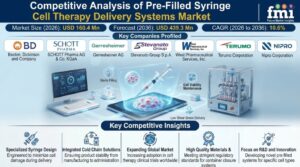


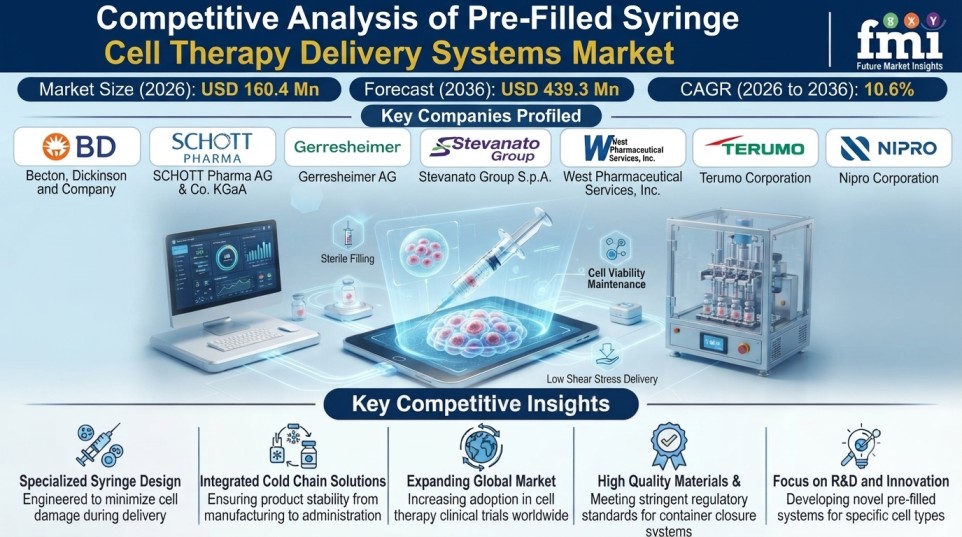
NEWARK, Del., November 26, 2026 — The global pre-filled syringe cell therapy delivery systems market is projected to grow from USD 160.4 million in 2026 to USD 439.3 million by 2036, registering a compound annual growth rate (CAGR) of 10.6% during the forecast period, based on the supplied market estimates. Growing investment in cell therapy manufacturing, increasing demand for specialized primary packaging and the need to preserve cellular viability during storage and administration are creating opportunities for delivery system manufacturers.
Pre-filled syringe cell therapy delivery systems are specialized primary packaging solutions designed to store and administer living-cell therapeutics while maintaining product quality. Unlike conventional injectable drug containers, these systems must address the material compatibility, sterility, temperature stability and handling requirements associated with sensitive cellular products.
As cell and gene therapy pipelines advance toward commercialization, pharmaceutical manufacturers and contract manufacturing organizations (CMOs) are evaluating packaging formats that can reduce manual handling, support aseptic processing and simplify administration at clinical sites.
Request For Sample: https://www.futuremarketinsights.com/reports/sample/rep-gb-32313
Pre-Filled Syringe Cell Therapy Delivery Systems Market: Key Growth Indicators
- Market Size (2026): USD 160.4 million
- Forecast Value (2036): USD 439.3 million
- CAGR (2026–2036): 10.6%
- Leading Material Segment: COP/COC Polymer Syringes
- Leading Sterility/Supply Format: Ready-to-Use (RTU) Nested Systems
- Leading Needle/Tip Format: Staked Needle Systems
- Leading Temperature Profile: Deep-Cold/Cryogenic-Compatible Systems
Why Is Demand for Pre-Filled Syringe Cell Therapy Delivery Systems Increasing?
Cell therapies present distinct packaging and delivery challenges because living cellular products can be sensitive to temperature changes, material interactions and handling conditions. Conventional vial-based workflows may require additional preparation and transfer steps before administration, creating opportunities for specialized pre-filled delivery formats.
Several factors are supporting market growth:
- Expansion of cell therapy pipelines: Increasing development of CAR-T, stem cell and other advanced cellular therapies is creating demand for specialized primary packaging.
- Need to preserve cellular viability: Packaging materials and closure systems must be evaluated for compatibility with sensitive cellular payloads.
- Reduction of manual transfer steps: Pre-filled formats can simplify clinical preparation by reducing the need for intermediate transfers.
- Growth of automated fill-finish operations: Commercial-scale cell therapy manufacturing is encouraging adoption of packaging formats compatible with automated aseptic processing.
- Cryogenic storage requirements: Certain cellular products require specialized containers and closure systems designed to withstand very low-temperature storage and handling conditions.
The shift toward specialized primary packaging is also changing procurement decisions. Packaging suppliers are increasingly expected to demonstrate material compatibility, container-closure integrity and suitability for the intended storage and administration conditions.
COP/COC Polymer Syringes Lead the Material Type Segment
COP/COC polymer syringes are projected to account for 58.0% of the market in 2026, according to FMI. Cyclic olefin polymer and cyclic olefin copolymer materials are attracting attention because of their potential suitability for specialized pharmaceutical packaging applications.
For cell therapy developers, material selection is particularly important because primary packaging comes into direct contact with the therapeutic product. Manufacturers must evaluate factors such as extractables and leachables, container integrity, temperature performance and compatibility with the formulation.
The material type segment also includes:
- Glass syringes
- Silicone-free specialty glass syringes
Suppliers that can provide comprehensive material characterization and product qualification documentation may have an advantage when working with advanced therapy developers.
Ready-to-Use Nested Systems Gain Adoption
Ready-to-use (RTU) nested systems are expected to account for 49.0% of the market in 2026. These systems are supplied in pre-sterilized formats designed to support integration with suitable aseptic filling operations.
RTU formats can reduce the need for pharmaceutical manufacturers to perform certain component preparation activities in-house. They can also support standardized handling and compatibility with automated filling equipment, depending on the manufacturing configuration.
The sterility and supply format segment includes:
- Ready-to-use (RTU) nested systems
- Bulk syringe systems
- Customized clinical-batch kits
As cell therapy manufacturing moves from clinical-scale production toward commercial volumes, the ability to integrate packaging components with automated fill-finish infrastructure is expected to become increasingly important.
Staked Needle Systems Represent the Leading Needle/Tip Format
Staked needle systems are projected to hold 38.0% of the market in 2026. These systems integrate the needle with the syringe assembly, potentially reducing the need for separate needle attachment during administration.
For high-value cellular therapies, reducing unnecessary handling and transfer steps is an important consideration. Integrated delivery configurations can support a more streamlined administration process, although suitability depends on the therapeutic product, clinical protocol and device specifications.
Other needle and tip formats covered in the FMI report include:
- Luer lock systems
- Luer cone systems
- Integrated tip cap systems
- Dual-chamber systems
Manufacturers are evaluating different configurations to address product compatibility, administration requirements and the needs of clinical users.
Deep-Cold and Cryogenic-Compatible Systems Address Specialized Storage Requirements
Deep-cold and cryogenic-compatible systems are expected to account for 41.0% of the market in 2026. Their importance is linked to the storage and transportation requirements of certain cellular therapies.
Packaging systems used in these applications must be evaluated for performance under specified temperature conditions. This includes assessment of container-closure integrity, material behavior and the ability to maintain the required sterile barrier during storage and subsequent handling.
Other temperature and stability categories include refrigerated systems and ambient or short-hold systems. Demand across these categories depends on the characteristics of the cellular product and its validated storage and distribution requirements.
Where Is the Pre-Filled Syringe Cell Therapy Delivery Systems Market Growing?
FMI projects the following country-level CAGRs for 2026 to 2036:
India is projected to record the fastest growth among the listed countries, with a CAGR of 12.4%. Increasing investment in biotechnology infrastructure, expansion of advanced therapy development and opportunities for localized manufacturing are expected to support demand for specialized packaging.
China is forecast to grow at 11.8%, supported by expanding cell therapy development and investment in biopharmaceutical manufacturing capabilities. South Korea, with a projected CAGR of 11.2%, is also expected to benefit from its contract manufacturing and advanced bioprocessing ecosystem.
In Europe, Germany is projected to grow at 10.8%, while the United Kingdom is expected to register a CAGR of 10.4%. Both markets offer opportunities as advanced therapy developers and manufacturing partners evaluate specialized primary packaging.
The United States is forecast to expand at 10.2%, supported by an established cell therapy development ecosystem and ongoing investment in commercial manufacturing. Japan is expected to record a CAGR of 10.0%, reflecting demand for qualified packaging solutions suited to its pharmaceutical and biotechnology environment.
Competitive Landscape: Who Are the Key Players?
The pre-filled syringe cell therapy delivery systems market includes established pharmaceutical packaging manufacturers and medical device suppliers with capabilities in specialized syringe materials, container-closure systems and sterile packaging formats.
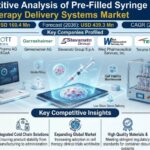
Key companies profiled in the FMI report include:
- Becton, Dickinson and Company
- SCHOTT Pharma AG & Co. KGaA
- Gerresheimer AG
- Stevanato Group S.p.A.
- West Pharmaceutical Services, Inc.
- Terumo Corporation
- Nipro Corporation
Competition is shaped by material science expertise, manufacturing quality, compatibility with aseptic filling equipment and the ability to support product qualification requirements.
Manufacturers are focusing on specialized polymer and glass formats, closure integrity, ready-to-use packaging configurations and cryogenic performance. Technical documentation and validation support are also important because cell therapy developers must assess primary packaging as part of the broader product development and manufacturing process.
Access Full Report: https://www.futuremarketinsights.com/reports/pre-filled-syringe-cell-therapy-delivery-systems-market
What Should Pre-Filled Syringe Cell Therapy Delivery System Manufacturers Prioritize?
Market participants can focus on the following strategic priorities:
- Advance material compatibility: Develop packaging materials that meet the specific requirements of living-cell formulations and undergo appropriate extractables and leachables assessment.
- Validate cryogenic performance: Establish container-closure integrity and material performance under the intended freezing, storage and thawing conditions.
- Expand RTU capabilities: Develop ready-to-use formats compatible with automated aseptic filling systems and relevant manufacturing requirements.
- Improve delivery configurations: Offer suitable needle, tip and closure formats that address the needs of different cell therapy products and administration protocols.
- Support early-stage qualification: Engage with therapeutic developers during product development so packaging selection and validation can progress alongside clinical development.
- Strengthen manufacturing consistency: Maintain quality systems and process controls that support reproducible production of specialized primary packaging.
- Build strategic partnerships: Collaborate with cell therapy developers, fill-finish CMOs and equipment suppliers to improve compatibility across the manufacturing and administration workflow.
The market’s long-term opportunity will depend on the ability of packaging suppliers to demonstrate reliable performance while meeting the specialized technical and regulatory requirements of advanced therapies.
Frequently Asked Questions
- How big is the pre-filled syringe cell therapy delivery systems market in 2026?
The global market is estimated at USD 160.4 million in 2026.
- What is the projected market value by 2036?
Based on the figures supplied for this release, the market is projected to reach USD 439.3 million by 2036.
- What is the expected CAGR?
The market is projected to expand at a CAGR of 10.6% from 2026 to 2036.
- Which material segment leads the market?
COP/COC polymer syringes are expected to lead, accounting for 58.0% of the market in 2026.
- Which sterility and supply format holds the largest share?
Ready-to-use (RTU) nested systems are projected to account for 49.0% of the market in 2026.
- Which needle/tip format leads the market?
Staked needle systems are expected to hold the leading position, with a 38.0% share in 2026.
- Which temperature and stability segment dominates?
Deep-cold and cryogenic-compatible systems are projected to account for 41.0% of the market in 2026.
- Which country is projected to grow fastest?
India is expected to record the highest CAGR among the listed countries, at 12.4% from 2026 to 2036.
- What is driving demand for specialized cell therapy delivery systems?
Expansion of cell therapy pipelines, the need to preserve cellular viability, demand for specialized primary packaging and growth in automated fill-finish operations are key growth factors.
- Who are the key companies in this market?
Key companies profiled include Becton, Dickinson and Company, SCHOTT Pharma, Gerresheimer, Stevanato Group, West Pharmaceutical Services, Terumo Corporation and Nipro Corporation.
Related Reports:
- CRISPR-Integrated Gene Editing Delivery Devices Market – https://www.futuremarketinsights.com/reports/crispr-integrated-gene-editing-delivery-devices-market
- Hyperspectral Wound Assessment Imaging Market – https://www.futuremarketinsights.com/reports/hyperspectral-wound-assessment-imaging-market
- Edge AI Continuous Vital Signs Patch Market – https://www.futuremarketinsights.com/reports/edge-ai-continuous-vital-signs-patch-market
About Future Market Insights (FMI)
Future Market Insights (FMI) is a global market intelligence and consulting firm providing comprehensive market research, competitive intelligence, and strategic business insights across industries. The firm delivers detailed forecasts, technology analysis, and data-driven recommendations that support informed decision-making for manufacturers, investors, distributors, and policymakers worldwide.
For Press & Corporate Inquiries
Rahul Singh
AVP – Marketing and Growth Strategy
Future Market Insights, Inc.
+91 8600020075
For Sales – sales@futuremarketinsights.com