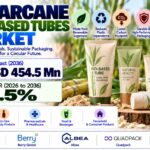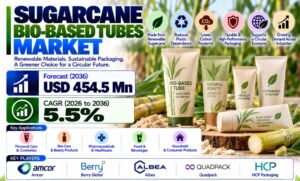


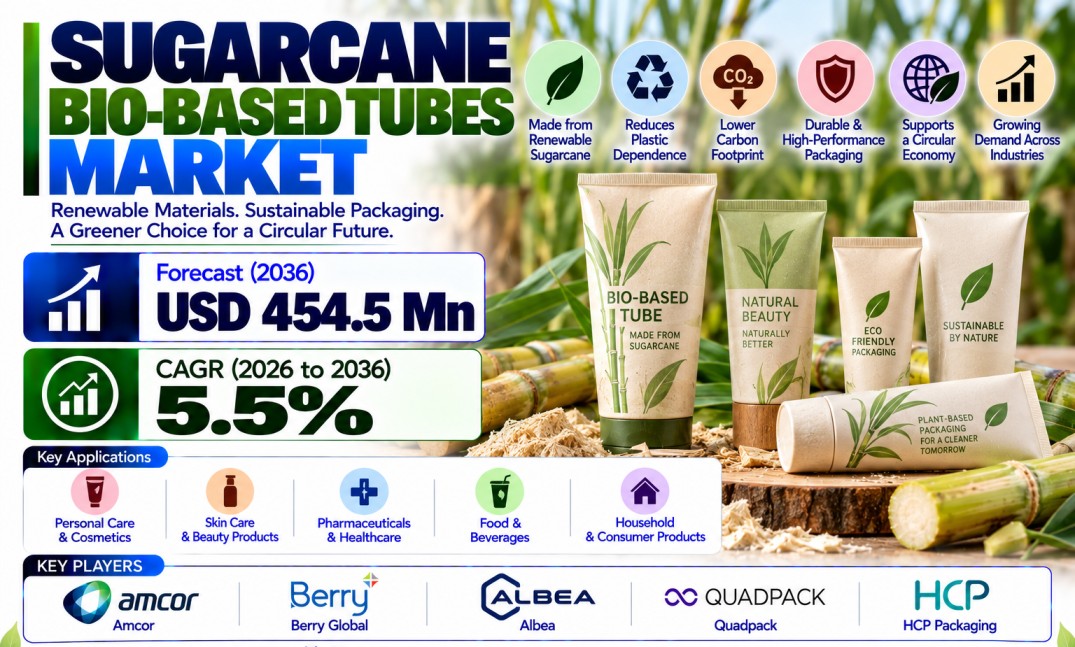
The global sugarcane bio-based tubes market is projected to grow from USD 266.1 million in 2026 to USD 454.5 million by 2036, registering a compound annual growth rate (CAGR) of 5.5%, according to Future Market Insights (FMI). Valued at USD 252.2 million in 2025, the market is expected to generate an additional USD 188.4 million in revenue over the forecast period.
The commercial opportunity is shifting beyond simply replacing fossil-derived polyethylene. Beauty brands are looking for packaging that combines renewable feedstock with recycled content while retaining familiar tube dimensions, filling-line compatibility and product performance. FMI expects hybrid tubes pairing a sugarcane-derived polyethylene sleeve with a post-consumer recycled (PCR) closure and a thinner wall to account for an important share of new opportunities.
>> Request For Sample Report | Customize Report | Purchase Full Report – https://www.futuremarketinsights.com/reports/sample/rep-gb-35721
Regulation puts material choices under scrutiny
The European Union’s Packaging and Packaging Waste Regulation (EU) 2025/40 entered into application on August 12, 2026. The regulation establishes requirements affecting packaging recyclability and recycled content, with 2030 targets forming part of the transition. For cosmetic packaging teams, the distinction between renewable and recycled material is commercially important: sugarcane-derived polyethylene uses renewable feedstock, but its renewable origin does not count as recycled plastic under recycled-content tax rules.
The United Kingdom’s Plastic Packaging Tax also applies to plastic packaging components containing less than 30% recycled plastic. According to FMI, this creates a cost disadvantage for bio-based tubes that do not incorporate PCR material. Hybrid designs can help brands combine renewable content with recycled components, although each finished pack still needs to meet its performance and material requirements.
Supply availability is another consideration. In May 2025, Braskem reported annual green ethylene output at its Triunfo facility in Brazil had reached 275,000 tonnes following expansion. FMI notes that tube converters compete with film, bottle and cap manufacturers for the same renewable resin supply, making dependable allocation an important factor in scaling production.
Where growth is fastest
The UAE leads FMI’s eight profiled country markets, with the Gulf region’s premium beauty retail demand supporting interest in documented lower-impact materials.
- United Arab Emirates – 6.8% CAGR: Premium beauty retail and travel channels are supporting demand for sugarcane-based tubes. Suppliers must demonstrate renewable content without compromising finish quality.
- Saudi Arabia – 6.5% CAGR: Brand sustainability programmes and Vision 2030’s links between waste management and circular-economy investment are supporting adoption.
- South Korea – 6.2% CAGR: Government plans to reduce naphtha-based virgin plastic use by more than 30% by 2030 and introduce recycled-content targets for cosmetic and food containers are shaping material choices.
- United States – 5.9% CAGR: California’s packaging rules are influencing design decisions for brands operating across multiple states.
- United Kingdom – 5.5% CAGR: Plastic Packaging Tax treatment makes the recycled content of the complete packaging specification an important purchasing consideration.
- Germany – 5.2% CAGR: Established collection and recycling systems favour packaging that fits conventional polyethylene recycling streams.
- France – 4.9% CAGR: Reuse, refill and lighter-packaging priorities are increasing the need for evidence on pack weight and sortability.
- Japan – 4.6% CAGR: Design certification criteria for cosmetic containers favour specified polyethylene and polypropylene formats, including uncoloured or white bodies and separable caps.
What leads the market
FMI’s 2026 segment estimates show that demand is concentrated in familiar tube formats and polymer materials, allowing brands to change feedstock without redesigning every component.
- Product type – Standard components: 44%. Familiar neck, shoulder and cap designs can reduce switching risk on existing filling lines.
- Material – Plastics and PCR resins: 39%. Polymer sleeves remain compatible with established tube extrusion and welding processes.
- Capacity – 15–50 ml: 35%. Face creams and serums can absorb the resin premium with a relatively small effect on total pack cost.
- Decoration – Standard: 43%. Familiar artwork and printing approaches can reduce the number of additional trials needed during material conversion.
- End use – Skincare brands: 33%. Creams, sunscreens and treatment products support demand for squeezable tubes and renewable packaging materials.
The hurdle: Renewable content alone is not enough
The main restraint is the treatment of renewable polyethylene under recycled-content rules. A tube made with sugarcane-derived PE can reduce dependence on fossil feedstock, but the renewable origin does not make that PE recycled material. Bio-only formats may therefore face a weaker cost case where taxes or requirements depend on recycled content.
Supply concentration adds a second challenge. Tube converters need reliable access to green resin while also proving that the finished pack performs as required. Squeeze, print and leak testing, wall thickness, closure compatibility and filling-line performance all affect whether a trial can progress to repeat orders.
FMI identifies hybrid packs as the main opportunity: a sugarcane-derived PE sleeve, PCR closure and thinner wall can combine renewable and recycled content while reducing material use. Buyers still need to verify the complete packaging specification rather than rely on a single sustainability attribute.
Recent developments and industry investment
Three dated developments illustrate how resin supply, tube design and closures are evolving:
- May 6, 2025 – Braskem: The company reported that annual green ethylene output at its Triunfo, Brazil, facility had reached 275,000 tonnes following expansion, up from 200,000 tonnes at launch in 2010.
- June 10, 2025 – Amcor: Amcor reported reducing the wall thickness of 50 mm Bulldog tube sleeves by more than 16%, saving 8.5 tonnes of plastic annually after squeeze, print and leak trials.
- July 8, 2026 – Aptar: Aptar announced four e-commerce-ready closures for beauty, personal care and home care applications. The closures were tested to Amazon ISTA-6 and offered in PCR versions.
FMI profiles Amcor, Berry Global, Albea, Quadpack, HCP Packaging, Aptar, Silgan Holdings, APC Packaging, Baralan and Gerresheimer. The companies cover tube conversion, dispensing and closure systems, and premium beauty components.
Analyst perspective
“Hybrid tubes combining a sugarcane-derived PE sleeve, a PCR closure and a thinner wall will offer the largest revenue opportunity in this market through 2036. Converters documenting renewable content, recycled content and leak performance on one pack, with secured resin allocation from Brazil, will turn skincare trials into multi-year supply contracts.”
— Nandini Roy Choudhury, Principal Consultant, Future Market Insights
What this means for beauty brands and packaging procurement teams
- Assess the complete pack, not just the tube sleeve. Review renewable content, PCR content, closure materials and wall thickness together. A bio-based sleeve alone may not address recycled-content requirements or related tax exposure.
- Qualify performance before scaling a material change. Test squeeze behaviour, print quality, leak performance and compatibility with existing filling equipment. Document the results against a defined specification before moving from trial quantities to repeat orders.
- Secure material supply alongside technical approval. Confirm resin availability and allocation with converters before committing to a wider rollout. A technically qualified tube can still face delays if renewable resin supply is constrained or competing applications draw on the same feedstock.
Contact Us:
Future Market Insights Inc.
Christiana Corporate, 200 Continental Drive,
Suite 401, Newark, Delaware – 19713, USA
T: +1-347-918-3531
For Sales Enquiries: sales@futuremarketinsights.com
About Future Market Insights
Future Market Insights (FMI) is a leading provider of market research and consulting services, offering syndicated and customized research across industries including Packaging, Consumer Product, and Food & Beverage.