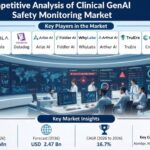


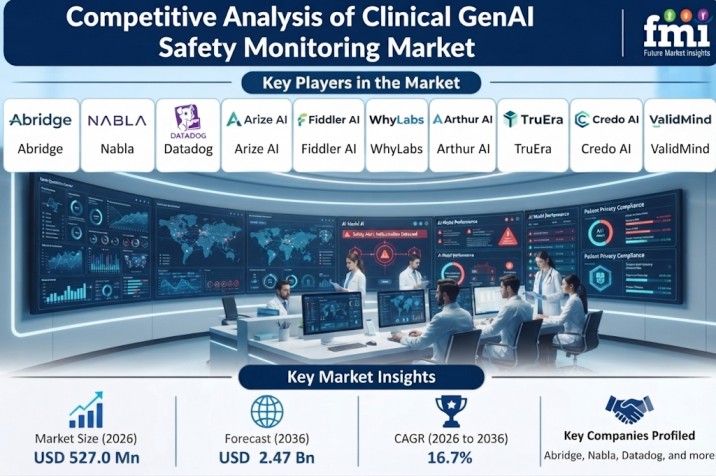
The report estimates the Clinical GenAI Safety Monitoring Market at USD 527 million in 2026, compared with USD 450 million in 2025, and projects it to reach USD 2.10 billion by 2036, representing a CAGR of 16.7% between 2026 and 2036. Growth is supported by increasing healthcare GenAI deployment, regulatory accountability requirements and the need to identify hallucinations, clinical errors, algorithmic bias and privacy risks before they affect patient care.
Request a Sample and Research Information https://www.futuremarketinsights.com/reports/sample/rep-gb-32189
Clinical GenAI Safety Monitoring Market: Key Growth Indicators
- Market value: USD 527 million in 2026.
- Forecast value: USD 2.10 billion by 2036 (headline market estimate).
- Growth rate:7% CAGR between 2026 and 2036.
- Key growth driver: Increasing adoption of generative AI across healthcare environments and demand for continuous safety monitoring.
- Leading monitoring focus: Hallucination and clinical risk detection, accounting for 29% share in 2026.
- Major care setting: Hospitals and integrated delivery networks (IDNs), accounting for 46% share in 2026.
- Dominant offering: Software platforms, accounting for 41% share in 2026.
Why Is Demand for Clinical GenAI Safety Monitoring Increasing?
The growing adoption of generative AI in healthcare is increasing the need for continuous monitoring and validation solutions. Hospitals and healthcare organizations are deploying AI-powered applications across clinical documentation, patient communication, diagnostic support and treatment planning. These applications require ongoing assessment to ensure that generated information remains clinically accurate and safe.
The risk of AI hallucinations is another important growth factor. Generative AI systems can produce convincing but medically inaccurate information, potentially affecting clinical documentation, diagnostic recommendations and treatment decisions. Monitoring solutions help identify these risks before unsafe outputs influence patient care.
Regulatory accountability is also encouraging investment. Healthcare providers and AI developers face increasing pressure to demonstrate algorithmic transparency, validate model performance and maintain audit trails. As a result, safety monitoring is becoming an important component of enterprise healthcare AI deployment.
Clinical GenAI Safety Monitoring and Healthcare AI Governance Shape Market Demand
Clinical GenAI safety monitoring solutions evaluate generative AI applications for clinical accuracy, hallucination risks, algorithmic bias, privacy violations and regulatory compliance. These capabilities are increasingly important as healthcare providers expand the use of large language models and AI-powered clinical applications.
Monitoring platforms support several functions, including:
- Performance and drift monitoring: Identifying changes in model behavior and output quality over time.
- Hallucination and clinical risk detection: Flagging inaccurate medical information and potentially unsafe AI-generated recommendations.
- Bias and fairness assessment: Evaluating whether AI outputs produce inconsistent or discriminatory results.
- Privacy and security monitoring: Identifying potential data exposure and privacy-related risks.
- Audit trails and traceability: Maintaining records of AI activity to support accountability and compliance.
Software platforms accounted for 41% of market demand in 2026, reflecting healthcare organizations’ preference for continuous automated monitoring rather than relying exclusively on periodic manual assessments.
Hospitals and Integrated Delivery Networks Influence Procurement
Hospitals and integrated delivery networks represent an important customer segment because they increasingly deploy enterprise-level generative AI applications across multiple clinical departments.
These organizations require monitoring infrastructure to evaluate AI-generated clinical notes, chatbot responses and diagnostic support outputs. Continuous validation can help healthcare administrators identify performance changes and establish safeguards before expanding AI deployments.
Integration with existing hospital IT infrastructure is another important procurement consideration. Compatibility with electronic health record platforms, including Epic, Oracle Cerner and Meditech, through standards such as FHIR and SMART on FHIR, can support monitoring within established clinical workflows.
Healthcare organizations also evaluate vendors based on clinical validation capabilities, data privacy safeguards, explainability, auditability and integration support.
Regional Growth Opportunities in Clinical GenAI Safety Monitoring
Regional adoption is influenced by healthcare digitalization, regulatory developments and investments in clinical AI governance. India is projected to record the highest country-level growth rate among the countries highlighted in the FMI report.
- India: Demand is projected to grow at a CAGR of 18.2% from 2026 to 2036, supported by healthcare digitalization and emerging AI governance requirements.
- United States: The market is expected to expand at 17.4% CAGR, supported by healthcare AI deployment and regulatory attention to algorithmic accountability.
- United Kingdom: Demand is forecast to increase at 16.9% CAGR, reflecting NHS AI governance initiatives and transparency requirements.
- Germany: The market is projected to grow at 16.3% CAGR, supported by digital health initiatives and increasing hospital AI adoption.
- Canada: Demand is expected to rise at 15.8% CAGR, supported by provincial healthcare procurement standards for AI safety solutions.
Access The Full Report: https://www.futuremarketinsights.com/reports/clinical-genai-safety-monitoring-market
Competitive Landscape: AI Observability and Clinical Validation Define Competition
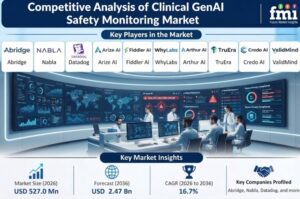
The Clinical GenAI Safety Monitoring Market includes specialist AI monitoring companies, healthcare AI application developers and enterprise observability providers. Competition is shaped by clinical risk detection, model explainability, regulatory compliance, EHR integration and the ability to monitor AI systems continuously in live healthcare environments.
Notable companies include:
- Abridge
- Nabla
- Datadog
- Arize AI
- Fiddler AI
- WhyLabs
- Arthur AI
- TruEra
- Credo AI
- ValidMind
Abridge and Nabla participate in the healthcare AI application ecosystem, while Datadog and Arize AI contribute AI observability and monitoring capabilities. Fiddler AI and WhyLabs focus on model monitoring, explainability and performance assessment.
Arthur AI, TruEra, Credo AI and ValidMind strengthen the competitive environment through AI governance, model risk management, explainability and compliance-oriented monitoring capabilities.
The competitive environment increasingly favors vendors that can demonstrate healthcare-specific validation rather than relying solely on general-purpose AI observability. Integration with hospital IT infrastructure and partnerships with healthcare institutions are also becoming important competitive differentiators.
What Should Clinical GenAI Safety Monitoring Manufacturers Prioritize?
Companies should prioritize monitoring platforms that identify hallucinations and clinical risks in real time. Healthcare-specific validation capabilities will be essential as hospitals move generative AI applications from pilot programs into enterprise-wide clinical operations.
Manufacturers should also invest in model explainability, bias detection, privacy protection and comprehensive audit trails. Integration with existing electronic health records and hospital IT infrastructure can improve adoption by reducing implementation complexity.
Managed monitoring services and cloud-based deployment models represent additional opportunities. Vendors that combine continuous monitoring, regulatory support and dependable technical services may be better positioned to address the evolving requirements of healthcare organizations.
For competitive positioning, businesses can also evaluate FMI’s Competitive Analysis services, which support assessments of market participants, competitive structures and strategic positioning.
Frequently Asked Questions
- How large is the Clinical GenAI Safety Monitoring Market in 2026?
The global market is estimated to reach USD 527 million in 2026, supported by growing healthcare GenAI adoption and demand for clinical AI safety solutions.
- What is the projected market value by 2036?
The headline market estimate projects the market to reach USD 2.10 billion by 2036, registering a CAGR of 16.7% between 2026 and 2036.
- What is driving demand for clinical GenAI safety monitoring?
Increasing generative AI deployment in healthcare, regulatory accountability, hallucination detection, clinical risk management and patient safety requirements are supporting market growth.
- Which monitoring focus accounts for the largest market share?
Hallucination and clinical risk monitoring accounts for an estimated 29% share in 2026, reflecting the importance of identifying potentially harmful AI-generated medical information.
- Which care setting dominates the market?
Hospitals and integrated delivery networks account for approximately 46% of the market in 2026, supported by enterprise AI deployments and growing requirements for clinical AI governance.
- Who are the key companies in the Clinical GenAI Safety Monitoring Market?
Abridge, Nabla, Datadog, Arize AI, Fiddler AI, WhyLabs, Arthur AI, TruEra, Credo AI and ValidMind are among the key companies.
About Future Market Insights (FMI)
Future Market Insights (FMI) is a global market intelligence and consulting firm providing comprehensive market research, competitive intelligence, and strategic business insights across industries. The firm delivers detailed forecasts, technology analysis, and data-driven recommendations that support informed decision-making for manufacturers, investors, distributors, and policymakers worldwide.
For Press & Corporate Inquiries
Rahul Singh
AVP – Marketing and Growth Strategy
Future Market Insights, Inc.
+91 8600020075
For Sales – sales@futuremarketinsights.com
For Media – Rahul.singh@futuremarketinsights.com
For Web – https://www.futuremarketinsights.com