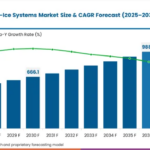


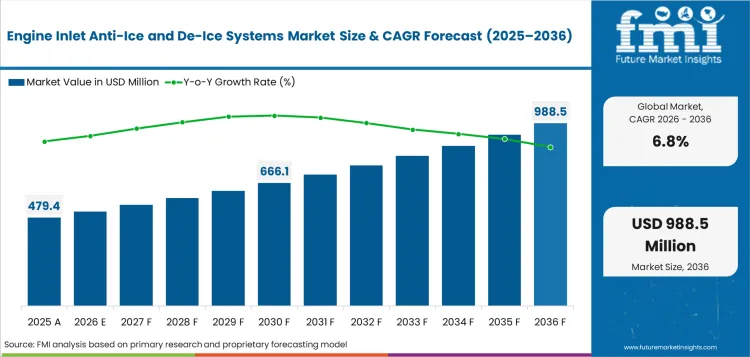
Future Market Insights (FMI) estimates that the engine inlet anti-ice and de-ice systems market was valued at USD 479.4 million in 2025 and is expected to reach USD 512.0 million in 2026. Demand is forecast to reach USD 988.5 million by 2036, expanding at a 6.8% CAGR during the forecast period. Integrated systems are expected to account for 55.0% of integration-level demand in 2026, while turbofan applications are projected to represent 54.0% of engine-type demand.
Engine inlet anti-ice and de-ice systems are gaining commercial importance as aircraft manufacturers and airlines place greater emphasis on certified protection against icing conditions. The shift is moving the market beyond basic hardware supply toward integrated systems supported by thermal testing, certification evidence, approved documentation, and retrofit capabilities.
Get detailed market forecasts, competitive benchmarking, and pricing trends:
https://www.futuremarketinsights.com/reports/sample/rep-gb-33241
Why are certified engine inlet protection systems gaining commercial importance?
For aircraft manufacturers and engine suppliers, inlet anti-ice and de-ice systems are increasingly tied to certification rather than treated as standalone thermal components. The eCFR requirements for turbine engines require manufacturers to demonstrate safe operation under defined icing conditions, increasing the importance of test evidence, thermal margins, and approved technical documentation.
Certification requirements can influence supplier selection because inlet protection must perform reliably across specified icing environments. Systems therefore need to demonstrate that heat distribution, airflow protection, valves, sensors, and related components can operate together under demanding conditions.
The requirement for ground-idle testing at defined icing conditions further increases the value of validated system designs. Suppliers able to demonstrate performance across Appendix C and O icing conditions can provide aircraft and engine manufacturers with stronger evidence during qualification and integration programs.
Fleet maintenance is adding another layer of demand. Aging aircraft require inspection and replacement of inlet-related components during nacelle and engine service. FAA airworthiness directives affecting Boeing 787 aircraft in May 2024 and Boeing 737-8 and 737-9 aircraft in June 2024 illustrate how fleet-level technical actions can create additional demand for approved repairs, electrical changes, seal replacement, and associated testing.
Which technologies and aircraft applications are shaping demand?
Bleed-air systems remain an established technology because they use heated engine air to protect inlet surfaces from ice accumulation. Their long-standing use across aircraft programs gives airlines and MRO providers extensive experience with inspection, maintenance, and troubleshooting.
Electro-thermal systems are gaining attention as newer aircraft architectures place greater emphasis on electrical control. These systems can deliver heat to specific inlet areas and may support more targeted thermal management while reducing dependence on pneumatic components.
Integrated systems are expected to account for 55.0% of integration-level demand in 2026. Integration allows heaters, valves, sensors, controllers, ducts, and related components to be evaluated as a coordinated protection package, potentially simplifying qualification and maintenance planning.
Turbofan engines are forecast to represent 54.0% of engine-type demand in 2026. Commercial narrowbody and widebody aircraft equipped with turbofan engines continue to create demand for certified inlet protection as airlines expand and maintain their fleets.
The market also extends across turboprop, turboshaft, business jet, helicopter, and military applications, creating different technical requirements based on engine architecture, aircraft category, operating environment, and certification class.
What does the analyst see as the key commercial issue?
“Engine inlet anti-ice and de-ice systems are becoming a reliability decision for aircraft operators. A small failure near the inlet lip can affect aircraft readiness during winter operations. Suppliers with certified thermal control and nacelle integration proof are expected to be preferred across new aircraft and retrofit programs.”- Nikhil Kaitwade, Principal Consultant, Future Market Insights
The analyst perspective highlights the increasing connection between inlet protection, aircraft availability, and supplier qualification. Airlines need systems that can perform consistently during icing conditions while allowing maintenance teams to complete inspections and repairs without unnecessary aircraft downtime.
For suppliers, certification capability and nacelle integration experience are therefore becoming important competitive factors. Product performance alone may not be sufficient where airlines and aircraft manufacturers require documented thermal performance and approved repair procedures.