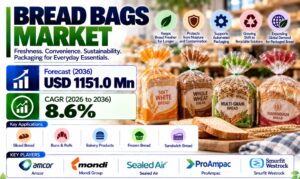


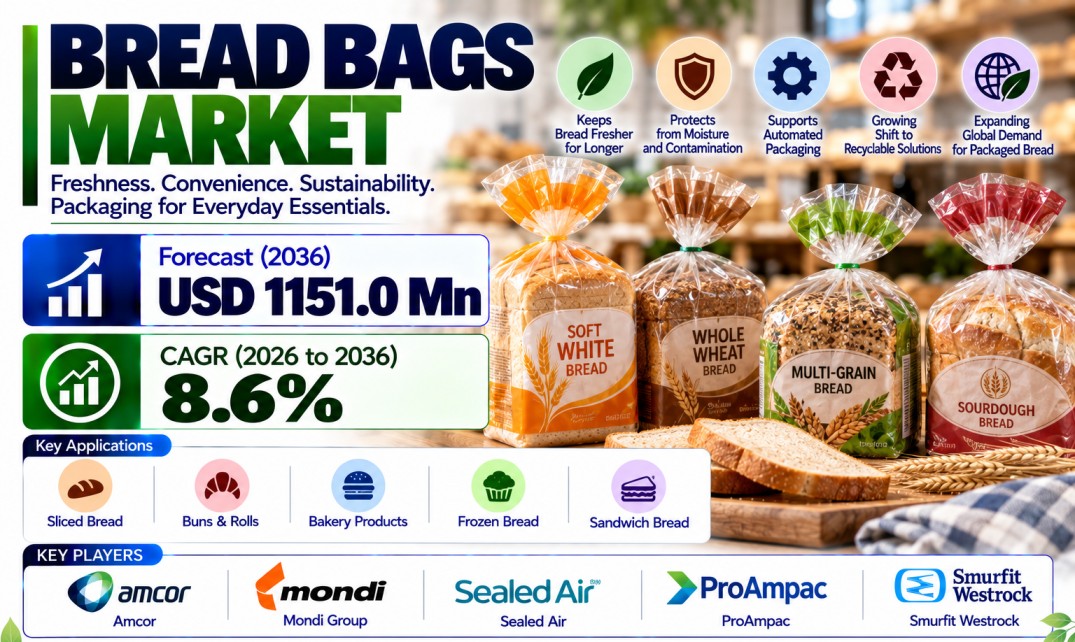
The global bread bags market is projected to reach USD 1,151.0 million by 2036, up from USD 504.4 million in 2026, at a compound annual growth rate (CAGR) of 8.6%, according to Future Market Insights (FMI). The market was valued at USD 464.5 million in 2025, and the forecast period is expected to generate USD 646.6 million in additional market value.
The growth outlook reflects changes in how bakeries source packaging rather than a broad rise in bread consumption. More packaged bread is moving through supermarkets and in-store bakeries, while converters are developing coated-paper and recycle-ready mono-PE formats. Industrial bakeries are expected to account for 48% of demand by end use in 2026, supported by continuous production and large-volume orders for standardized bags.
>> Access detailed market insights: https://www.futuremarketinsights.com/reports/brochure/rep-gb-35720
Regulation and material costs shape purchasing decisions
Producer-responsibility fees are making packaging material a more consequential purchasing decision. In the United Kingdom, the Department for Environment, Food & Rural Affairs (Defra) published 2025–2026 Extended Producer Responsibility for Packaging base fees on June 30, 2025. The published rates cited by FMI are £196 per tonne for paper and card, £423 per tonne for plastic and £461 per tonne for fibre-based composite packaging.
Those differences give bakeries a financial reason to review material specifications, but the lowest fee does not automatically make a format suitable. A replacement bag must protect bread freshness, release cleanly from wicket pins and run at the required speed on existing equipment. Coatings, shelf-life performance and material classification can all affect the final decision.
The underlying demand picture also calls for care. According to USDA figures cited in FMI’s report, US per-capita flour consumption fell to 126.6 pounds in 2025, its lowest level in 39 years. In mature markets, therefore, growth in bag revenue will depend partly on population, the shift from loose to packaged bread and higher value per bag—not simply on people eating more bread.
Where growth is fastest
FMI projects growth across all eight profiled countries, with the UAE leading the group at 10.2% CAGR through 2036.
- United Arab Emirates – 10.2%: Expanding retail bakery sales across Gulf supermarkets are expected to support growth in packaged-bread volumes.
- Saudi Arabia – 9.9%: The market is forecast to benefit from increasing demand for packaged bakery products.
- South Korea – 9.6%: Packaging material and structure grade-labeling requirements are part of the changing market context.
- United States – 9.3%: Producer-responsibility rules and the move toward recycle-ready formats are shaping packaging decisions.
- United Kingdom – 8.9%: Material-based EPR fees are encouraging buyers to compare paper and plastic on total packaging cost.
- Germany – 8.6%: Packaging compliance and material selection are expected to influence supplier qualification.
- France – 8.3%: Single-use plastic reduction measures form part of the wider context for material choices.
- Japan – 7.9%: Mature sorting systems are expected to influence the pace and type of material adoption.
What leads the market
The largest segments show where established production systems and everyday bakery requirements continue to support demand. FMI’s 2026 estimates are:
- Bag type – LDPE bags: 39%. Moisture protection and reliable release from wicket pins support their use on high-speed packaging lines.
- Material – Paper and board: 37%. Lower UK EPR base fees for paper and card support interest in fibre-based alternatives.
- Bakery application – Bread and rolls: 38%. Daily production and retail sales of fresh loaves and rolls sustain demand for primary bags.
- Function – Primary packaging: 57%. Each packaged loaf generally requires a bag that holds the product and supports branding and reclosure.
- End use – Industrial bakeries: 48%. Automated plants purchase standardized bags in large quantities for continuous production.
The hurdle: A new bag must work on the existing line
The main restraint is the qualification process. A material change can fail if a bag tears during feeding, runs too slowly, closes poorly or does not deliver the required shelf life. These operational risks can delay a switch even when the alternative material offers lower producer-responsibility fees.
That is why equipment compatibility matters as much as the material itself. Suppliers need to demonstrate performance on the bakery’s actual wicket, bagging and closing equipment. For buyers, the relevant comparison is the total cost of a qualified bag—including fees, line performance and product requirements not the price per unit alone.
Recent developments and industry signals
Three developments cited in the report illustrate how suppliers and brands are responding to changing packaging requirements:
- September 2, 2025 – Kwik Lok: The company debuted its 872 Plus bag-closing machine at IBIE 2025. Kwik Lok described the system as having fewer parts, reduced maintenance requirements and higher output.
- October 17, 2025 – ProAmpac: ProAmpac announced the acquisition of International Paper’s bag-converting operations in California, Oregon and Texas as part of its Fiberization of Packaging initiative.
- April 15, 2026 – Modern Milkman: Packaging Europe reported that Modern Milkman introduced a home-compostable, single-layer bread bag made with Treetop Biopak.
FMI profiles Amcor, Mondi Group, Sealed Air, ProAmpac, Smurfit Westrock, Novolex, Kwik Lok, Sabert, Detmold Group and Vegware, among other participants. These companies span flexible films, paper-bag conversion, bakery packaging, closure systems and compostable formats.
Analyst perspective
“Recyclable bread bags running at full speed on existing wicket lines will receive the larger share of new bakery contracts. Converters proving line speed, shelf life and lower EPR fee exposure on one specification will convert trials into multi-year supply.”
— Nandini Roy Choudhury, Principal Consultant, Future Market Insights
What this means for bakery manufacturers and packaging buyers
- Test performance before changing materials. Run replacement bags on the actual production line and assess feeding, wicket release, closure performance and shelf life. A lower material fee is useful only if the format meets operating requirements.
- Compare total packaging cost. Include producer-responsibility fees, bag price, conversion requirements and any line adjustments. For UK buyers, the cited 2025–2026 base fees show why material selection can affect the economics of a high-volume contract.
- Qualify suppliers against a specific specification. Ask converters to demonstrate the required line speed and product performance for each proposed material. A documented, repeatable trial can reduce the risk of disruption when moving to coated paper or recycle-ready mono-PE
Contact Us:
Future Market Insights Inc.
Christiana Corporate, 200 Continental Drive,
Suite 401, Newark, Delaware – 19713, USA
T: +1-347-918-3531
For Sales Enquiries: sales@futuremarketinsights.com
About Future Market Insights
Future Market Insights (FMI) is a leading provider of market research and consulting services, offering syndicated and customized research across industries including Packaging, Consumer Product, and Food & Beverage.