


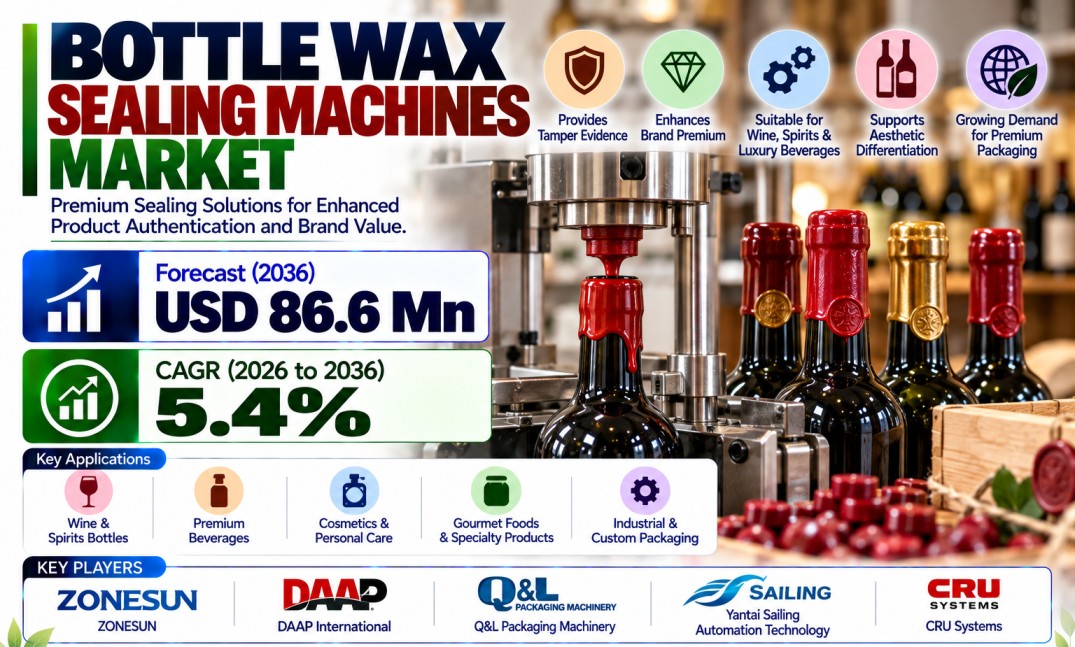
The global bottle wax sealing machines market is estimated at USD 51.2 million in 2026 and is projected to reach USD 86.6 million by 2036, expanding at a compound annual growth rate (CAGR) of 5.4%, according to Future Market Insights (FMI). The market was valued at USD 48.6 million in 2025, with a projected incremental opportunity of USD 35.4 million over the forecast period.
Demand is tied to a specialized packaging application: applying wax to bottle necks and closures to distinguish selected products, particularly premium spirits and limited releases. Because conventional closures generally provide the required closure function, wax is primarily a finishing feature rather than a replacement for the main closure. That distinction makes batch flexibility, changeover time and equipment configuration important investment considerations.
>> Request For Sample Report | Customize Report | Purchase Full Report – https://www.futuremarketinsights.com/reports/sample/rep-gb-35749
Context: Premium packaging faces a selective demand environment
The market’s near-term prospects depend on where producers can justify additional finishing costs. The International Organisation of Vine and Wine (OIV), in its State of the World Wine Sector in 2025 report published in May 2026, reported global wine production of 227.0 million hectolitres in 2025, while consumption declined 2.7% to 208.0 million hectolitres. This environment limits the case for equipment purchases based solely on higher wine volumes.
Premium spirits offer a more targeted application. In September 2026, the UK Department for Environment, Food & Rural Affairs (Defra) reported that UK whisky exports were valued at GBP 5.4 billion in 2025, although they declined 6.6% in real terms. Whisky remained the UK’s highest-value food and drink export. For wax-sealing equipment suppliers, this points to an established base of high-value products where bottle presentation can justify a specialized finishing step.
Where growth is fastest
Japan leads the profiled countries by forecast CAGR, followed by Italy and the United Kingdom. FMI’s country-level projections for 2026–2036 are:
- Japan – 6.4% CAGR: Export-oriented whisky, sake and other alcoholic beverages support opportunities for distinctive bottle presentation on selected premium products.
- Italy – 5.9% CAGR: A substantial wine-production base supports selective use among estate wines and limited releases, although wine output does not translate directly into wax-sealing equipment demand.
- United Kingdom – 5.7% CAGR: The importance of whisky exports provides a relevant downstream base for premium bottle-finishing applications.
- France – 5.4% CAGR: Premium wine and spirits remain potential applications, while softer production conditions limit the case for capacity-led investment.
- Australia – 5.2% CAGR: Export-oriented producers may use wax finishing to differentiate selected products, although inventory conditions can constrain investment in additional capacity.
- Portugal – 5.0% CAGR: Demand is likely to remain concentrated among premium wine and fortified-wine producers rather than broad-based production expansion.
- United States – 4.8% CAGR: Premium spirits and smaller-producer bottling operations offer opportunities for standalone finishing equipment.
- Germany – 4.6% CAGR: FMI projects slower growth than in the other profiled markets.
What leads the market
The leading segments reflect the need to mechanize wax application without committing every product to a fully integrated, high-speed line. FMI’s 2026 estimates are:
- Automation – Semi-automatic machines: 49.0%. These systems mechanize parts of the dipping process while retaining flexibility for manual loading, unloading and short batches.
- Configuration – Standalone floor-mounted systems: 54.0%. A separate finishing station can be added after filling and closure without requiring extensive changes to the main bottling line.
- Application method – Bottle-neck dipping: 72.0%. A single immersion can apply wax around the closure and adjoining neck, making it suitable for conventional wax-covered bottle designs.
- End use – Spirits producers: 44.0%. The largest end-use share reflects wax sealing’s role in the presentation of premium spirits and selected limited releases.
- Equipment demand – New installations: 57.0%. New purchases can support producers mechanizing manual dipping or introducing wax finishing to products that previously used only their primary closure.
The hurdle: Wine-sector softness and the economics of small batches
The principal restraint is the limited case for capacity-led investment when downstream wine demand is weak. Wax sealing is a specialized finishing process, so a producer must justify the added equipment and operating steps through product differentiation, labor savings or more repeatable application.
For short production runs, rated machine speed alone can also be misleading. FMI’s illustrative calculation for a 500-bottle batch at 30 bottles per minute shows that reducing changeover time from 60 minutes to 10 minutes increases effective output by 187.5%. By comparison, doubling running speed from 30 to 60 bottles per minute increases effective output by 12.2% under the same 60-minute changeover assumption. Buyers should therefore assess changeover time alongside nominal throughput.
Recent developments and industry signals
Three dated developments and industry indicators help explain the demand environment:
- May 2026 – OIV wine-sector report: The OIV reported global wine production of 227.0 million hectolitres in 2025 and a 2.7% decline in consumption to 208.0 million hectolitres. The figures highlight the limits of relying on broad wine-volume growth to support equipment demand.
- 2026 – Japan’s National Tax Agency export statistics: Japan-made alcoholic beverage exports reached JPY 149.5 billion in 2025, up 11.8% year on year. Whisky exports rose 12.2% to JPY 49.0 billion, while sake exports increased 5.6% to JPY 45.9 billion. Export-oriented premium products provide a potential application base for differentiated bottle finishing.
- September 2026 – Defra trade report: UK whisky exports were valued at GBP 5.4 billion in 2025, despite a 6.6% decline in real terms. Whisky remained the country’s highest-value food and drink export, underscoring the importance of premium spirits in the downstream market.
FMI profiles the following companies in the bottle wax sealing machines market: ZONESUN, DAAP International, Q&L Packaging Machinery, Yantai Sailing Automation Technology and CRU Systems. Their publicly described equipment ranges include semi-automatic dipping machines and, for some suppliers, higher-automation configurations. These company references describe the competitive field; they do not imply endorsement by FMI.
>> Access detailed market insights: https://www.futuremarketinsights.com/reports/brochure/rep-gb-35749
Analyst perspective
“Bottle wax sealing is evolving from a closure-related process into a specialized bottle-finishing step. For small production runs, machine economics depend heavily on changeover time. In an illustrative batch calculation, cutting changeover from 60 minutes to 10 minutes increases effective output by 187.5% for a 500-bottle batch at 30 bottles per minute, assuming batch time consists of changeover plus running time, while doubling running speed from 30 to 60 bottles per minute increases output by only 12.2%. This favors flexible semi-automatic systems and line-integrated modules for premium spirits, limited releases and other short-run applications.”
— Nandini Roy Choudhury, Principal Consultant at FMI
What this means for bottlers and packaging-equipment buyers
- Compare effective output, not just rated speed. Calculate expected output using actual batch sizes, changeover time, loading and unloading requirements. Frequent product changes can make a flexible machine more productive than a faster machine with longer setup times.
- Match the equipment configuration to the production line. A standalone floor-mounted system may suit intermittent wax finishing after closure application. Consider line-integrated modules when production requirements and operating volumes justify closer integration.
- Tie investment to specific premium products. Evaluate the expected production volume and commercial purpose of wax finishing for each product or release. Given the market’s specialized role and the softer wine-consumption environment, avoid assuming that overall beverage output will automatically translate into demand for wax-sealing equipment.
Learn About the Methodology : https://www.futuremarketinsights.com/methodology
Read the Full Report
For detailed market sizing, segment analysis, country forecasts, competitive benchmarking, and market methodology: https://www.futuremarketinsights.com/reports/bottle-wax-sealing-machines-market
Beverage Can Washer Systems Market: https://www.futuremarketinsights.com/reports/beverage-can-washer-systems-market
Bottle Capsule Spinning Machines Market: https://www.futuremarketinsights.com/reports/bottle-capsule-spinning-machines-market
Desiccant Canister Inserters Market: https://www.futuremarketinsights.com/reports/desiccant-canister-inserters-market
Contact Us:
Future Market Insights Inc.
Christiana Corporate, 200 Continental Drive,
Suite 401, Newark, Delaware – 19713, USA
T: +1-347-918-3531
For Sales Enquiries: sales@futuremarketinsights.com
About Future Market Insights
Future Market Insights (FMI) is a leading provider of market research and consulting services, offering syndicated and customized research across industries including Packaging, Consumer Product, and Food & Beverage.