

The global food tray market is projected to grow from US$13.1 billion in 2026 to US$23.2 billion by 2036, registering a compound annual growth rate (CAGR) of 5.9% during the 2026–2036 forecast period, according to Future Market Insights (FMI). Increasing prepared-food volumes, expansion of central delivery kitchens and growing supermarket meal-counter operations are supporting demand for rigid and semi-rigid food packaging solutions.
Food trays have become an important part of modern foodservice and retail packaging. They are used to contain, display, transport and serve meals while supporting portion control, product presentation and protection during distribution. As food businesses expand high-volume packaging operations, suppliers are under pressure to deliver trays that combine structural strength, reliable sealing and compatibility with automated filling equipment.
>> Get Detailed Market Forecasts, Competitive Benchmarking, and Pricing Trends: https://www.futuremarketinsights.com/reports/sample/rep-gb-14355
Plastic and Ready-to-Eat Meals Lead Market Demand
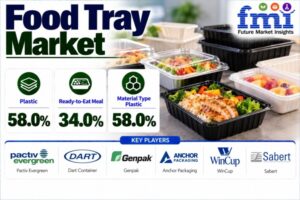
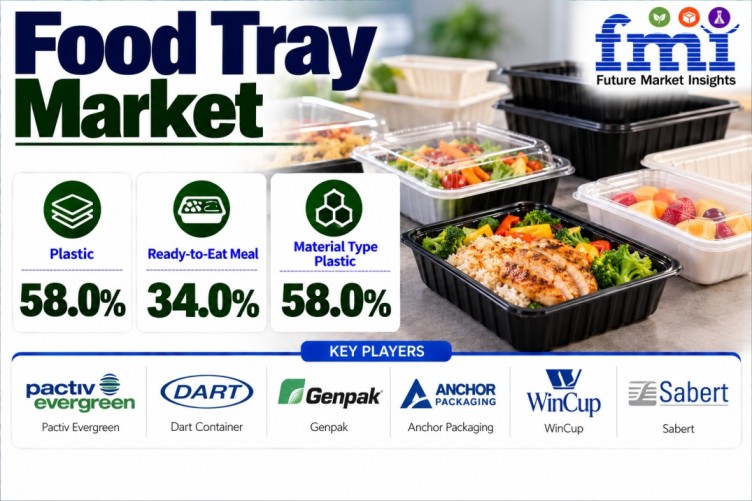
FMI estimates that plastic will account for 58.0% of the food tray market by material type in 2026. Its forming efficiency, moisture resistance and compatibility with established sealing systems support widespread use across food packaging applications. PET is used where product visibility is important, while polypropylene supports applications requiring heat and microwave performance.
By application, ready-to-eat meals are projected to account for 34.0% of market demand in 2026. The growth of prepared-food retail, takeaway meals and delivery services is increasing demand for trays that can carry food from portioning and filling through display and final delivery.
Other material categories covered by FMI include paperboard, aluminum and molded fiber. Application segments also include bakery and confectionery, fresh produce, meat and poultry, and other food categories.
Foodservice Expansion and Convenience Drive Growth
The expansion of central kitchens, supermarket prepared-food counters and institutional catering networks is a major driver of food tray demand. These operations require standardized packaging formats that can support high-volume meal preparation, consistent portioning and efficient transportation.
Food delivery also increases the importance of tray performance. Packaging must protect meal portions, separate different food components and prevent leakage during transit. Secure lids, compartment designs and stackable formats are therefore important purchasing considerations.
Automation is another important factor. High-speed meal packaging lines require consistent tray dimensions, flat rims and reliable denesting. Poor tray separation or incompatible sealing surfaces can lead to production interruptions, rejects and increased operating costs.
Sustainability and Material Innovation Shape Industry Trends
Food tray manufacturers are increasingly evaluating material efficiency and alternative packaging structures. Several developments are influencing product innovation:
- Lightweighting: Reducing tray weight while retaining stiffness and corner strength can lower material consumption and packaging costs.
- Recyclable mono-material formats: Simpler material structures can improve recovery potential where suitable collection and recycling infrastructure exists.
- Molded-fiber development: Fiber-based trays are gaining attention for applications where grease resistance, moisture management and heat performance meet operating requirements.
- Improved barrier performance: Coatings and material developments are helping suppliers address food protection and shelf-life requirements.
- Automated sealing compatibility: Consistent rim flatness and dimensional accuracy support reliable lidding and high-speed packaging operations.
Regulatory developments are also influencing purchasing decisions. The European Union’s Packaging and Packaging Waste Regulation, which generally applies from August 12, 2026, increases attention to packaging minimization and recyclability. For suppliers, material transitions must balance regulatory expectations with actual performance on customer production lines.
Regional Outlook: China Leads Country-Level Growth
FMI’s country analysis identifies China as the fastest-growing evaluated market, with a projected CAGR of 7.2% between 2026 and 2036. Expansion of quick-service restaurants and dense food-delivery networks is supporting demand for standardized, high-volume food tray production.
Other country-level growth forecasts include:
- India: 6.8% CAGR, supported by urban foodservice expansion and institutional catering.
- United States: 6.4% CAGR, driven by prepared meals, supermarket food counters and catering operations.
- Germany: 5.6% CAGR, influenced by packaging regulation and demand for retail prepared foods.
- Japan: 5.3% CAGR, supported by convenience retail, portion control and precision packaging requirements.
These regional differences create opportunities for manufacturers to align their product portfolios with local foodservice needs. China and India offer growth potential through delivery and prepared-meal operations, while the United States and Germany present opportunities for standardized, recyclable and performance-focused tray formats.
Competitive Landscape: Top Players in the Food Tray Market
The global food tray market includes large foodservice packaging suppliers and specialized thermoformed tray manufacturers. Competition is influenced by material breadth, manufacturing scale, customization capabilities, product clarity, sealing compatibility and geographic reach.
Companies identified in FMI’s report include:
- Novolex (formerly Pactiv Evergreen Inc.)
- Dart Container Corporation
- Genpak LLC
- Anchor Packaging
- WinCup Holdings
- Sabert Corporation
- D&W Fine Pack
- Placon Corporation
- Inline Plastics Corp.
- Huhtamaki Oyj
These companies serve different areas of the food packaging ecosystem. Larger suppliers compete through broad foodservice product portfolios and established customer relationships, while specialized manufacturers focus on customized tray designs and application-specific performance.
A notable industry development was Novolex’s completion of its acquisition of Pactiv Evergreen in April 2025, in a transaction valued at approximately US$6.7 billion. Huhtamaki also acquired Zellwin Farms Company in April 2025, expanding its molded-fiber packaging capabilities in North America.
Access Detailed Market Insights: https://www.futuremarketinsights.com/reports/food-trays-market
Business Priorities for Food Tray Manufacturers
The market outlook highlights several priorities for suppliers and investors. Manufacturers can focus on lightweight designs that maintain structural integrity, reliable sealing and efficient denesting. These performance factors can help customers reduce material use without compromising production speed or food protection.
Companies developing fiber-based alternatives should validate grease resistance, moisture performance and heat tolerance under real foodservice conditions. Suppliers targeting international expansion should also consider regional food-contact requirements, recycling infrastructure and customer-specific packaging specifications.
For buyers, supplier selection should extend beyond unit price. Tray quality, lid compatibility, case-packing efficiency, leakage prevention and consistent performance across production sites can have a direct impact on total packaging costs.
Realted Report Of Packaging Industry :
Toilet Roll Converting Lines Market: https://www.futuremarketinsights.com/reports/toilet-roll-converting-lines-market
Scented Insert Applicators Market: https://www.futuremarketinsights.com/reports/scented-insert-applicators-market
Reconditioned Steel Drums Market: https://www.futuremarketinsights.com/reports/reconditioned-steel-drums-market
MEDIA CONTACT
Contact Person: Media Relations Team
Designation: Corporate Communications
Email: sales@futuremarketinsights.com
Phone: +1-347-918-3531
Website: https://www.futuremarketinsights.com/
ABOUT FUTURE MARKET INSIGHTS
Future Market Insights, Inc. (FMI) is an ESOMAR-certified market research and consulting firm headquartered in Delaware, USA, with offices in the United Kingdom, the United Arab Emirates, and India. FMI delivers syndicated and custom research across food and beverage, healthcare, chemicals, technology, packaging, consumer goods, and industrial sectors. Its research helps organizations assess market opportunities, understand industry developments, and make informed strategic decisions.