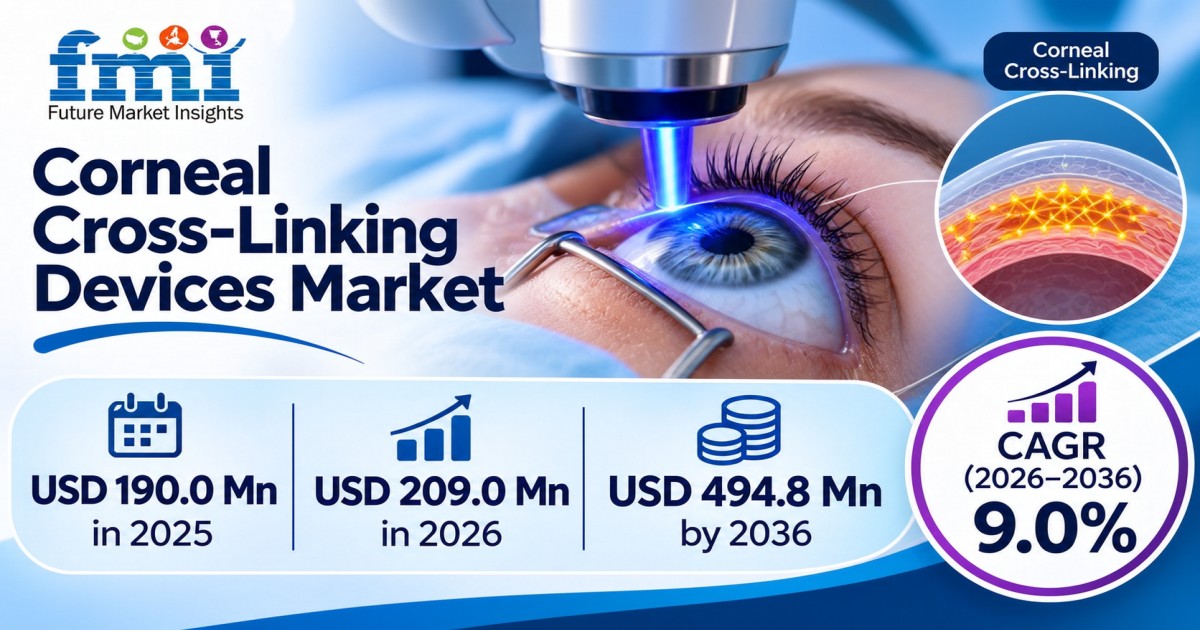
The global corneal cross-linking devices market is estimated at USD 209.0 million in 2026, advancing from USD 190.0 million in 2025, and is projected to expand to USD 494.8 million by 2036. According to market research published by Future Market Insights, Inc., the industry is forecast to grow at a compound annual growth rate (CAGR) of 9.0% over the ten-year assessment period. This steady expansion is supported by earlier clinical identification of progressive keratoconus, expanding reimbursement and regulatory approvals for advanced treatment platforms, and a shift toward recurring consumable kits.
Detailed Market Background & Industry Context
Commercial expansion in the corneal cross-linking sector is reshaped by new therapeutic approvals and platform-specific supply relationships. In the United States, the commercial availability of Glaukos’s Epioxa following its October 2025 FDA approval and March 2026 rollout utilizing the O2n System and Boost Goggles requires clinics to evaluate delivery systems and pharmaceutical supply together. Outside the United States, reimbursement frameworks and regulatory bodies impose strict evidence requirements; for instance, Germany’s G-BA framework mandates that corneal progression be documented through longitudinal measurements taken with comparable diagnostic equipment.
Consequently, equipment placement represents only the initial transaction. The long-term commercial viability of a cross-linking account depends heavily on sustained clinical follow-up, documented patient eligibility, and reliable replenishment of consumables.
>> Get Detailed Market Forecasts, Competitive Benchmarking, and Pricing Trends:
https://www.futuremarketinsights.com/reports/sample/rep-gb-36196
Granular Segment & Regional Analysis
Future Market Insights segments the global corneal cross-linking devices market across Product, Procedure, End User, and Region:
- Product: Treatment kits represent the leading product segment, holding 48.0% of the market in 2026 (valued at approximately USD 100.3 million) and expanding at a 9.9% CAGR to reach USD 258.4 million (52.2% share) by 2036. This growth reflects recurring transactions tied to platform-specific disposable kits. Riboflavin solutions and UV light devices (which fall from 30.0% to 25.9% of product revenue) comprise the remainder.
- Procedure: Epithelium-off (epi-off) procedures hold the initial revenue lead at 52.0% in 2026, anchored by established clinical guidelines such as the American Academy of Ophthalmology’s Preferred Practice Pattern. However, epithelium-on (epi-on) procedures are forecast to surge at a leading 13.4% CAGR, growing from 38.0% to capture 56.3% of the market by 2036. Accelerated protocols cover the remaining segment share.
- End User: Eye clinics capture 43.0% of market revenue in 2026 (expanding to 45.4% by 2036 at a 9.6% CAGR), reflecting the specialist, outpatient nature of keratoconus assessment and ongoing corneal care. Hospitals and ambulatory surgical centres account for the remaining 57.0% of end-user adoption.
- Regional Performance: China and India lead national growth projections with matching 11.7% CAGRs from 2026 to 2036 (with Chinese revenue reaching USD 38.0 million by 2036), followed by the United States at a 9.7% CAGR. Brazil and Turkiye register 8.7% CAGRs, Japan follows at 7.7%, and Western European markets including Germany, Italy, the United Kingdom, and Spain post mature-market growth at 6.8% CAGR.
Executive Perspective & Strategic Implications
“The decisive commercial question is whether a cross-linking platform becomes part of a functioning corneal referral service. Equipment placement creates an initial sale. Documented eligibility, dependable consumable delivery and sustained follow-up create the recurring account. Suppliers with a new epithelial-sparing approach must establish those capabilities alongside clinical evidence. An attractive recovery proposition alone does not determine reimbursement or treatment volume.” — Anurag Sharma, Principal Consultant, FMI
Future Outlook & Methodology Highlights
Looking toward 2036, the corneal cross-linking devices market’s 9.0% CAGR underscores a transition toward integrated therapeutic workflows where hardware sales are anchored by single-use pharmaceutical kits. Long-term success requires medical device suppliers to align their commercial strategies with referral network capacity, platform compatibility rules, and local regulatory pathways rather than relying on equipment shipments alone.
The comprehensive 250-page study evaluates UV light devices, treatment kits, and riboflavin solutions used in corneal collagen cross-linking for keratoconus and corneal ectasia. FMI’s research methodology synthesizes clinical technology assessments, regulatory filings, reimbursement updates, and primary industry inputs across North America, Latin America, Western Europe, Eastern Europe, East Asia, South Asia, and Turkiye.
Explore More Research Reports by FMI
Elastomeric Infusion Pumps Market –
https://www.futuremarketinsights.com/reports/elastomeric-infusion-pumps-market
Robotic Knee Replacement Market –
https://www.futuremarketinsights.com/reports/robotic-knee-replacement-market
MRI-Compatible Guidewire Market –
https://www.futuremarketinsights.com/reports/mri-compatible-guidewire-market
About Future Market Insights, Inc.
Future Market Insights, Inc. (FMI) is a market intelligence and consulting firm providing syndicated and custom research across global healthcare, medical device, and specialized diagnostic sectors. By integrating clinical guidelines, regulatory frameworks, and country-specific commercial operating metrics, FMI equips B2B decision-makers with actionable data to navigate product positioning, supply chain investments, and long-term demand forecasting.
For Press & Corporate Inquiries
Rahul Singh
AVP – Marketing and Growth Strategy
Future Market Insights, Inc.
Phone: +91 8600020075
For Sales: sales@futuremarketinsights.com
For Media: Rahul.singh@futuremarketinsights.com