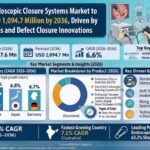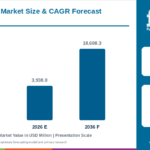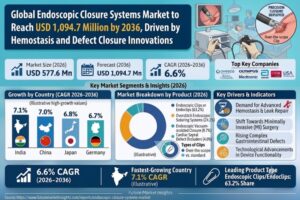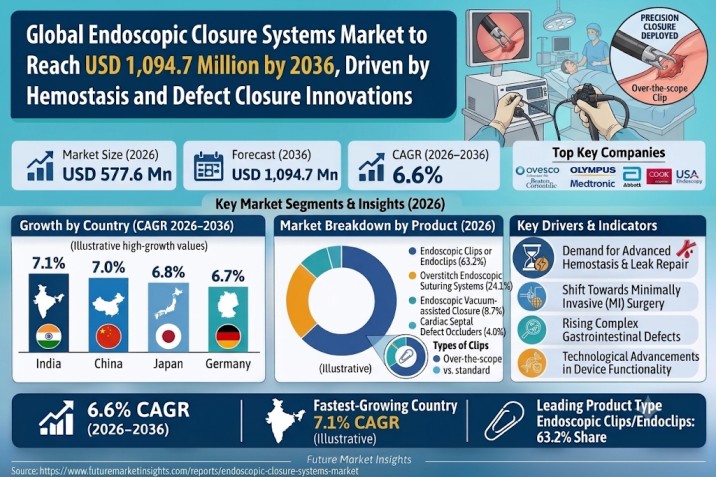
The global Endoscopic Closure Systems Market is projected to reach USD 1,094.7 million by 2036, increasing from USD 541.8 million in 2025 to USD 577.6 million in 2026, according to Future Market Insights (FMI). The market is expected to expand at a compound annual growth rate (CAGR) of 6.6% from 2026 to 2036, creating an incremental opportunity of USD 517.1 million over the forecast period.
Growth is supported by wider adoption of minimally invasive gastrointestinal procedures, increasing use of therapeutic endoscopy, and demand for dependable devices used in bleeding control, tissue approximation, and gastrointestinal defect repair. Endoscopic clips or endoclips are expected to lead product demand, accounting for 63.2% of the market in 2026. Hospitals are projected to represent 58.0% of end-user demand.
India is forecast to record the fastest country-level growth at 6.3%, followed by China at 6.2% and the United States at 6.0%.
Request For a Report Sample: https://www.futuremarketinsights.com/reports/sample/rep-gb-5273
The Short Version
- Market outlook: The global market is projected to reach USD 1,094.7 million by 2036.
- Growth rate: FMI forecasts a 6.6% CAGR between 2026 and 2036.
- Incremental opportunity: The market is expected to create USD 517.1 million in additional value during the forecast period.
- Leading product: Endoscopic clips or endoclips are projected to hold a 63.2% share in 2026.
- Leading procedure: Gastrointestinal bleeding management is expected to account for 28.5% of procedure demand.
- Leading end user: Hospitals are projected to capture 58.0% of the market.
- Fastest-growing country: India is forecast to expand at a 6.3% CAGR.
Three Numbers That Matter
USD 1,094.7 million: The projected market value by 2036, reflecting growing demand for therapeutic gastrointestinal closure devices.
63.2%: The expected 2026 share of endoscopic clips or endoclips, highlighting the importance of familiar, quickly deployed closure formats.
58.0%: The projected 2026 share of hospitals, reflecting their central role in complex therapeutic endoscopy and gastrointestinal intervention.
Why Is the Endoscopic Closure Systems Market Growing?
Endoscopic closure systems are used to approximate tissue and seal gastrointestinal defects during therapeutic endoscopy. Their applications include bleeding control, post-resection closure, perforation management, fistula closure, and leak repair.
The growing preference for minimally invasive gastrointestinal care is supporting demand. These systems can help clinicians manage selected defects and bleeding episodes endoscopically, potentially reducing the need for more invasive surgical intervention.
Higher therapeutic endoscopy volumes are also creating opportunities for suppliers. Hospitals and specialist centers require devices that can be deployed reliably during urgent procedures, particularly when rapid hemostasis or defect closure is necessary.
Device familiarity remains an important purchasing consideration. Endoscopic clips offer faster deployment and are widely understood by physicians, supporting repeat use across routine bleeding-control procedures. Advanced suturing and vacuum-assisted closure systems serve more complex clinical needs and provide opportunities in specialized gastrointestinal intervention.
However, adoption is influenced by device cost, operator training requirements, and the need for consistent deployment performance. Suppliers must demonstrate clinical usability and provide adequate training support to strengthen hospital adoption.
Where Growth Is Strongest
India is projected to record the highest country-level growth, with a 6.3% CAGR from 2026 to 2036. Expanding hospital access, increasing use of minimally invasive gastrointestinal procedures, and rising therapeutic endoscopy capabilities are supporting demand. Tertiary-care hospitals and specialist centers offer opportunities for suppliers targeting bleeding control and perforation repair.
China is expected to expand at a 6.2% CAGR. Advanced endoscopy adoption and improving hospital capabilities are supporting the use of closure devices across major healthcare centers. Larger hospitals with higher patient throughput and broader therapeutic capabilities are expected to contribute to demand.
The United States is forecast to grow at a 6.0% CAGR. Established hospital networks, complex gastrointestinal procedures, and broad availability of therapeutic endoscopy are supporting the market. Suppliers with reliable clinical support and product portfolios suited to different GI procedures may strengthen their position.
Other country forecasts include Brazil at 5.8%, Germany at 5.4%, South Korea at 5.4%, and Japan at 5.0%.
Which Segments Are Shaping Demand?
Endoscopic clips or endoclips, including over-the-scope clips, are projected to account for 63.2% of product demand in 2026. Their fast deployment and established use in gastrointestinal bleeding management support their leading position. Advanced suturing systems and vacuum-assisted formats provide additional options for complex defect repair.
By procedure, gastrointestinal bleeding management is expected to represent 28.5% of demand in 2026. The segment benefits from the immediate need for hemostasis and routine use of clip-based closure. Post-endoscopic mucosal resection closure, perforation and fistula repair, and anastomotic leak repair also contribute to the market.
Hospitals are projected to account for 58.0% of end-user demand, supported by specialist availability and higher-complexity caseloads. Inpatient procedures are expected to represent 61.0% of care-setting demand, while bleeding control is projected to account for 30.0% of clinical-need demand.
Who Is Moving: Competitive Landscape and Key Players
Competition is shaped by deployment reliability, tissue-holding performance, compatibility with endoscopic equipment, clinical support, and the breadth of closure-device portfolios. Suppliers with established hospital relationships and training capabilities have an advantage in therapeutic endoscopy programs.
FMI identifies the following companies among the market participants:
- Ovesco Endoscopy AG
- Boston Scientific Corporation
- Olympus Corporation
- Medtronic
- Abbott
- Cook
- USA Endoscopy
- Endo Tools Therapeutics
- EnVision Endoscopy
- Apollo Endosurgery Inc.
Recent developments highlight continued activity in closure-device innovation and gastrointestinal intervention.
In September 2024, Ovesco Endoscopy AG introduced OTSC neo in Europe, expanding access to clip-based gastrointestinal closure for bleeding control and defect sealing.
In August 2025, Endura Weight Loss Solutions entered the market using the OverStitch Endoscopic Suturing System in endoscopic sleeve gastroplasty, extending the visibility of endoscopic suturing in bariatric intervention.
In March 2026, Endo Tools Therapeutics received FDA 510(k) clearance for its next-generation endomina EZFuse system, supporting further development of advanced soft-tissue approximation in the gastrointestinal tract.
Where to Act and Where to Be Careful
Manufacturers can prioritize devices that combine rapid deployment, dependable tissue hold, and compatibility with established endoscopic workflows. Product development opportunities include improving closure performance in complex defects and expanding device options for bleeding control, leak repair, and fistula management.
Hospitals and specialist centers should assess device reliability, operator training requirements, procedure fit, and the availability of technical support. Suppliers that provide structured clinical education may strengthen adoption among endoscopy teams.
However, device cost and the skill requirements of advanced suturing can slow uptake, particularly in smaller facilities and price-sensitive markets. Manufacturers must balance product innovation with ease of use, clinical validation, and reliable hospital support.
Access the Full Report: https://www.futuremarketinsights.com/reports/endoscopic-closure-systems-market
Analyst Perspective
Anurag Sharma, Principal Analyst at Future Market Insights, states:
“Commercial importance is highest in endoscopic closure systems used in urgent bleeding control and complex GI defect repair because clinical teams place more weight on deployment reliability and tissue hold than on device novelty. Demand is being shaped by wider therapeutic endoscopy use across hospitals and specialty centers.”
Questions for Your Next Planning Meeting
- How can manufacturers improve deployment reliability and tissue-holding performance?
- Which gastrointestinal procedures offer the strongest opportunities for closure-device adoption?
- How should suppliers prioritize hospitals and specialist endoscopy centers?
- What training programs can support the adoption of advanced suturing systems?
- Which country markets offer the strongest growth opportunities through 2036?
Related Reports:
- Fat Modular Nutrition Market – https://www.futuremarketinsights.com/reports/fat-modular-nutrition-market
- Fiber Modular Nutrition Market – https://www.futuremarketinsights.com/reports/fiber-modular-nutrition-market
- Shelf-Stable Clinical Meal Market – https://www.futuremarketinsights.com/reports/shelf-stable-clinical-meal-market
About Future Market Insights (FMI)
Future Market Insights (FMI) is a global market intelligence and consulting firm providing comprehensive market research, competitive intelligence, and strategic business insights across industries. The firm delivers detailed forecasts, technology analysis, and data-driven recommendations that support informed decision-making for manufacturers, investors, distributors, and policymakers worldwide.
For Press & Corporate Inquiries
Rahul Singh
AVP – Marketing and Growth Strategy
Future Market Insights, Inc.
+91 8600020075
For Sales – sales@futuremarketinsights.com