

NEWARK, Del., November 13, 2026 — The global polyaryletherketone (PAEK) market is gaining momentum as aerospace manufacturers, automotive suppliers, semiconductor equipment producers, and medical device companies increasingly adopt high-performance thermoplastic materials for demanding industrial applications. Growing requirements for lightweight components, high-temperature resistance, chemical stability, and mechanical durability are strengthening the commercial adoption of PAEK polymers across advanced manufacturing industries.
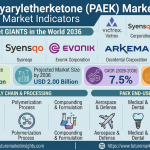
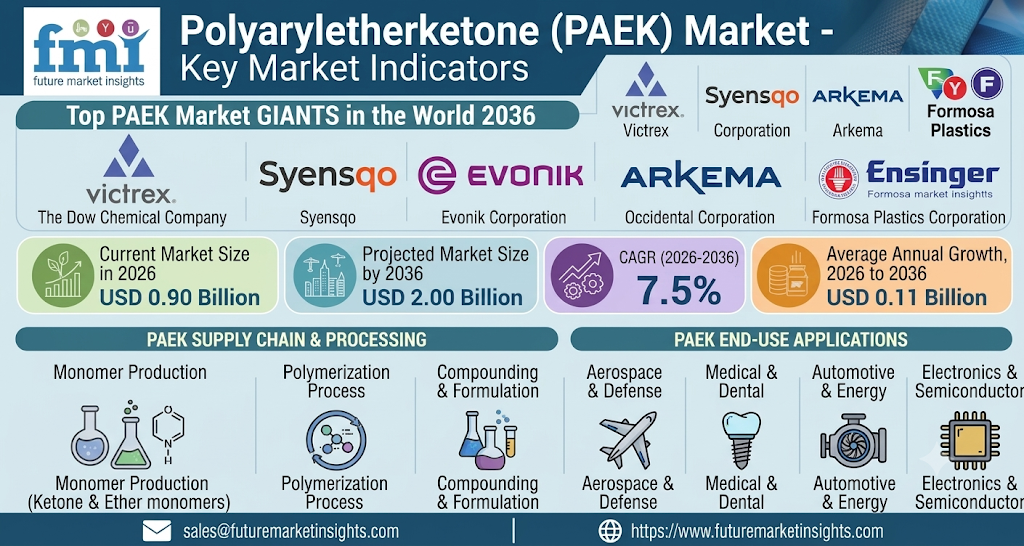
According to the latest market intelligence report published by Future Market Insights (FMI), the global polyaryletherketone market is estimated to reach USD 972.0 million in 2026, up from USD 900.0 million in 2025. The market is projected to expand to USD 2,003.3 million by 2036, registering a compound annual growth rate (CAGR) of 7.5% during the 2026–2036 forecast period. The market is expected to generate an incremental revenue opportunity of USD 1,031.3 million over the assessment period.
Get Detailed Market Forecasts, Competitive Benchmarking & Industry Insights: Request a Sample Report https://www.futuremarketinsights.com/reports/sample/rep-gb-36183
The expansion reflects increasing demand for advanced engineering polymers that can replace conventional metals and lower-performance plastics in specialized applications. PAEK materials, particularly polyether ether ketone (PEEK) and polyether ketone ketone (PEKK), are gaining importance across aerospace structures, medical implants, automotive components, electrical systems, semiconductor equipment, and industrial machinery.
Market Size & Growth Forecasts
The polyaryletherketone market is entering a sustained growth phase supported by advanced engineering applications, lightweight material adoption, and increasing requirements for high-performance thermoplastics.
PEEK is projected to account for 86.0% of the type segment in 2026, supported by its established commercial applications across aerospace, medical, automotive, and industrial manufacturing.
Neat resin is estimated to command 52.0% of the form segment, reflecting its importance as a foundational material for molding, extrusion, compounding, and downstream conversion processes.
Aerospace and defense applications are expected to represent 24.0% of end-use demand in 2026, supported by the increasing adoption of lightweight thermoplastic materials in aircraft structures and high-performance components.
Specialized forms are also gaining importance. Powder and filament are projected to expand at an 11.7% CAGR through 2036, significantly faster than neat resin, which is forecast to grow at 6.2%.
Key Market Takeaways
- Market Valuation: The global PAEK market is projected to increase from USD 972.0 million in 2026 to USD 2,003.3 million by 2036.
- Growth Rate: The market is expected to register a 7.5% CAGR between 2026 and 2036.
- Incremental Opportunity: The market is forecast to generate USD 1,031.3 million in additional revenue during the assessment period.
- Leading Type Segment: PEEK is anticipated to capture 86.0% of the type segment in 2026.
- Leading Form Segment: Neat resin is projected to hold 52.0% of the form segment.
- Leading End Use: Aerospace and defense are expected to account for 24.0% of end-use demand in 2026.
- Fastest-Growing Form: Powder and filament are forecast to expand at an 11.7% CAGR through 2036.
- Fastest-Growing Country: India is projected to lead evaluated national markets with a 10.0% CAGR through 2036.
Aerospace Lightweighting and Advanced Manufacturing Strengthen PAEK Demand
The increasing adoption of lightweight engineering materials in aerospace and defense manufacturing is becoming a major growth catalyst for the PAEK market.
Aircraft manufacturers are increasingly exploring advanced thermoplastic materials to reduce component weight, improve manufacturing efficiency, and support the development of next-generation aircraft structures.
PEEK and PEKK offer high mechanical strength, chemical resistance, and thermal stability, making them suitable for demanding aerospace applications. Their use in structural components, aircraft interiors, electrical systems, and specialized composite structures is expanding the commercial opportunity for polymer suppliers.
Thermoplastic composite development is also creating opportunities for PAEK manufacturers. Carbon-fiber-reinforced PEKK materials can support the production of lightweight aircraft components through forming and overmolding technologies.
The Arkema and Hexcel collaboration on thermoplastic composite structures demonstrates the industry’s focus on improving manufacturing cycle times and expanding the use of advanced polymer-based components.
PEEK Dominates the Product Type Segment
PEEK is expected to remain the leading material category, accounting for 86.0% of the PAEK type segment in 2026.
Its established commercial availability across neat resin, reinforced compounds, and powder grades supports adoption across multiple manufacturing processes.
PEEK offers a combination of high-temperature performance, mechanical strength, chemical resistance, and wear properties. These characteristics make it suitable for applications where conventional engineering plastics may not provide sufficient performance.
Medical device manufacturers use PEEK in specialized implant and medical component applications, while automotive suppliers incorporate it into selected lightweight and high-performance components.
PEKK is also gaining commercial importance as manufacturers explore alternative high-performance polymer chemistries, particularly in aerospace composite structures and additive manufacturing.
PEKK is projected to grow at a 9.6% CAGR through 2036, supported by expanding specialized applications and material development.
Neat Resin and Specialized Polymer Forms Shape Market Demand
Neat resin is estimated to account for 52.0% of the PAEK form segment in 2026.
Its leading position reflects its importance as the starting material for downstream manufacturing processes, including molding, extrusion, machining, compounding, and coating.
Industrial converters purchase neat PAEK resin and process it into application-specific products according to their manufacturing requirements.
However, specialized forms are gaining commercial importance as manufacturers increasingly demand customized material characteristics.
Powder and filament are projected to grow at an 11.7% CAGR through 2036, driven by opportunities in additive manufacturing, wire coating, specialized industrial components, and advanced processing technologies.
Filled and reinforced compounds are also gaining importance as manufacturers seek improved mechanical performance and application-specific material properties.
Aerospace and Defense Lead End-Use Applications
Aerospace and defense applications are projected to account for 24.0% of the PAEK market’s end-use segment in 2026.
The increasing focus on aircraft lightweighting, structural efficiency, and advanced thermoplastic composite manufacturing is supporting demand for high-performance polymer materials.
PAEK polymers are increasingly being evaluated for aircraft structural components, electrical systems, specialized mechanical parts, and high-temperature applications.
Beyond aerospace, medical and dental applications represent another important opportunity.
PEEK is used in selected medical applications because of its mechanical properties, biocompatibility characteristics, and suitability for specialized device manufacturing.
Automotive manufacturers are also exploring PAEK materials for electric vehicle components, motor insulation, and high-performance engineering applications.
In electrical and electronics manufacturing, specialized PAEK grades are used where thermal stability, dimensional consistency, and contamination control are important.
Regional Growth Outlook: India, China and South Korea Lead Expansion
The PAEK market is experiencing varied growth patterns across major national markets, driven by industrial manufacturing investments, semiconductor production, aerospace development, and increasing adoption of advanced engineering polymers.
India is projected to register the fastest growth among evaluated countries, with a 10.0% CAGR through 2036. Increasing investment in advanced polymer compounding, industrial manufacturing, aerospace components, and engineering materials is expected to strengthen market opportunities.
China is forecast to expand at a 9.5% CAGR during the assessment period. Domestic polymer production, semiconductor manufacturing, automotive electrification, and expanding high-performance material capabilities are supporting demand.
South Korea is projected to record an 8.0% CAGR, supported by semiconductor manufacturing, advanced electronics production, and demand for high-purity polymer components.
The United States PAEK market is anticipated to grow at a 7.0% CAGR through 2036. Established aerospace manufacturing, medical device development, and advanced polymer production capabilities are creating opportunities for suppliers.
Taiwan is also expected to expand at a 7.0% CAGR, supported by semiconductor fabrication investments and increasing demand for specialized materials used in wafer-processing equipment.
The United Kingdom and France are forecast to register CAGRs of 6.5% each, while Germany, Japan, and Italy are projected to grow at 6.0% respectively through 2036.
Semiconductor Manufacturing Creates Opportunities for High-Purity PAEK Materials
The expansion of semiconductor manufacturing is creating additional opportunities for specialized PAEK materials.
Semiconductor equipment manufacturers require materials with controlled ionic contamination, low particle shedding, dimensional stability, and reliable performance under demanding operating conditions.
PEEK is used in selected semiconductor equipment components, including wafer-handling and chemical-mechanical polishing applications.
The growing complexity of semiconductor manufacturing is increasing the importance of material qualification and documented processing quality.
In April 2026, Evonik opened a PEEK rectangular magnet wire laboratory in Shanghai, China, to support electric-drive supply chains and specialized motor-wire coating development.
Such investments demonstrate the growing importance of application-specific material development and technical collaboration between polymer suppliers and industrial manufacturers.
Key Companies in the Polyaryletherketone (PAEK) Market
The competitive landscape includes established high-performance polymer manufacturers, specialty resin suppliers, engineering plastic processors, and companies developing application-specific PAEK materials.
Key companies covered in the Future Market Insights report include:
- Victrex plc
- Syensqo
- Evonik Industries AG
- Arkema S.A.
- Ensinger GmbH
- Panjin Zhongrun High Performance Polymers
- Jilin Joinature Polymer
- Oxford Performance Materials
Market participants are focusing on polymer development, manufacturing capacity, specialized product grades, and stronger technical relationships with industrial customers.
Victrex focuses on PEEK-based high-performance polymer solutions, while Syensqo supplies KetaSpire PEEK grades across neat resin, reinforced compounds, and powder applications.
Evonik is strengthening its position through specialized PEEK applications and technical development, while Arkema continues to develop PEKK-based material solutions under its Kepstan portfolio.
Ensinger and Oxford Performance Materials provide downstream conversion and specialized material solutions, including stock shapes and additive manufacturing applications.
Growth Opportunities and Industry Challenges
The expansion of aerospace lightweighting, semiconductor manufacturing, electric vehicle production, and medical technology is creating significant opportunities for PAEK manufacturers.
Suppliers offering specialized polymer grades, application-specific technical support, and consistent processing performance are positioned to address evolving industrial procurement requirements.
The growing adoption of additive manufacturing is also creating opportunities for powder and filament suppliers.
However, high material costs, complex processing requirements, manufacturing capacity limitations, and lengthy customer qualification procedures may create challenges for market participants.
The commercial success of PAEK materials depends not only on announced production capacity but also on the ability to manufacture consistent, qualified polymer grades.
A change in resin specifications can influence machining, molding, extrusion, and component performance. Consequently, industrial customers often require extensive material validation before approving a new supplier.
Competition from alternative engineering plastics, metals, and composite materials may also influence adoption in cost-sensitive applications.
Another emerging opportunity lies in electric mobility. PAEK-based wire coatings, motor components, and specialized electrical applications are creating new avenues for manufacturers as electric vehicle architectures evolve.
Future Market Outlook
The global polyaryletherketone market is expected to benefit from the continued transformation of advanced manufacturing toward lightweight materials, high-performance thermoplastics, and specialized engineering applications.
Growing demand from aerospace and defense, medical and dental, automotive, electrical and electronics, and semiconductor industries will support long-term market opportunities.
For polymer manufacturers, industrial converters, aerospace suppliers, and engineering procurement teams, material consistency, qualified production capacity, application-specific innovation, and technical support will remain important factors in strengthening market positioning.
Future Market Insights expects the PAEK market to maintain a positive growth trajectory through 2036 as high-performance polymers continue to replace conventional materials in selected demanding industrial applications.
Explore the market outlook, forecast analysis and competitive landscape in the Full Report: https://www.futuremarketinsights.com/reports/polyaryletherketone-paek-market
About the Polyaryletherketone (PAEK) Market Report
Future Market Insights’ Polyaryletherketone (PAEK) Market Report provides comprehensive insights into market size, growth forecasts, segment performance, regional opportunities, competitive benchmarking, and industry developments for the 2026–2036 assessment period.
The report evaluates the market across type, form, and end-use categories, covering PEEK, PEKK, PEK and other PAEK materials, neat resin, filled and reinforced compounds, powder and filament, aerospace and defense, medical and dental, automotive, oil and gas, and electrical and electronics applications.
The geographical assessment covers North America, Western Europe, East Asia, South Asia, and the rest of the world.
Related Chemicals & Materials Industry Reports
Alumina Market https://www.futuremarketinsights.com/reports/alumina-market
Acrylamide Market https://www.futuremarketinsights.com/reports/acrylamide-market
Acrylonitrile Market https://www.futuremarketinsights.com/reports/acrylonitrile-market
Caprolactam Market https://www.futuremarketinsights.com/reports/caprolactam-market
About Future Market Insights (FMI)
Future Market Insights (FMI) is a market intelligence and consulting firm providing data-driven research, strategic insights, and industry analysis to support business decision-making. FMI delivers market forecasts, competitive intelligence, demand assessments, and growth opportunity analysis across global industries, helping businesses identify emerging trends and develop informed growth strategies.
Media Contact
For Press & Corporate Inquiries
Rahul Singh
AVP – Marketing and Growth Strategy
Phone: +91 8600020075
For Sales: sales@futuremarketinsights.com
For Media: Rahul.singh@futuremarketinsights.com
Website: https://www.futuremarketinsights.com