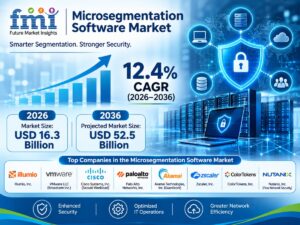


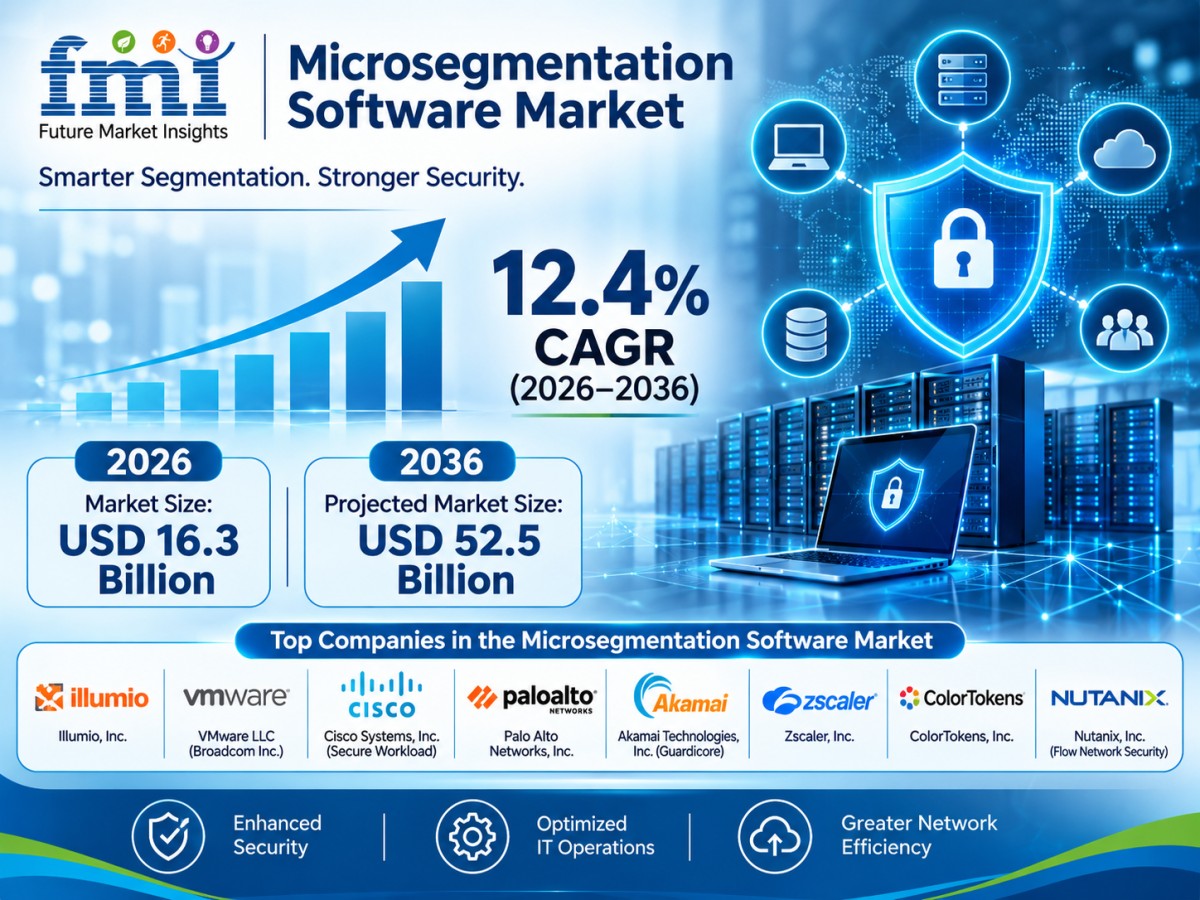
NEWARK, Del. — The global Microsegmentation Software Market is projected to grow from USD 16.3 billion in 2026 to USD 52.5 billion by 2036, registering a compound annual growth rate (CAGR) of 12.4%, according to Future Market Insights (FMI). The market was valued at USD 14.5 billion in 2025, reflecting increasing enterprise investment in workload isolation, zero-trust security architectures, and protection against unauthorized lateral network movement.
Microsegmentation software enables organizations to establish granular security boundaries around individual workloads, applications, and systems. Unlike conventional perimeter security, which primarily monitors traffic entering and leaving networks, microsegmentation helps security teams control internal east-west communications. This capability is becoming increasingly relevant as enterprises operate complex data centers, hybrid clouds, and containerized environments.
Access the Sample Report — Explore Key Insights Today!
https://www.futuremarketinsights.com/reports/sample/rep-gb-35866
Microsegmentation Software Market Size and Forecast, 2026–2036
FMI estimates that the market will generate an additional USD 36.2 billion in revenue between 2026 and 2036. This expansion reflects the growing importance of identity-based access policies and workload-level security controls.
Organizations are increasingly evaluating microsegmentation to reduce the potential impact of compromised credentials, ransomware, and unauthorized access between connected systems. Security teams can use granular policies to restrict communication between workloads and limit the movement of attackers within enterprise infrastructure.
For decision-makers, the investment opportunity extends beyond deploying security software. Automated application dependency discovery, policy orchestration, and compatibility with existing infrastructure are important considerations when selecting a platform.
Key Growth Drivers in the Microsegmentation Software Market
Increasing adoption of zero-trust security: Enterprises are moving away from implicit internal network trust toward continuous identity verification and least-privilege access policies. Microsegmentation supports this transition by restricting communication between workloads according to defined security rules.
Growing ransomware and lateral movement threats: Attackers increasingly target interconnected enterprise systems after gaining initial access. Microsegmentation helps organizations establish internal security boundaries and contain unauthorized movement between applications and servers.
Expansion of hybrid and multi-cloud infrastructure: Businesses operating workloads across private data centers, public clouds, and container environments require security policies that can follow applications across infrastructure boundaries.
Demand for automated security management: Automated dependency mapping and policy generation can simplify the identification of application communication patterns. These capabilities help security teams develop enforcement policies while reducing manual configuration requirements.
Host-Based Microsegmentation Leads Segmentation Methods
According to FMI, host-based microsegmentation is projected to account for 43.7% of segmentation method demand in 2026. The data center environment is expected to represent 42.5% of deployment demand, while zero-trust applications are projected to account for 44.3% of use-case demand.
The BFSI sector is forecast to represent 43.0% of end-use demand in 2026.
Host-based solutions apply security controls directly through operating-system agents and kernel-level enforcement mechanisms. This approach allows enterprises to establish workload isolation without requiring extensive changes to physical network switches.
For financial institutions and healthcare providers, data center microsegmentation can help protect sensitive databases and restrict unauthorized access between internal systems. Meanwhile, zero-trust deployments support continuous policy enforcement across distributed enterprise infrastructure.
Regional Opportunities in the Microsegmentation Software Market
FMI identifies Australia, Canada, the United States, the United Kingdom, Germany, and Japan as important country markets with distinct growth opportunities.
- Australia: 13.2% CAGR, supported by critical infrastructure cybersecurity requirements and network isolation priorities.
- Canada: 13.1% CAGR, driven by zero-trust modernization and healthcare data protection requirements.
- United States: 13.0% CAGR, supported by federal zero-trust adoption and enterprise multi-cloud security requirements.
- United Kingdom: 12.6% CAGR, reflecting financial-sector operational resilience and healthcare network protection.
- Germany: 12.1% CAGR, supported by industrial cybersecurity and manufacturing infrastructure protection.
- Japan: 11.8% CAGR, driven by semiconductor supply chain security and enterprise infrastructure modernization.
Australia leads the listed country forecasts, indicating an opportunity for suppliers offering automated security controls and critical infrastructure protection solutions. In North America, cloud modernization and enterprise security requirements support demand. European opportunities are connected with financial services, healthcare, and industrial cybersecurity, while Japan’s manufacturing ecosystem creates demand for carefully managed workload isolation.
Top Companies in the Microsegmentation Software Market
FMI identifies eight notable participants in its competitive assessment:
- Illumio, Inc. – Dedicated zero-trust microsegmentation and workload isolation solutions.
- VMware LLC (Broadcom Inc.) – Distributed firewall and virtualization-based security capabilities.
- Cisco Systems, Inc. (Secure Workload) – Workload security and application dependency mapping.
- Palo Alto Networks, Inc. – Integrated network security and workload protection.
- Akamai Technologies, Inc. (Guardicore) – Host-based segmentation and application visibility.
- Zscaler, Inc. – Cloud-delivered zero-trust security and workload protection.
- ColorTokens, Inc. – Software-defined microsegmentation and breach containment.
- Nutanix, Inc. (Flow Network Security) – Infrastructure-integrated network segmentation and security.
Competition is developing across three broad categories: dedicated zero-trust specialists, enterprise networking and infrastructure providers, and integrated cloud security platforms.
Dedicated vendors focus on workload visibility, granular policy enforcement, and application dependency mapping. Infrastructure providers integrate security controls into virtualization and software-defined networking environments. Cloud security companies combine workload protection with broader zero-trust and secure access capabilities.
For enterprise buyers, platform selection should consider agent compatibility, multi-cloud coverage, automated policy management, operational overhead, and integration with existing security infrastructure.
Business Outlook for the Microsegmentation Software Market
The projected expansion of the Microsegmentation Software Market creates opportunities for cybersecurity vendors serving financial institutions, healthcare networks, government organizations, and manufacturing enterprises.
Organizations planning deployments should begin by identifying critical workloads, mapping application dependencies, and defining access requirements. They should also evaluate whether host-based, network-based, identity-based, or application-aware solutions best match their infrastructure.
Vendors that simplify deployment, support hybrid environments, and provide automated policy enforcement can address important enterprise security requirements. As zero-trust adoption expands, microsegmentation is positioned to become an increasingly important component of enterprise cybersecurity strategies.
About the Microsegmentation Software Market Report
Future Market Insights provides market sizing, forecasts, segmentation analysis, regional assessments, and competitive intelligence for the global Microsegmentation Software Market.
Read the full report: https://www.futuremarketinsights.com/reports/microsegmentation-software-market
Explore More Related Reports –
Computer Aided Facility Management (CAFM) Market – https://www.futuremarketinsights.com/reports/computeraided-facility-management-cafm-market
Digital Transformation in Healthcare Market – https://www.futuremarketinsights.com/reports/digital-healthcare-market
Enterprise Laboratory Informatics Market – https://www.futuremarketinsights.com/reports/enterprise-laboratory-informatics-market