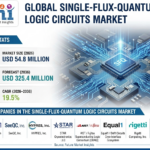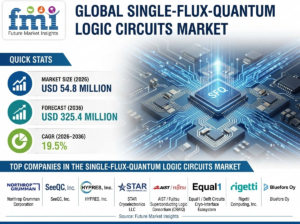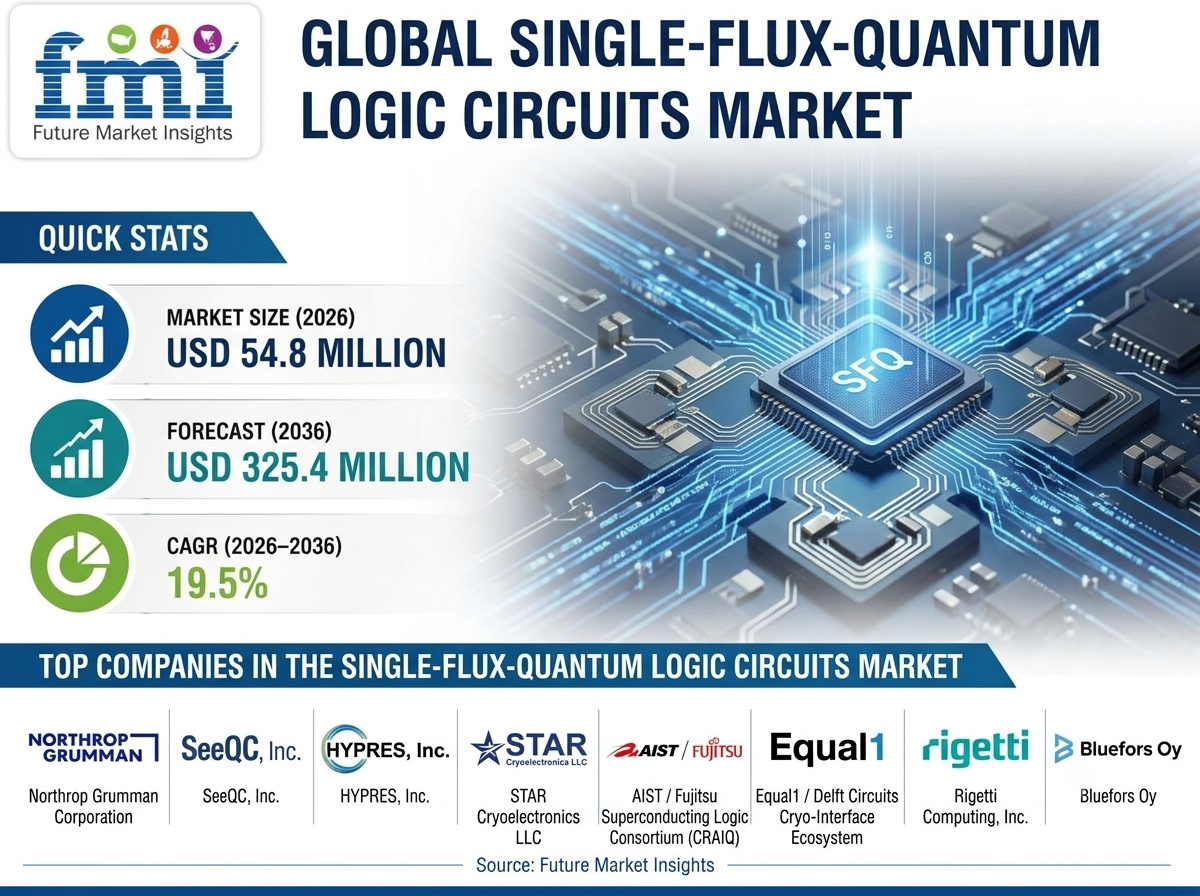
NEWARK, Del. — The global Single-Flux-Quantum Logic Circuits Market is projected to grow from US$54.8 million in 2026 to US$325.4 million by 2036, registering a compound annual growth rate (CAGR) of 19.5% during the forecast period, according to Future Market Insights (FMI). The market was valued at US$46.5 million in 2025, reflecting increasing demand for superconducting digital circuits in quantum computing, cryogenic control systems, and advanced electronic applications.
Single-flux-quantum (SFQ) technology uses Josephson junctions to process digital information through quantized magnetic flux pulses. These circuits offer high switching speeds and extremely low energy consumption, making them relevant to applications where conventional semiconductor processors face power and thermal constraints.
Access the Sample Report — Explore Key Insights Today!
https://www.futuremarketinsights.com/reports/sample/rep-gb-35858
Single-Flux-Quantum Logic Circuits Market Size and Forecast, 2026–2036
FMI estimates that the market will generate an additional revenue opportunity of approximately US$270.6 million between 2026 and 2036. This expansion reflects growing interest in superconducting computing architectures, specialized foundry services, and cryogenic co-processors.
Quantum computing developers are evaluating SFQ circuits to support qubit readout, control, and error-correction operations. These applications require fast digital processing while maintaining strict thermal limits inside cryogenic environments.
For manufacturers, the opportunity extends across superconducting logic chips, niobium-based wafer fabrication, cryogenic modules, and specialized packaging solutions.
Key Growth Drivers in the Single-Flux-Quantum Logic Circuits Market
Expansion of superconducting quantum computing: Increasing efforts to develop larger quantum processors are creating demand for digital control technologies that can operate at cryogenic temperatures. SFQ circuits offer a potential approach to reducing the power and wiring requirements associated with conventional control systems.
Demand for energy-efficient computing: Traditional digital architectures can generate substantial heat during operation. Energy-efficient superconducting logic families, particularly eSFQ and Reciprocal Quantum Logic (RQL), address this challenge through circuit designs that reduce static power dissipation.
Growth in cryogenic electronics: Quantum processors and specialized computing environments require reliable signal processing at extremely low temperatures. This creates opportunities for SFQ-based co-processors and cryogenic electronic components.
Advanced niobium fabrication: Higher-density Josephson junction integration and multi-layer niobium manufacturing processes are supporting the development of more complex superconducting circuits.
eSFQ and RQL Lead the Logic Family Segment
FMI projects that Energy-Efficient eSFQ and Reciprocal Quantum Logic (RQL) will account for 54.6% of logic-family demand in 2026.
The report also identifies three important segment leaders:
- 8- to 10-Metal-Layer Nb Process: Expected to represent 63.8% of foundry process demand in 2026.
- In-Dilution-Fridge (4K) Co-Processors for Qubit Readout/Control: Projected to account for 58.2% of cryogenic application revenue.
- Lidded FCBGA with Integrated Heat Spreader: Expected to represent 69.2% of package thermal design demand.
These estimates demonstrate the importance of energy-efficient circuit architectures, advanced fabrication capabilities, and thermal management in the development of superconducting electronics.
For technology suppliers, investment opportunities extend beyond circuit design to wafer processing, cryogenic integration, and packaging technologies.
Regional Opportunities in the Single-Flux-Quantum Logic Circuits Market
FMI identifies six important national markets with strong growth prospects between 2026 and 2036.
- Finland: 20.9% CAGR
- Netherlands: 20.7% CAGR
- Germany: 20.4% CAGR
- United States: 19.3% CAGR
- Japan: 19.0% CAGR
- United Kingdom: 18.3% CAGR
Finland leads the country-level growth outlook, supported by superconducting quantum processor development and domestic cryogenic technology capabilities. The Netherlands benefits from quantum research infrastructure and superconducting interconnect development.
Germany presents opportunities through advanced niobium fabrication and metrology capabilities. In the United States, defense electronics, superconducting foundries, and quantum computing research support market development.
Japan’s superconducting electronics research and adiabatic quantum-flux-parametron technologies create opportunities for specialized computing applications. Meanwhile, the United Kingdom’s national quantum research infrastructure supports the development and testing of superconducting technologies.
Top Companies in the Single-Flux-Quantum Logic Circuits Market
FMI identifies the following eight companies and industry participants in its competitive assessment:
- Northrop Grumman Corporation – Superconducting digital logic and defense-oriented electronic systems.
- SeeQC, Inc. – Superconducting digital quantum management and SFQ control technologies.
- HYPRES, Inc. – Superconducting digital electronics and rapid single-flux-quantum systems.
- STAR Cryoelectronics LLC – Josephson junction fabrication and superconducting electronics.
- AIST / Fujitsu Superconducting Logic Consortium (CRAIQ) – Superconducting logic research and quantum computing technologies.
- Equal1 / Delft Circuits Cryo-Interface Ecosystem – Cryogenic computing integration and superconducting interconnect solutions.
- Rigetti Computing, Inc. – Superconducting quantum processors and quantum computing systems.
- Bluefors Oy – Dilution refrigerators and cryogenic infrastructure.
The competitive landscape spans three major areas: superconducting digital logic foundries, quantum computing and superconducting processor development, and cryogenic co-processor and interconnect technologies.
Northrop Grumman, SeeQC, and HYPRES participate in superconducting digital circuit development, while AIST/Fujitsu and Rigetti contribute to superconducting computing ecosystems. Bluefors and the Equal1/Delft Circuits ecosystem address cryogenic infrastructure and system integration.
For buyers and technology developers, supplier selection depends on fabrication capabilities, circuit performance, cryogenic compatibility, integration support, and manufacturing consistency. These companies represent identified market participants rather than a ranked market-share list.
Business Outlook and Strategic Implications
The projected growth of the Single-Flux-Quantum Logic Circuits Market creates opportunities for semiconductor foundries, quantum computing developers, defense electronics suppliers, and cryogenic technology providers.
Businesses entering this market should prioritize Josephson junction manufacturing capabilities, energy-efficient circuit architectures, thermal management, and compatibility with quantum processor environments.
Partnerships between circuit manufacturers, research institutions, and cryogenic equipment providers may also support the development of integrated superconducting computing systems.
As quantum computing infrastructure advances, suppliers capable of combining specialized circuit fabrication with reliable cryogenic integration will be positioned to address emerging technical requirements.
About the Single-Flux-Quantum Logic Circuits Market Report
Future Market Insights provides market forecasts, segment-level analysis, country growth estimates, and competitive intelligence covering the global Single-Flux-Quantum Logic Circuits Market.
Explore the complete report: https://www.futuremarketinsights.com/reports/single-flux-quantum-logic-circuits-market
Explore More Related Reports –
Computer Aided Facility Management (CAFM) Market – https://www.futuremarketinsights.com/reports/computeraided-facility-management-cafm-market
Digital Transformation in Healthcare Market – https://www.futuremarketinsights.com/reports/digital-healthcare-market
Enterprise Laboratory Informatics Market – https://www.futuremarketinsights.com/reports/enterprise-laboratory-informatics-market