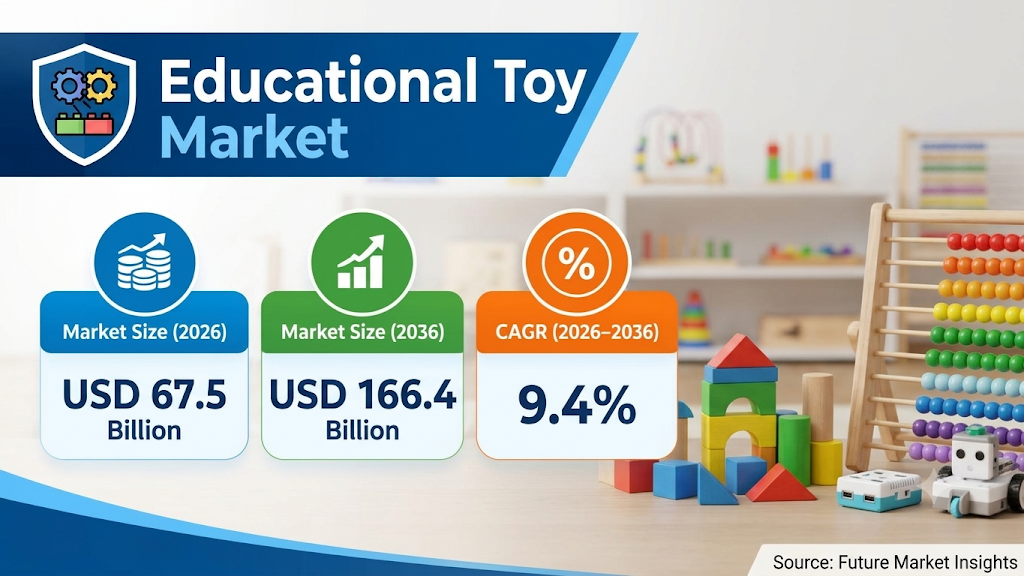
The global educational toy market is estimated to reach USD 67.5 billion in 2026, up from USD 61.7 billion in 2025, and is projected to grow to USD 166.4 billion by 2036, according to the latest market intelligence report published by Future Market Insights (FMI). The market is expected to expand at a compound annual growth rate (CAGR) of 9.4% between 2026 and 2036, supported by increasing parental demand for toys that develop children’s cognitive, creative, language and motor skills.
Market Size & Growth Forecasts
- 2025 Baseline Market Value: USD 61.7 billion
- 2026 Estimated Market Size: USD 67.5 billion
- 2036 Projected Market Value: USD 166.4 billion
- Growth Rate: 9.4% CAGR (2026–2036)
- Incremental Growth Opportunity: USD 98.9 billion
- Market Expansion: 2.5x between 2026 and 2036
The expansion reflects sustained demand for learning-oriented play products across different childhood development stages. Parents increasingly purchase toys that support counting, problem-solving, early reading, creativity and physical coordination. Each developmental milestone creates opportunities for new purchases, particularly among families with babies and preschool children.
Get detailed market forecasts, competitive benchmarking, and pricing trends: https://www.futuremarketinsights.com/reports/sample/rep-gb-18733
Key Market Segments
By Product Type
- Games and Puzzles: Expected to account for the largest share at 20.5% in 2026. Board games, card games, jigsaw puzzles and logic games encourage counting, reasoning and family participation.
- STEM Toys: Estimated to capture 18% of the market, supported by demand for coding robots, science kits and technology-based learning activities.
- Arts and Crafts: Projected to represent approximately 15.8%, reflecting recurring purchases of creative activity kits.
- Role-Play: Expected to account for 12.5%, while motor skills toys represent 11% and musical toys 8.2%.
By Age Group
- Up to 4 Years: Expected to contribute 41% of sales in 2026, making this the leading age group. Stacking toys, shape sorters, rattles and musical activity products support early developmental milestones.
- 4 to 8 Years: Estimated to account for approximately 38%, with demand for building sets, early reading devices and science kits.
- Above 8 Years: Represents the remaining 21%, supported by coding kits, advanced puzzles and educational games.
By Distribution Channel
- Supermarkets and Hypermarkets: Expected to hold a 34% share in 2026, supported by seasonal promotions and convenience-led family shopping.
- E-commerce: Projected to account for 31%, with product variety and customer reviews supporting online purchases.
- Specialty Stores: Estimated to represent 26%, particularly for premium wooden toys and STEM learning products.
- Others: Account for the remaining 9%.
Regional Market Outlook
Australia and New Zealand are projected to record the fastest growth among the profiled country markets, supported by rising demand for electronic learning toys and developmental products.
- Australia and New Zealand: 10.6% CAGR through 2036.
- India: 10.3% CAGR, supported by government initiatives promoting domestic toy manufacturing, innovation and product quality.
- China: 10.1% CAGR, driven by demand for building sets and educational learning devices.
- Germany: 9.9% CAGR, supported by established demand for games, puzzles and creative learning products.
- United States: 9.5% CAGR, with domestic manufacturing investments and product safety requirements shaping the market.
- United Kingdom: 8.7% CAGR, reflecting comparatively softer electronic learning toy sales.
India’s Toy Sector Playbook, unveiled in August 2026, aims to increase the country’s share of the global toy market to 5% by 2032. This policy direction could support domestic manufacturers focusing on innovation, design and quality standards.
Major Market Trends and Growth Drivers
Increasing Demand for Developmental Play: Parents are prioritising toys that develop problem-solving, language, motor and creative skills. Products designed around different childhood milestones continue to support repeat purchasing.
Growth of Screen-Free Smart Learning Systems: Educational technology is creating new product opportunities. Spielwarenmesse identified AI Loves (to) Play and Creative Mindfulness among its 2026 toy trends, highlighting adaptive robots, smart learning systems and hands-on creative activities.
Expansion of Digital Learning Content: Product launches combining physical devices with downloadable games are creating opportunities for recurring revenue. In September 2026, LeapFrog added licensed and two-player titles to its LeapMove motion-based learning system for children aged four and above.
Product Safety and Supply Chain Adjustments: Tariff costs, counterfeit products and stricter import inspections are influencing sourcing and retail strategies. In August 2026, the U.S. Consumer Product Safety Commission and U.S. Customs and Border Protection stopped 355,683 units of violative squishy toys at U.S. ports.
Competitive Landscape
The educational toy market includes established international toy manufacturers, educational electronics companies, game publishers and specialist learning product brands. Companies are focusing on product innovation, manufacturing capacity, distribution networks and interactive learning formats to strengthen their market positions.
LEGO Group reported revenue growth of 21% to DKK 41.9 billion in the first half of 2026. Mattel recorded net sales of USD 1,125.3 million for the three months ended June 2026, representing a 10% increase. VTech reported FY2026 group revenue of USD 2,027.5 million.
Key Companies Profiled Include:
LEGO Group, Mattel, Spin Master, Hasbro, VTech, Ravensburger, Simba Dickie Group, TOMY, JAKKS Pacific, GoldLok Toys, WowWee and CocoMoco Kids.
Analyst Perspective
“I am most confident about learning systems that get children moving, because parents want skill-building play without more screen time. LeapMove-style devices with paid downloads will earn sales long after the box is opened, and the brands that build those libraries before the 2027 holiday season will set the price points for ages 4 to 8.”
— Rahul Pandita, Principal Consultant, Future Market Insights.
Explore More Related Studies Published by FMI Research:
Razors and Blades Market: https://www.futuremarketinsights.com/reports/razors-and-blades-market
Home Decor Market: https://www.futuremarketinsights.com/reports/home-decor-market
Handloom Product Market: https://www.futuremarketinsights.com/reports/handloom-product-market
About Future Market Insights (FMI)
Future Market Insights (FMI) is an ESOMAR-certified market research and consulting organisation providing actionable intelligence, strategic insights and industry analysis to businesses worldwide. Headquartered in Delaware, USA, with offices in the United Kingdom, the United Arab Emirates and India, FMI serves clients across food and beverage, healthcare, chemicals, technology, packaging, consumer goods and industrial sectors. Its research supports business decision-making through market sizing, forecasting, competitive intelligence and industry assessments.
Media Contact:
Corporate Communications Team
Future Market Insights (FMI)
Email: sales@futuremarketinsights.com
Phone: +1-347-918-3531
Official Report Page: Educational Toy Market – Future Market Insights