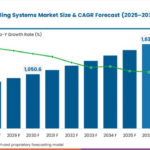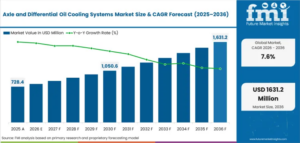


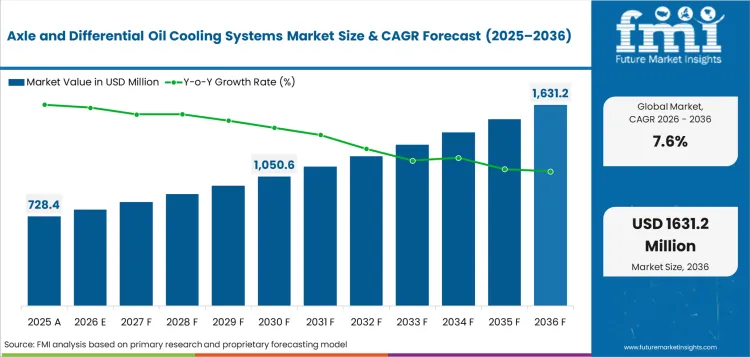
The development comes as electric axles, towing-oriented vehicles, performance SUVs, and commercial platforms place greater emphasis on maintaining lubricant temperature under high-load operating conditions. Future Market Insights (FMI) finds that the axle and differential oil cooling systems market is expected to rise from USD 784.1 million in 2026 to USD 1,631.2 million by 2036, representing a 7.6% CAGR over the forecast period. The market stood at USD 728.4 million in 2025, with an incremental opportunity of USD 847.1 million expected between 2026 and 2036.
AISIN highlighted improvements to its Toyota bZ4X eAxle in October 2025, including enhanced gear precision and reduced oil agitation through casing shape optimization. The front eAxle reaches 167 kW, while the rear-wheel-drive output reaches 88 kW, illustrating how lubricant management is becoming increasingly connected to electric drive unit efficiency and compact axle packaging.
Get detailed market forecasts, competitive benchmarking, and pricing trends: https://www.futuremarketinsights.com/reports/sample/rep-gb-33199
Why are integrated axle oil cooling systems gaining commercial importance?
For vehicle manufacturers, axle oil cooling is increasingly becoming an engineering consideration rather than a service-level add-on. Differential gears, bearings, and electric drive units generate heat during operation, while compact e-axle packaging places motors, reducers, bearings, and lubrication circuits in increasingly constrained spaces.
AISIN’s Toyota bZ4X eAxle development illustrates this shift. Improvements in gear precision and casing geometry can reduce oil agitation while supporting efficiency, but thermal management remains important as drive units operate across changing torque and speed conditions. As e-axle architectures become more compact, manufacturers need oil circuits that provide controlled lubrication and heat removal without creating excessive drag or packaging complexity.
The commercial implications extend to towing and off-road applications. Repeated high-load operation can raise differential oil temperatures during long climbs, towing cycles, and demanding terrain. Maintaining oil temperature within a usable range helps protect bearings, gears, and seals, making cooling performance relevant to vehicle durability and warranty exposure.
This is also encouraging a move from standalone heat exchangers toward validated driveline protection packages. Oil coolers, electric pumps, hoses, valves, and sensors increasingly need to operate as one circuit. Suppliers that can validate flow, heat rejection, and thermal recovery within the complete axle package can offer greater value than suppliers focused only on individual cooling hardware.
Which cooling formats and vehicle applications are shaping demand?
OEM integration is projected to remain the leading sales channel, accounting for 68.3% of market value in 2026. Cooling circuits are increasingly specified during axle and vehicle development because hose routing, pump placement, heat exchanger positioning, and oil-flow requirements must work within the available driveline package.
Active circuits are anticipated to capture 57.2% share in 2026. Electric pumps provide greater control over lubricant circulation and can support oil movement when vehicle speed is low but thermal loads remain high. This makes active architectures particularly relevant to electric axles, towing applications, and steep-grade driving.
Oil coolers are forecast to represent 38.4% share in 2026. Heat exchangers remain the primary visible hardware for transferring lubricant heat, while pumps, valves, sensors, and routing components complete the thermal circuit.
Passenger vehicles are expected to account for 41.6% share in 2026, supported by AWD SUVs and performance-oriented vehicle configurations. Electric axles are projected to represent 46.8% share as motors and reducers increasingly operate within compact drive units where heat management becomes a central design requirement.
Gear oil remains the dominant cooling medium, with a projected 54.7% share in 2026. Conventional differentials and e-axle reducers continue to rely on lubricant for gear and bearing protection, creating a requirement for controlled heat removal under sustained loads.