

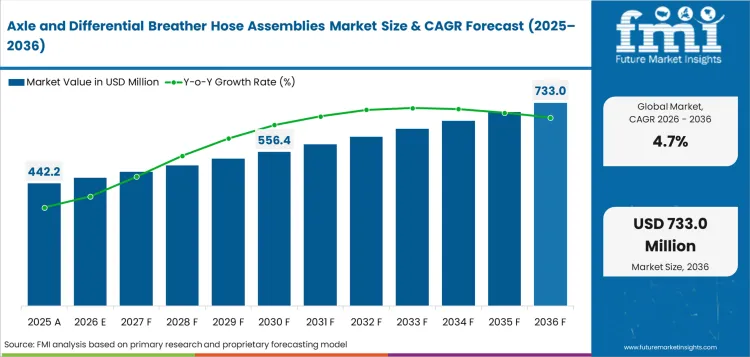
Future Market Insights (FMI) finds that the axle and differential breather hose assemblies market is expected to rise from USD 463.0 million in 2026 to USD 733.0 million by 2036, expanding at a 4.7% CAGR over the forecast period. The market was valued at USD 442.2 million in 2025, with demand increasingly shifting from loose vent tubes toward finished assemblies supplied with clips, fittings, and protective components.
Ford Parts lists differential vent hose applications for Ford F-250 and F-350 Super Duty models from 2017 to 2025, highlighting the continued importance of correctly routed and validated breather lines in heavy-duty axle systems. The development comes as pickup, utility, and off-road vehicle platforms place greater emphasis on protecting axle housings from water entry, contamination, and pressure-related seal failures.
Get detailed market forecasts, competitive benchmarking, and pricing trends: https://www.futuremarketinsights.com/reports/sample/rep-gb-33198
Why are validated axle breather assemblies gaining commercial importance?
For vehicle manufacturers and service channels, axle breather hoses perform a small but important reliability function. Differential and axle housings experience pressure changes as lubricants heat during operation. A properly routed breather line allows pressure equalization while reducing the possibility of water, mud, and other contaminants entering the housing.
This makes fitment accuracy commercially important, particularly for pickup trucks, utility vehicles, and off-road platforms exposed to splash and debris. Ford Parts’ differential vent hose listing for F-250 and F-350 Super Duty models demonstrates how axle vent components are maintained as identifiable service parts with defined vehicle applications. Such cataloged fitment can reduce incorrect-part returns while supporting replacement demand through established OEM service channels.
The market is also moving toward preassembled vent solutions. Factory programs increasingly favor hose assemblies supplied with clips and related retention hardware because validated routing can reduce loose-part handling and assembly variation around axle housings. The commercial value therefore extends beyond the hose itself to the complete routing solution.
Off-road applications strengthen this requirement. Differential breather systems can be exposed to mud and water during operation, making remote venting and protective routing relevant to vehicles that encounter deeper water crossings or harsh terrain. Suppliers capable of combining suitable hose compounds with proven routing and retention systems can therefore address both OEM and aftermarket requirements.
Which formats and applications are shaping demand?
OEM fitment is projected to remain the leading sales channel, accounting for 71.0% of market share in 2026. Factory supply benefits from axle vent routing being validated during vehicle platform development. Once a breather assembly is approved for a specific axle package, its dimensions, connections, clips, and routing become part of the vehicle’s production configuration.
Hose assemblies are expected to account for 58.0% of assembly-type demand in 2026. Finished assemblies reduce the number of individual components that need to be handled around the axle housing and can improve consistency during installation. This is particularly relevant where limited underbody space makes hose routing and retention important.
EPDM rubber is forecast to represent 46.0% of material demand in 2026. The material provides a balance between cost, aging characteristics, and resistance to common underbody splash conditions. PA nylon, fluoroelastomer, and silicone formats also have roles where specific chemical, temperature, or durability requirements justify alternative material selection.
Light trucks are projected to represent 42.0% of demand in 2026. Pickup and utility vehicle production creates recurring axle vent requirements, while off-road operation adds replacement demand when breather lines are exposed to mud, water, and road debris.
Axle-mounted systems are expected to hold 54.0% share in 2026. Direct placement keeps the breather connection close to the axle housing, while remote vent arrangements provide additional protection where operating conditions require the vent opening to be positioned farther away from splash zones.